
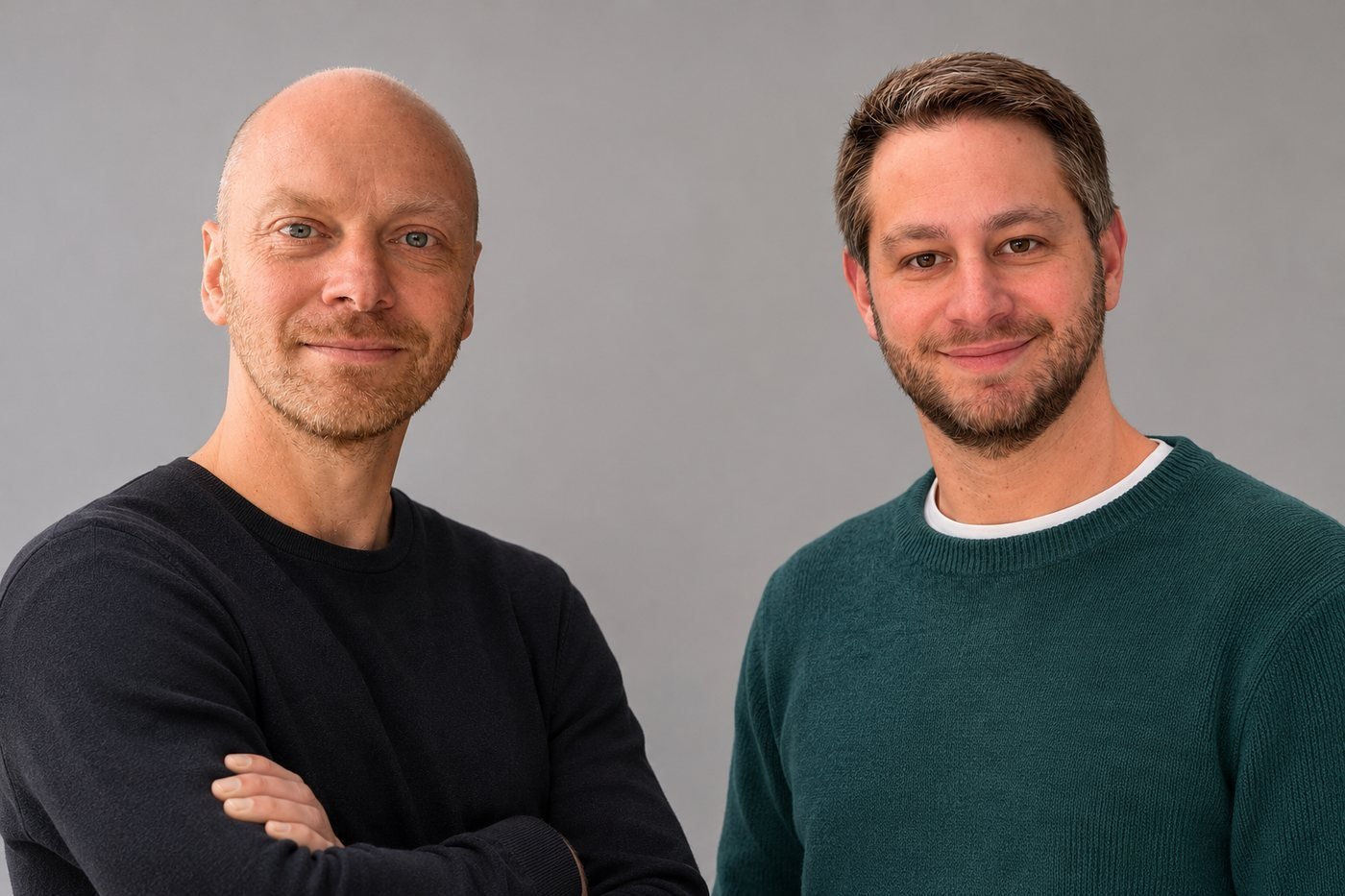
Alex Cohen grew up mainly in Kent, UK, with three years in Hong Kong along the way. He has always built things without being a developer: websites at university, starting with a community called Student Entrepreneur, then a first job as the first hire at a small business consultancy, then a marketing agency of his own. It was hiring for that agency that led to FirstLook.
When a single job ad began to draw 100 or 200 applications that all sounded the same, Cohen prototyped a different first step over a weekend: ask each candidate one short, role-specific question before the CV, let the hiring manager read the answers blind, and show how each answer was written. His co-founder Christian Jones rebuilt the prototype into the product. We spoke about why FirstLook scores effort rather than quality, why it refuses to let AI judge candidates, and what changes when AI writes most applications.
Key takeaways
- FirstLook asks each applicant one relevant question before the CV. Hiring managers read the answers blind, ranked by effort, and open the CV afterwards.
- It is not an AI detector and there is no AI in the scoring. It shows time spent, typing versus pasting, edits and time away from the page, and the recruiter judges the work.
- A first version of the scoring punished people who think between bursts of typing. Cohen's team rebuilt it around a few hard rules and made it say so when the data is ambiguous.
- Cohen's view of success is simple: looking at someone's answer before their CV becomes the standard way people recruit, with integrations into applicant tracking systems along the way.
Before any of this
Startup.talk:Where did you grow up, and what was childhood like?
Cohen:I grew up mainly in Kent, UK, with three years in Hong Kong. I think I was lucky to have the experience of living in Hong Kong, and I got to travel a lot when I was younger. Generally, it was a middle-class family and a good childhood. I got into computers from about the age of 12 or 13 and had an interest in them from there.
Startup.talk:What first got you into building things?
Cohen:I've always built stuff, but I've never been a developer. I started learning to code as a teenager and tinkered with computers. At university, I built websites. My first website was called Student Entrepreneur, which was, as you'd imagine, a community for student entrepreneurs. I built various mini projects and started building websites for other people. That's where it started.
Startup.talk:What was your first job, and what did it teach you?
Cohen:My first job was at a small business consultancy. I decided at university that I wanted my own business, but I thought the best thing to do was get a job that taught me about business. I was their first hire, which meant I worked directly with the owner, or founder, as we'd call them nowadays.
The role involved a mixture of consultancy projects around project management and people development. We worked with some blue-chip companies, but I also built the consultancy's website, handled marketing, learned sales and learned how to run a business. I got to learn about a lot of different types of business as well.
I was just 21 when I started, so learning how a business works by working directly with the owner was invaluable. It really did teach me a lot about business, management and hiring people. That's why I got into marketing as well: I ended up doing all of their marketing.
The road to FirstLook
Startup.talk:What made you start FirstLook?
Cohen:I run a marketing agency, and we hire people. It's not uncommon to put up a job ad, especially for a marketing executive role, and get 100 or 200 applications. Pre-AI, it took work, but it was fairly easy to filter out the ones that weren't a good fit because you could tell.
As AI became more common, we started seeing CVs and cover letters that all sounded the same. I remember putting a specific job ad up on a freelancer site and getting such specific replies that I thought, "This can't be right," because what we were asking for was very niche.
People were just using AI to apply, and it was impossible to tell who was a good candidate at that stage. We read a lot about it and heard about it on podcasts and elsewhere. There was a massive problem, and it was twofold: hiring managers in a similar situation to us were getting inundated with CVs that sounded the same, but there was also a problem on the candidate side.
It's getting harder and harder to find a job, and everyone sounds the same. How does a candidate stand out? That two-sided problem made me think about what a solution could be. That's when I came up with the idea for FirstLook.
Startup.talk:What did you see in hiring that convinced you CVs had stopped working?
Cohen:There were a couple of issues. People were putting a job ad into AI and having it write their CV and cover letter. Everything was sounding the same, and you couldn't really test someone through those applications either.
Then there's auto-apply on things like LinkedIn. Whether that's AI or not, it's still not helpful. It may be efficient for the person applying, but when everyone's doing it, it's not efficient for the hiring manager.
You need to think about what's going on at the hiring manager's end. Putting myself in a hiring manager's shoes, it's so hard. We want to find the best candidates, but you can't do that when you've got to sift through hundreds of CVs and cover letters that all sound the same. Then you have to think, "Right, I've got to fact-check it all as well," because if AI is writing it, what's right and what's not right?
Startup.talk:How did FirstLook evolve into blind answers and a view of how answers were written?
Cohen:It was conceived with blind answers from the start. You can tell so much from someone's answer before reading their CV. CVs are expected to look and sound a certain way, and the blind answer concept came out of that. It was always part of the idea.
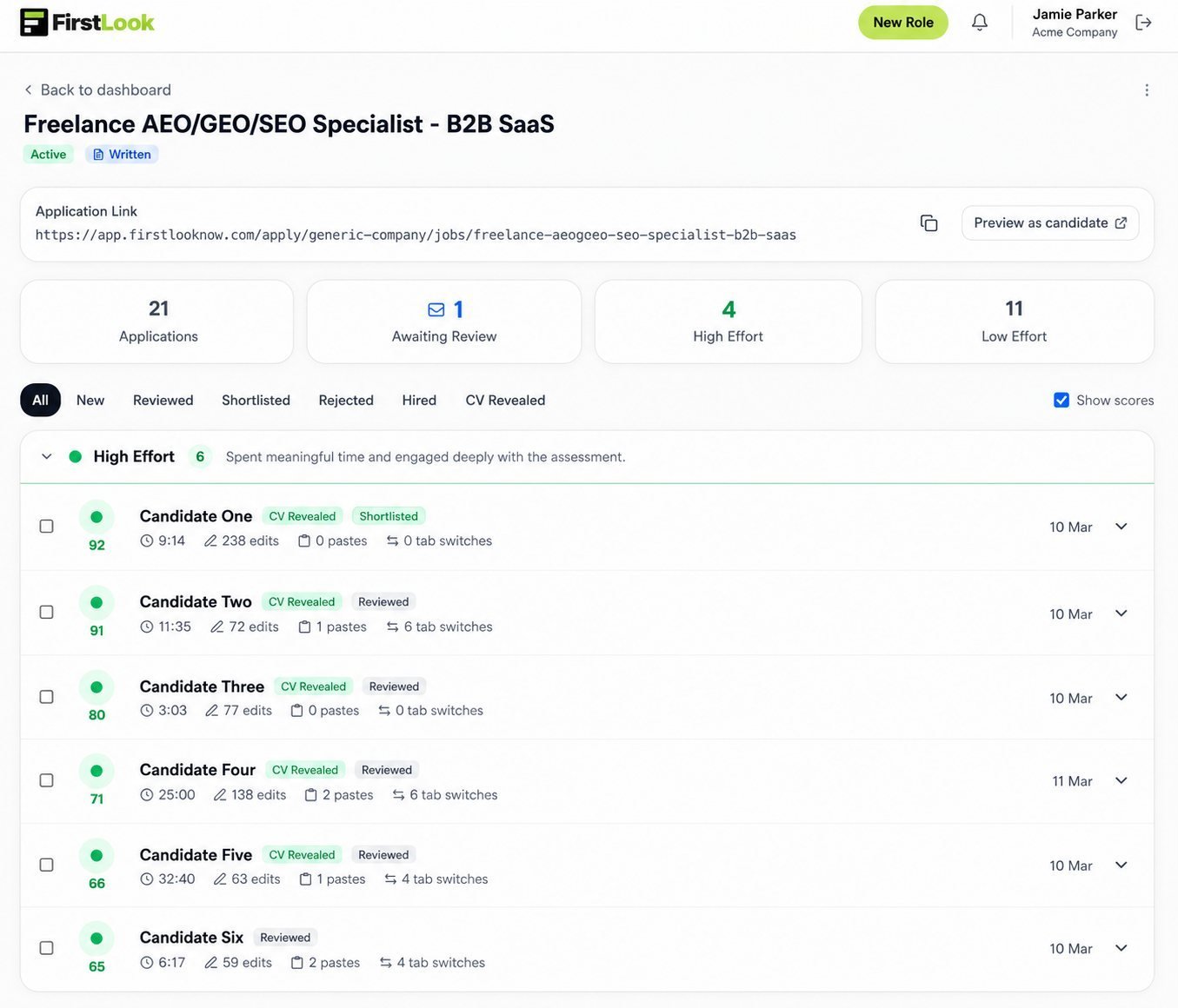
What we really wanted to look at was effort. We're not judging the answer, that's for the hirer to judge, but we're showing how someone worked on it. The recruiter can see things like time spent, edits and typing versus pasting, alongside the answer itself.
Those signals give the recruiter more context, but they don't prove whether someone used AI or how good their answer is. That's what we want to get across: the process behind the answer, with the hirer deciding what they think of the work itself.
Startup.talk:What is it like to build FirstLook as a co-founder?
Cohen:It's a good challenge. I've always been involved in websites, SaaS and marketing, but always on the marketing side. I'm not a developer. I initially prototyped FirstLook and actually got it working over a weekend. That was an amazing experience.
I then spoke to Christian in our agency team, who'd built apps before and became my co-founder. He said, "Yeah, it's good, but I can rebuild it."
We get lots of great feedback. From a marketing angle, it's about thinking through how we get it in front of the right people. Getting a prototype working was an amazing first step; now the challenge is getting it to the people who have the hiring problem we built it to solve.
The product
Startup.talk:Why the name FirstLook?
Cohen:It's the first look someone gets at a candidate. That's where the name came from.
Startup.talk:How do you design the one question that reveals the most about a candidate?
Cohen:That's for the recruiter or hiring manager to do. We don't choose the question for them, but we can help them think it through.
I'd start with something that matters in the actual job. Ask for a specific example of something they've done, what they did personally and what happened as a result. Or give them a short situation they might face in the role and ask how they'd approach it. You want to understand their thinking.
Keep it focused and reasonable to answer. You're asking one question at the start of an application, so it shouldn't turn into a whole project. Decide what a good answer would show before the responses come in, and ask everyone applying for that role the same question so you can compare them consistently.
For example, a PR agency asked applicants for an Account Executive role to turn a fictional news story and a client's views into a press comment of no more than 150 words. It was the kind of writing they'd actually do in the job, and no external research was needed.
Startup.talk:Why read answers blind before seeing the CV?
Cohen:It's a very quick way to see answers. FirstLook ranks the answers by effort, so you can start at the top and work your way down. You can't do that with CVs - you're opening them one at a time.
When you read the answer, it tells you so much more about someone. Have they put the effort in? What's their thinking? Have they answered the question correctly? If it's that kind of question, is their thought process good?
It makes it much quicker to understand who they are and what they're saying. You see that first, and then you can look at the CV.
We tried it when we were looking for someone to do answer engine optimisation for our agency. We asked candidates to give an example of something they'd done. Some gave great examples. Others gave an SEO example from five years ago, so you knew straight away they weren't right for what we needed. You didn't have to decipher a CV to figure that out.
“You see that first, and then you can look at the CV.”Alex Cohen
Startup.talk:How does FirstLook handle AI-written answers?
Cohen:We actually have an AI mode.
FirstLook is about effort. We show the recruiter how someone worked on their answer: time spent, typing versus pasting, edits and time away from the page. The employer chooses whether AI is allowed for the role. If it isn’t, an answer that’s essentially pasted in whole lands in the lowest effort band. If it is, pasting isn’t penalised, because we’re looking at how much the candidate engaged with the work, and an additional question about 'how' they came to their answer is included.
FirstLook isn't an AI detector, and there's no AI in the scoring. We score the process; the recruiter judges the work. Candidates are told what's recorded before they start, and they can say if they're using assistive technology or drafting elsewhere.
Startup.talk:Which teams get the most from FirstLook: hiring managers, small businesses or agencies?
Cohen:I think they each get something different from it. Some companies already use applicant tracking systems and AI to help screen people. Small businesses and people who don't hire often may not have that setup. They don't have time to sift through lots of CVs, so being able to get to the relevant answers quickly can be really useful.
Recruitment agencies have a different problem: they have many, many candidates to review at one time. For them, it's about making that first review easier and getting to a shortlist more quickly.
Startup.talk:What do you deliberately leave out of FirstLook?
Cohen:AI scoring or judging the answers. We don't want FirstLook to do that. We don't agree with handing that judgement over to software.
This is about helping recruiters and candidates by showing the effort behind an answer and letting the recruiter make the call. We score effort; we don't have AI decide how good the answer is or whether someone should get the job.
“We score effort; we don't have AI decide how good the answer is or whether someone should get the job.”Alex Cohen
Positioning
Startup.talk:Who is FirstLook for, and what job does it do for them? Describe the person who gets the most value.
Cohen:The person is someone running a business or a team, needing to hire, and looking at 100 or 200 applications that all sound much the same. Hiring is one part of their job, and they don't have days to spend deciphering CVs.
FirstLook gives them a way to ask one relevant question, see the answers blind and understand the effort behind them. They can read what someone actually has to say about the work before opening the CV. The job it does is help them decide who deserves a closer look.
Startup.talk:How do you view your positioning relative to TestGorilla, Applied, Vervoe, HireVue and LinkedIn Easy Apply screening? Is there another competitor you think of first?
Cohen:There's overlap, but the way we approach it is quite specific. TestGorilla and Vervoe offer skills assessments and screening. HireVue covers interviews and assessments. Applied is closer to the blind-answer part of what we're doing because it also lets teams review anonymised answers to job-related questions.
Our focus is that first look: one relevant question before the CV, visibility into the effort behind the answer, and the recruiter deciding what they think of it. We're not trying to build a whole assessment suite or have AI judge the quality of someone's answer.
I don't really see LinkedIn Easy Apply as a direct competitor. I understand why making applications easy is appealing, but making it easier to send more applications doesn't solve the problem we had as a hiring team. I'd rather have something relevant to read from a candidate than another CV that sounds like all the others.
For me, the everyday alternative is still someone sitting there opening CV after CV and trying to work out who to shortlist. That's the process we want to improve.
Startup.talk:What is your core moat in skills-first hiring?
Cohen:I think it's the way the pieces work together: one relevant question, answers read blind, and a view of the effort behind them. The recruiter still makes the judgement. We're trying to make that first decision much easier without asking someone to work through a whole test.
For me, the longer-term advantage comes from understanding this problem really well and making the product useful enough that hiring teams keep coming back to it.
Startup.talk:What are some of the use cases for FirstLook that are not obvious and can add a lot of value to users? List as many as possible.
Cohen:The key thing is: will people fill out the question? If people go to the effort to fill out the question, that shows they're interested in the job. That is a really big signal. What we've found from customers and our testing is that you can get fewer, more relevant applications. Ultimately, as a recruiter, that's what you want: people who want to work for you and will put in the effort to do so.
Another one is people whose CV doesn't tell the whole story: career changers, people returning to work, or someone who's done relevant work but hasn't had the obvious job title. A good question gives them a chance to show something you might miss in their CV.
The common thread is giving someone a chance to show how they think before you make assumptions from their CV.
“giving someone a chance to show how they think before you make assumptions from their CV.”Alex Cohen
Startup.talk:What is the one detail in FirstLook you are proudest of?
Cohen:It's when you log in and see the candidates ranked by effort on your dashboard. You can go through their answers and choose who to shortlist without having to start by opening every CV.
For me, that's the killer thing. It's solving the problem we had and saving so much time.
Launch
Startup.talk:What did you learn from your launch?
Cohen:A launch on its own isn't enough. You still have to work out how to get the product in front of the people who actually have the problem. For us, that's hiring managers dealing with a pile of applications that all sound the same. That's where the marketing work needs to go.
Startup.talk:Which feedback from the launch surprised you?
Cohen:The feedback that stuck with me came from an early user, a PR and media agency owner preparing to recruit for a junior role. He wanted to check the wording of his question with a colleague and realised he couldn’t see it the way a candidate would. And because a published question is locked, so every candidate gets exactly the same one, the only way to fix a typo was to delete the role and start again. It wasn’t a clever feature request, just something we’d missed because we know the product too well. We added draft roles and a candidate-view preview, and shipped it the same day, before his role went live.
The hard part
Startup.talk:What is a challenging time you had building FirstLook?
Cohen:The hardest stretch was getting the scoring right. Our first version punished people who think between bursts of typing, so someone who wrote every word themselves could be marked as low effort. That’s the worst possible mistake for a product that’s meant to reward real effort. We tested it extensively, found where it was wrong, and rebuilt it so that a few hard rules catch the obvious cases first. We also made it say so when the data is ambiguous, instead of pretending to be certain. The lesson is that you only find out how a scoring system fails by running real people through it.
Startup.talk:How do you convince hiring managers to look at work before CVs?
Cohen:I'd start with the problem they already know: you've got a pile of CVs, they all sound similar, and you need to decide who to speak to. Then I'd show them what happens when you ask one question that's relevant to the job.
A PR agency that used FirstLook is a good example. They used FirstLook for an Account Executive role and hired someone with no previous PR or marketing experience. The candidate's writing showed the team something their CV hadn't. Their Chief of Staff said they would never have guessed from the CV alone that this was the person for the job.
You can still read the CV afterwards. You're just giving yourself something useful to judge first.
What it is all for
Startup.talk:What would make you say FirstLook has succeeded?
Cohen:Beyond lots of companies using it to manage their recruitment, I'd like this to become the standard way people recruit: looking at someone's answer before their CV.
Ultimately, success means hiring managers are hiring more of the right people and candidates are getting the right jobs.
Startup.talk:What will hiring look like when AI writes most applications?
Cohen:I think we're already there. AI-written applications are already widespread, and it's an absolute mess. Employers and recruiters are getting inundated with CVs, and candidates can't get through the noise.
That's the problem we've built FirstLook to help fix.
The road ahead
Startup.talk:What are your milestones for the next 12 months, in users and revenue?
Cohen:The aim over the next 12 months is to get as many people using FirstLook as possible. I want hiring teams to try it on a real role, find it useful and come back when they're hiring again.
Startup.talk:And beyond the first year, where do you want FirstLook to go?
Cohen:We'd like FirstLook to be the de facto standard for that first look at a candidate. Looking at someone's answer before their CV should be a normal part of hiring.
Getting there will probably mean integrating with applicant tracking systems and other tools, so it fits into the way people already recruit.
Startup.talk:What are your hopes and fears for a post AGI world?
Cohen:There are the humanitarian hopes, of course: that it helps cure diseases and solve problems around climate and energy. I like how AI has already improved the way you can work, and I find that exciting.
My biggest fear is what it means for jobs. Knowing what I know about AI, I can't see a world where there are more jobs, or even the same number of jobs. I think there are going to be fewer. What does that mean for society? That needs thinking through.
This interview was conducted in writing and has been edited lightly for length and clarity.
About FirstLook
FirstLook is a skills-first hiring tool co-founded by Alex Cohen and Christian Jones in the UK. Employers ask applicants one short, role-specific question before the CV, read the answers blind and see the effort behind each one, with no AI scoring. firstlooknow.com
| Attribute | Verified Detail |
|---|---|
| Company | FirstLook |
| Founder(s) | Alex Cohen |
| Country | UK |
| Grew up | Kent, UK, and three years in Hong Kong |
| Background | Marketing agency owner; first hire at a business consultancy |
| Co-founder | Christian Jones |
| Official Website | firstlooknow.com |
| Interview Published | 2026-11-21 |
More founder interviews
 digiQueue
 ATS Engine
 Jotted
 Harmonian
For founders
Building something? Want to share your journey?
Tell us how it started, what nearly broke it and where it is headed. We will turn it into a story like this one.
Share your journeyFor readers
Want to read more human stories behind the startups?
New founder interviews and stories, as they are published.
Follow us on LinkedIn