
Bryan Lum grew up in Kuala Lumpur, went to Chinese-medium schools from SJKC Taman Connaught to Tsun Jin High School, and fixed his first computer as a boy because he was afraid of being scolded for breaking his sister's. He studied IT at Asia Pacific University, co-founded PicaPica, an Instagram photo printing kiosk business that reached Korea and Thailand, and still helps run Wilda Machinery, the power tool distributor his family started in 1996.
Harmonian is his fourth idea. It began as a free AI wellness companion that speaks the way Malaysians do, switching between English, Bahasa Malaysia, Mandarin and Cantonese, and today most of its work is GydeX, an AI workplace coach built with PsyHome Asia that helps employees prepare for the conversations they keep avoiding. He builds every product himself, with AI as his team. We spoke about five products and zero paying customers, the chance meeting with a fellow Tsun Jin alumnus that changed the company's direction, and why psychologists are his partners, not his competitors.
Key takeaways
- Harmonian builds AI wellness tools for Malaysia: the free Harmonian AI companion (also on WhatsApp), GydeX for the workplace, the IPC Super App with International Psychology Centre, and the EmoCall peer voice app.
- GydeX, built with PsyHome Asia, reads an employee's Mind Report against seven EQ frameworks and coaches them in English, Bahasa Malaysia or Chinese. It has about 500 users across some ten organisations, with teams at Sony, Daikin and Perodua.
- The person who needs support never pays: psychology centres and employers do. Harmonian is self-funded and still pre-revenue, and Bryan runs it alone with no employees.
- His targets: a first RM30,000 in sales before 1 April 2027, then six new companies a month, a 2027 forecast of about RM168,000 and Singapore next.
Before any of this
Startup.talk:Where did you grow up, and what was childhood like?
Lum:I grew up in Kuala Lumpur and went to Chinese-medium schools all the way: SJKC Taman Connaught for primary, then Tsun Jin High School from Form 1 to Form 6, where I sat the UEC. My family started Wilda Machinery, a power tool distributor, in 1996, when I was about five, and I still help run it today.
As a kid, I loved playing on my sister's computer, until one day I broke it. I was so afraid of getting scolded that I tried to fix it myself, and it worked. That's probably where my love for fixing and building things started. In high school, I was in charge of the computer society and ran computer courses for both junior and senior students.
Growing up with Mandarin, Cantonese, English and Malay around me is also a big reason I care so much about people being able to talk in their own language.
Startup.talk:What first got you into building things?
Lum:Computers. I studied IT at Asia Pacific University, specialising in mobile technology, and spent those years writing Java, C# and Android apps and fixing PCs. But building something real came with PicaPica: we built Instagram photo printing kiosks from scratch, both the hardware and the software. That's when I got hooked on building things people actually use, and I've been building ever since.
Startup.talk:What was your first job, and what did it teach you?
Lum:After university I co-founded PicaPica, an Instagram photo printing kiosk business, in 2017. I handled the hardware and software, procurement, customer support and events, and managed a team of technicians covering all of Malaysia. We took it to Korea and Thailand before I exited and left my partner running it. It taught me that a good product is only half the job; operations, people and support are the other half. Later, at our family business Wilda Machinery, I did everything from IT and e-commerce to walk-in retail sales. That's where I saw the people problems SMEs deal with every day.
Startup.talk:How does your family's power tool business shape the way you build?
Lum:Wilda Machinery is my real-world test lab. My family started it in 1996, and working there, from IT and e-commerce to serving walk-in customers, showed me the everyday people and operations problems SMEs face. It's also where I built WildaBot, a WhatsApp AI sales assistant first used at Wilda as "Xiao Wei" (小威), which answers enquiries using live product data. Building for our own business first keeps me honest: if a tool doesn't help a real shop on a busy day, it doesn't matter how clever it is.
The road to Harmonian
Startup.talk:What made you start Harmonian?
Lum:I came into mental wellness from tech, not counselling. In 2023 I started building small wellness apps and reading a lot of psychology research to bridge the two worlds. What kept bothering me is that struggles, especially at work, are often invisible until it's too late. People don't speak up, and by the time anyone notices, the damage is done. Harmonian is actually my fourth idea; I pivoted three times before this one. The long-term dream is simple: phones gained cameras, watches gained blood-oxygen sensors, and I believe everyday devices will one day notice when someone is struggling, so help comes before a crisis, not after. We're building the brain first, then the body.
“We're building the brain first, then the body.”Bryan Lum
Startup.talk:Why build mental health support in English, Bahasa Malaysia and Chinese?
Lum:Because that's how Malaysians actually talk. Most of us switch between English, Bahasa Malaysia, Mandarin, Cantonese and Manglish in one conversation. When you're upset, you think in your own language, and being forced into a "proper" one adds friction exactly when you need it least. I speak English, Mandarin, Cantonese and Manglish myself, so this was never a feature to add later. GydeX's AI coach works in English, Bahasa Malaysia and Chinese.
Startup.talk:How did Harmonian find its first users in Malaysia?
Lum:Through partners, not ads. GydeX reached its first users through PsyHome Asia, a corporate psychology and training company. Employees meet GydeX in PsyHome's workshops and then use it to follow up afterwards. That's how we reached around 500 users across about ten organisations, including teams at companies like Sony, Daikin and Perodua. For the consumer app it has been slower and more personal: a free WhatsApp version people share with friends and family, booths at events like Cradle LIVE, and talks I give at high schools.
Startup.talk:What is it like to build a free mental health platform as a young company?
Lum:Honestly, it's a balancing act. I run Harmonian on my own, with no employees. I use AI for much of the work I'd otherwise hire for, and I only need people for face-to-face meetings with partner centres and for events. The hard part is that cloud and AI bills arrive every month, before revenue does. Free for users only works if someone else pays, so our model is built around partners: psychology centres and employers pay, not the person who needs support.
Startup.talk:What is it like building as a solo founder, with AI as your team?
Lum:I've run Harmonian on my own for about three years, with no employees. I write the code for every product myself, and I use AI the way other founders use a team. I work in a very structured way, writing a spec and a task list before I build, so the AI and I stay on track. The only things AI can't do for me are face-to-face meetings with partner centres and showing up at events. It keeps costs low, but it also means everything depends on one person's time and focus, so choosing what not to do matters a lot.
The product
Startup.talk:Why the name Harmonian?
Lum:It comes from the word "harmony". I wanted everyone who uses it to become a Harmonian, the same way people from a country carry its name: Malaysia gives you Malaysians. Think of Harmony as the place, and everyone in it as a citizen, a Harmonian. It's meant to feel like belonging somewhere, not just using another app.
Startup.talk:How does the AI companion support people day to day?
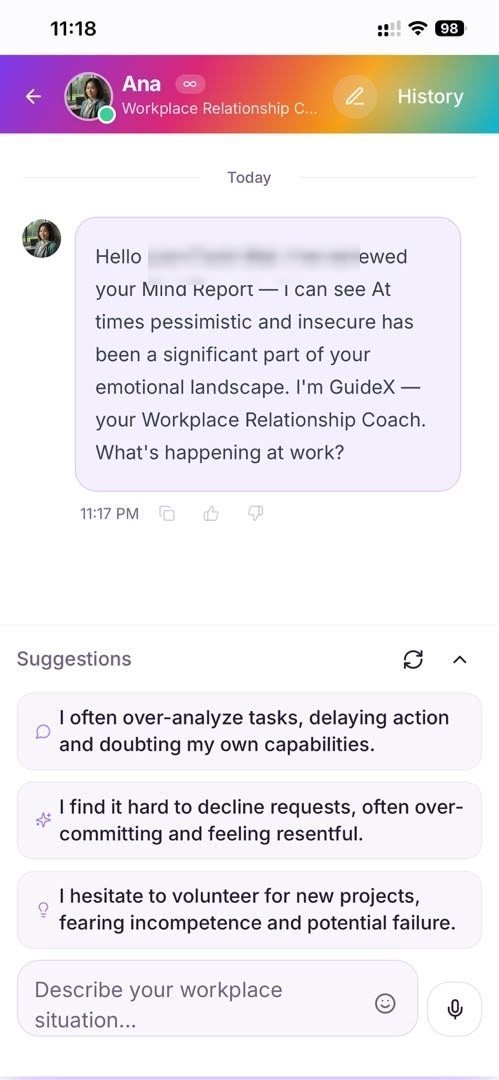
Lum:Harmonian AI is a wellness companion you can message any time, in the app or on WhatsApp, when you've had a rough day and need to think out loud. It's there to listen, help you sort out your thoughts, and point you to real people when you need more. At work, GydeX goes further. After an employee gets their Mind Report from PsyHome, GydeX reads it against seven research-backed EQ frameworks, follows up, and helps them practise the conversation they've been avoiding, like telling the boss about a problem or giving honest feedback. It's support and practice, not therapy or diagnosis.
Startup.talk:What is EmoCall and why make it anonymous?
Lum:EmoCall is a voice app where you can talk through what you're feeling with another person. Anonymity matters because many people here still worry about being judged for struggling, and it's easier to be honest when nobody knows who you are. To be honest, EmoCall is launched but hasn't found its audience yet, so it's not where my focus is right now.
Startup.talk:How does Harmonian work with psychologists and counselling centres?
Lum:We don't hire therapists ourselves, on purpose. Harmonian is the technology; licensed psychologists and counselling centres are the clinical side. With International Psychology Centre we built the IPC Super App, which matches people to IPC's services and supports them between sessions. With PsyHome Asia, GydeX picks up after their assessment and keeps the coaching going. The centres do what they're best at, and we handle what happens after the session or the report, at scale.
Startup.talk:How do you keep users safe when someone is in crisis?
Lum:Our first rule: Harmonian is a wellness tool, not a medical one. It doesn't diagnose, and it's not a replacement for a psychologist. When someone is in real distress, the right move is to get them to a human: a professional through our partner centres, or crisis lines such as Talian HEAL 15555 or Befrienders KL. That's also why we partner with clinical teams instead of pretending AI can do everything.
Startup.talk:What do you deliberately leave out of Harmonian?
Lum:Diagnosis and assessment: our psychology partners do that, not us. Medical claims: we're wellness, and pretending otherwise is dangerous. An in-house team of therapists: we partner with centres instead. Private conversations for employers: GydeX is designed so HR sees team-level patterns, not what any one person said. And we don't charge the person who needs support; centres and employers pay.
Positioning
Startup.talk:Who is Harmonian for, and what job does it do for them? Describe the person who gets the most value.
Lum:Right now, mostly the people GydeX serves at work: young employees, Gen Z first-jobbers and new managers in high-pressure teams. The person who gets the most value is someone with a hard conversation they keep avoiding: a problem they should raise with their boss, feedback they need to give, or tension with a colleague. GydeX helps them understand themselves, practise what to say and walk in prepared. For HR, the job is seeing the bigger picture across teams early, instead of finding out in an exit interview.
Startup.talk:Why is your focus now on helping employees speak up at work?
Lum:Because that's where I see the biggest gap. In most companies, the information is there, the ideas are there, the warnings are there, but nobody speaks up. Someone knows a customer is unhappy, or spots a mistake that's wasting money, and stays quiet because they're afraid of being blamed. GydeX, which we built with PsyHome Asia, helps employees prepare for those conversations: they reflect, get a Mind Report, practise what to say, and walk in ready. HR sees team-level patterns, not private chats. Mental wellbeing is still part of it, but helping people speak up is a business problem every company understands.
Startup.talk:How do you view your positioning relative to Wysa, Calm, Headspace, BetterHelp, and local counselling services? Is there another competitor you think of first?
Lum:Calm and Headspace are great for meditation and sleep content. Wysa is an AI wellbeing chatbot, and BetterHelp is online therapy. Local counselling services aren't our competitors; they're our partners, and our model is built to give them more reach. Our angle is different: built for Malaysia's languages, sold through psychology centres, and focused on what happens after an assessment, at work and in daily life. The competitor I think about first is actually ChatGPT. It's free and can help anyone practise a conversation, so we have to prove a focused, locally built experience is worth paying for. In the workplace space, Naluri and Intellect are the names I watch.
Startup.talk:What is your core moat in mental health support?
Lum:Partnerships more than technology. Psychology and counselling centres sell Harmonian inside their own services, so they become our channel, and they bring the clinical credibility we deliberately don't build ourselves. Add local languages, and the learning that only comes from real use in Malaysian workplaces. I'll be honest: a moat is something you earn over time, and we're still building ours.
“a moat is something you earn over time, and we're still building ours.”Bryan Lum
Startup.talk:What are some of the use cases for Harmonian that are not obvious and can add a lot of value to users? List as many as possible.
Lum:- Rehearsing how to tell your boss about a problem before you walk into the room
- Preparing to ask for a raise, a transfer or more support
- New managers practising their first difficult feedback conversation
- Gen Z first-jobbers making sense of unwritten workplace rules
- Repairing things after an argument with a colleague
- Getting ready for a performance review, from either side of the table
- Keeping a training workshop alive after the day ends, instead of forgetting it by Monday
- Wording a message to a colleague in the language they prefer
- Coping with a restructure, or a role that's changing because of AI
- Following up between sessions with a partner counselling centre
- Salespeople deciding how to flag an unhappy customer early instead of hiding it
- HR spotting team-wide patterns early to plan the right training
Startup.talk:What is the one detail in Harmonian you are proudest of?
Lum:How GydeX reads a Mind Report. An employee uploads the report from PsyHome, and GydeX pulls out the EQ data, interprets it against seven research-backed EQ frameworks, and turns it into coaching in English, Bahasa Malaysia or Chinese. That's the moment a one-off assessment becomes something people actually use.
Launch
Startup.talk:What did you learn from your first launch?
Lum:Honestly, that a launch is not the same as distribution. I put Harmonian on Product Hunt as a solo founder with no audience behind me. It got a couple of upvotes and never got featured. It was humbling, but useful. Product Hunt rewards founders who already have a community ready to show up on launch day, and I didn't have one yet. It also showed me that a global tech crowd isn't really my user. The people who need Harmonian are Malaysian employees and families, and they found us through partners like PsyHome Asia, not through a launch page. Now I build the channel first, then launch.
Startup.talk:What did early users tell you that surprised you?
Lum:I asked people what would make them trust an AI with their feelings, and the answers surprised me. One person said the AI wellness tools they'd tried felt generic and forgot everything from one chat to the next. Another suggested a summary you could bring to your therapist. And both wanted the AI to recognise when it's time to say, "You should talk to a real person." That surprised me most: people didn't want AI to replace humans. They wanted it to remember them, know its limits and get them to the right person. That's very close to how Harmonian works today, with psychologists and counselling centres as our partners, not our competitors.
“They wanted it to remember them, know its limits and get them to the right person.”Bryan Lum
The hard part
Startup.talk:How many people use Harmonian and GydeX today?
Lum:GydeX has around 500 users across about ten organisations, reached through PsyHome Asia. Our last working count was about 490 users, with roughly 5,000 coaching messages and 555 Mind Reports analysed. These are usage numbers, not paying customers; we're still pre-revenue. The consumer app and its WhatsApp version are still small and early.
Startup.talk:What is a challenging time you had building Harmonian?
Lum:Realising I had five products and zero paying customers. I'd built Harmonian AI, EmoCall, GydeX, WildaBot and the IPC Super App, each one real and shipped, but spreading myself that thin meant none got the focus it needed. At the same time, monthly cloud and AI costs were straining cash, and I had to be open with my partners about it. The lesson was focus. Today most of my energy goes into GydeX and getting our first RM30,000 in real sales.
“Realising I had five products and zero paying customers.”Bryan Lum
Startup.talk:Who believed in you before there was anything to show? What did they say or do?
Lum:In 2025 I got talking to a stranger I ran into by chance. It turned out we'd both studied at Tsun Jin High School, though we never knew each other there. He owns PsyHome Asia, a counselling and training company. He gave GydeX a real home: his workshops, his corporate clients, and later the door to working with other counselling firms. That one chance meeting changed the direction of Harmonian.

Startup.talk:How do you keep support free for users while building a sustainable company?
Lum:The person who needs support doesn't pay; partners do. For GydeX, an employer pays PsyHome for training with GydeX included, and PsyHome shares revenue with us under our joint venture. For the IPC Super App, we share in what International Psychology Centre bills its clients. Next, new partner centres will pay an onboarding and licence fee to join the platform. Because the centres sell Harmonian inside their own services, I don't need a sales team, and using AI instead of hiring keeps costs low.
What it is all for
Startup.talk:What would make you say Harmonian has succeeded?
Lum:Short term, three things: our first RM30,000 in real sales, companies renewing because they see the value, and employees telling us they feel more ready to speak up. Long term, success is when struggling at work is no longer invisible: when help reaches people before a crisis, and everyday devices can notice someone needs support and point them to the right human.
Startup.talk:What would Malaysia look like if everyone had someone to talk to, any time, in their own language?
Lum:Fewer problems would stay hidden until it's too late. An employee would raise a concern while it's still small, a manager would hear about it before it costs a customer or a resignation, and nobody would have to translate their feelings into a language they don't think in. Counselling centres would reach far more people than their rooms can hold. And talking about how you feel would just be normal, not something you hide.
Startup.talk:What would you tell a young Malaysian who wants to build something?
Lum:Start by fixing what's in front of you. I started by repairing my sister's computer because I was scared of getting scolded. Then build something real and learn from it: my first company, PicaPica, taught me that operations matter as much as the product. Expect to pivot; Harmonian is my fourth idea. Learn to focus earlier than I did; I once had five products and zero paying customers. And find your channel before your launch day. I share this whenever I give talks at high schools.
The road ahead
Startup.talk:What are your milestones for the next 12 months, in users and revenue?
Lum:Revenue first: our first RM30,000 in real sales before 1 April 2027, then a steady six new companies a month on GydeX's Team package. That's roughly 120 new employees joining each month. If we hit that, our forecast for 2027 is about RM168,000 in sales. That's a forecast, not a result. Alongside that, we want paid pilots where we measure whether employees feel more ready to speak up, and companies that renew.
Startup.talk:And for the next 24 months?
Lum:Scaling to about 25 new companies a month, which puts our 2028 sales forecast at about RM699,300, with around 1,500 employees using GydeX at any one time. That's still a tiny slice of Malaysia's 12.65 million employees. In the same window we want proven outcomes and renewals, more sales capacity beyond PsyHome, and to be ready to enter Singapore. We plan to raise a seed round once our first milestones are proven.
Startup.talk:Where do you want Harmonian to be in five years?
Lum:From Malaysia to Asia: Singapore first, then the wider region. And closer to the big vision: technology in everyday devices, phones first, that can notice when someone is struggling, so prevention happens before a crisis. Harmonian won't be just another wellness app. It will be the layer that connects people to the right support, with psychology partners in every market.
Startup.talk:What are your hopes and fears for a post AGI world?
Lum:My hope is that AI takes over the busywork and gives people more time for each other, and that everyone has someone to talk to, any time, in their own language. My fear is the opposite: that we start talking to machines instead of each other, and that jobs change faster than people can adjust, with no one helping them through it. That's why I believe the more work AI does, the more the human side of work matters. At Harmonian, AI's job is to get people back to people: a better conversation with their boss, or a real psychologist when they need one.
“the more work AI does, the more the human side of work matters.”Bryan Lum
This interview was conducted in writing and has been edited lightly for length and clarity.
About Harmonian
Harmonian builds AI wellness and workplace coaching tools from Petaling Jaya, Malaysia, in English, Bahasa Malaysia and Chinese. Its products include the free Harmonian AI companion (also on WhatsApp); GydeX, an AI workplace EQ coach built with and sold through PsyHome Asia; the IPC Super App with International Psychology Centre; and EmoCall, a peer support voice app. Harmonian is a wellness tool, not a medical one, and works with licensed psychologists and counselling centres. It is built by Bryan Lum. harmonian.online
| Attribute | Verified Detail |
|---|---|
| Company | Harmonian |
| Founder(s) | Bryan Lum |
| Country | Malaysia |
| Based | Petaling Jaya, Selangor, Malaysia |
| Grew up | Kuala Lumpur |
| Studied | IT (mobile technology), Asia Pacific University |
| Before | Co-founder, PicaPica (2017–2019); Wilda Machinery, family business |
| Products | Harmonian AI, GydeX, IPC Super App, EmoCall, WildaBot |
More founder interviews
 OkTreat
 VoCalm
 AIStupidLevel
 Dots
For founders
Building something? Want to share your journey?
Tell us how it started, what nearly broke it and where it is headed. We will turn it into a story like this one.
Share your journeyFor readers
Want to read more human stories behind the startups?
New founder interviews and stories, as they are published.
Follow us on LinkedIn