
Steven Thompson is a Georgia native, a U.S. Army veteran who served eight years, and a former Northrop Grumman engineer on the B-2 Spirit stealth bomber. He started digiQueue after watching restaurant guests slip hosts cash to skip the wait, and after a government contract he worked on lost its funding and his team was laid off.
digiQueue is queue and demand management with paid priority access. Guests join by QR code with no app, get alerted when it is their turn, and can buy a Priority Pass to move ahead, with the venue keeping a share. Bootstrapped and cash-flow positive since day one, digiQueue says it has more than 45 clients across the US and UK, including a U.S. Air Force installation, and Thompson is working to get its first airport live.
Key takeaways
- Thompson built digiQueue so the waitlist pays the venue instead of costing it: the free Starter plan has no subscription and still pays the venue a share of every Priority Pass.
- Paid priority already happens in the shadows, with guests slipping the host cash; digiQueue puts it in the open with a posted price, a free standard line and honest wait times.
- Thompson does not want to be a POS or reservation system: digiQueue aims to be the queue and priority layer underneath other platforms, API first, like Stripe for lines.
- digiQueue reports that some restaurant clients have earned an extra $5,000–$8,000 a month in peak season from priority passes alone, according to Thompson.
- Over the next 12 to 18 months the milestone is getting the first airport live, after a first U.S. Air Force contract running a base ID office queue.
Before any of this
Startup.talk:Where did you grow up, and what was childhood like?
Thompson:I'm a Georgia native, born and raised. Both my mom and dad ended up taking the entrepreneur path, so I grew up watching them build something of their own, and I always felt that same pull. Community has always been part of it for me. I've sponsored charity 5Ks, and I donate where I can. One weekend, a restaurant client was raising money through a GoFundMe, so we gave back every dollar digiQueue earned there that weekend. As digiQueue grows, my goal is to make giving back part of the model: a share of profits going to causes our clients choose, with veteran organizations as the default.
Startup.talk:What first got you into building things?
Thompson:I grew up in the '90s, when video games were really problem-solving puzzles. You had to figure out the system to beat it. That habit stuck with me, and it followed me into the military, where I was always looking for the simplest, most efficient way to get something done.
Startup.talk:What was your first job, and what did it teach you?
Thompson:My first job was at a fried chicken restaurant. It taught me how to fill orders quickly and accurately when the line is out the door. In a way, I've been thinking about queues ever since. Then I joined the Army and served eight years, including in Religious Affairs. That taught me that taking care of people is a logistics problem: you can't look after people if you can't get them where they need to be, when they need to be there. My first tech job was with Northrop Grumman, working on the B-2 Spirit stealth bomber. That's where I learned to take simplicity and efficiency and scale them, and to build things that can't fail under pressure.
The road to digiQueue
Startup.talk:What made you start digiQueue?
Thompson:The idea had been with me for a while. I'd seen people slip the host cash to get seated faster, and everyone knows that happens. I wanted to make it fair and open to anyone, not just whoever has the nerve to flash a twenty. The first version was a rough concept I ran in a terminal window on my laptop. I got serious about it the week I was getting married. The government contract I was working on had its funding cut, and our whole team was laid off. I could have gone looking for the next contract. Instead I decided to bet on the thing I'd been building on the side.
Startup.talk:Where did you first see a queue problem that convinced you to build digiQueue?
Thompson:Everywhere, once I started looking. At busy restaurants I'd watch guests hand the host money to skip the wait. At physical lines I'd see people cut in all the time while everyone else just stood there frustrated. Both are the same problem. People will pay for priority, but the systems don't account for it, so it happens in the shadows. digiQueue brings it into the open: the line stays fair, priority is a visible option with a posted price, and the venue gets paid instead of a side hustle at the host stand.
“People will pay for priority, but the systems don't account for it, so it happens in the shadows.”Steven Thompson
Startup.talk:How has your military service shaped the way you build a company?
Thompson:Mission first, and adapt to the terrain. In the Army you don't wait for perfect conditions; you execute with what you have. As a solo founder I'm the developer, the salesperson and support, so that discipline matters every day. It also taught me to respect process. Airports, ports and government offices run on procurement rules and security reviews, and I don't fight that, I plan for it.
Startup.talk:What is it like to build digiQueue as a veteran-owned business?
Thompson:It feels like a continuation of serving. We're a certified Service-Disabled Veteran-Owned Small Business (SDVOSB), registered on SAM.gov, and we've won our first U.S. Air Force contract, running the queue at a base ID office. I build like the people using it are depending on it, because they are. Being of service and giving back is why I do this, and supporting the veteran community comes naturally.
Startup.talk:What advice would you give other veterans who want to start a company?
Thompson:Start before you feel ready. In the service you learn to execute with what you have, and that's exactly what building a company takes. My first version of digiQueue ran in a terminal window on my laptop. Fail fast, listen to every piece of feedback, and fix it by next week. Use the resources built for veterans too: SDVOSB certification opened government doors for me that would have taken years otherwise. And keep the mission bigger than yourself. Being of service is what keeps you going when the “no's” pile up.
The product
Startup.talk:Why the name digiQueue?
Thompson:It's what it does: a digital queue that moves the line onto your phone. It's short, easy to say, and it works in any industry. The domain has a little play on words built in, too. digiQueue.me reads like “digital queue me,” which is exactly what the guest is doing.
Startup.talk:How does a priority pass work for the venue and for the guest who pays to skip the wait?
Thompson:For the guest: you scan the QR code at the door, join the line in your browser, and see your estimated wait. If you're in a hurry, you can buy a Priority Pass right there and move into the priority lane. You get a text, email or call when it's your turn.
For the venue: there's nothing to install. Staff manage the line from a dashboard, passes are paid through Stripe, and the venue's share is paid out automatically. Passes usually start selling once waits pass about 20 minutes. Staff can also give priority for free as a comp, whether that's a regular, a VIP or a guest with an accessibility need.
Startup.talk:What have you shipped recently, and what’s coming next?
Thompson:Most recently, Table Maps, which gives venues a live floor view of what's open, seated and turning, and our Partner API, which lets other systems plug digiQueue's queue and priority engine straight into their own platforms. Before that came multi-queue support, so one venue can run separate lines for different experiences, and support for 8 languages for guests. Next is going deeper on the API, because the long-term goal is for digiQueue to run underneath any system that has a line. Every feature gets the same test: does it make us the best at queues and priority access? If not, it doesn't ship.
Startup.talk:Why give away a free plan and share revenue instead of charging monthly fees?
Thompson:Most waitlist tools are a cost, one more monthly bill on top of the POS and the reservation system. I wanted digiQueue to be the one line item that earns money. The free Starter plan has no subscription, no contract and no upfront cost, and it still pays the venue a share of every pass. The Priority plan gives the venue the larger share and lets them set their own pass price. We only make money when the venue does, so our incentives line up and the venue stays in full control.
Startup.talk:How do the needs of a restaurant differ from an airport, a port or a government office?
Thompson:Less than you'd think. Every one of them needs a way to manage demand: more people (or ships) want in than there's capacity to serve right now. What changes is the setting. A restaurant needs it to work in two taps for a slammed host. An airport needs scale and security review. A port is queuing vessels for a berth, where waiting at sea instead of rushing in saves fuel. A government office may not sell priority at all; staff grant it. The core is the same everywhere: join remotely, get notified, and an optional priority lane. Each venue sets its own rules.
Startup.talk:How do guests join a queue from anywhere, and what keeps them from missing their turn?
Thompson:They scan a QR code or open a link. There's no app and no account, and it works in 8 languages. They get a live status page with their place in line, the estimated wait and a countdown. When it's their turn, we send a text or email and fall back to a phone call if needed. Theme parks figured this out years ago: a guest stuck standing in line isn't spending money. Free them from the line and they grab a drink, shop next door or walk the boardwalk, and the venue and its neighbors benefit.
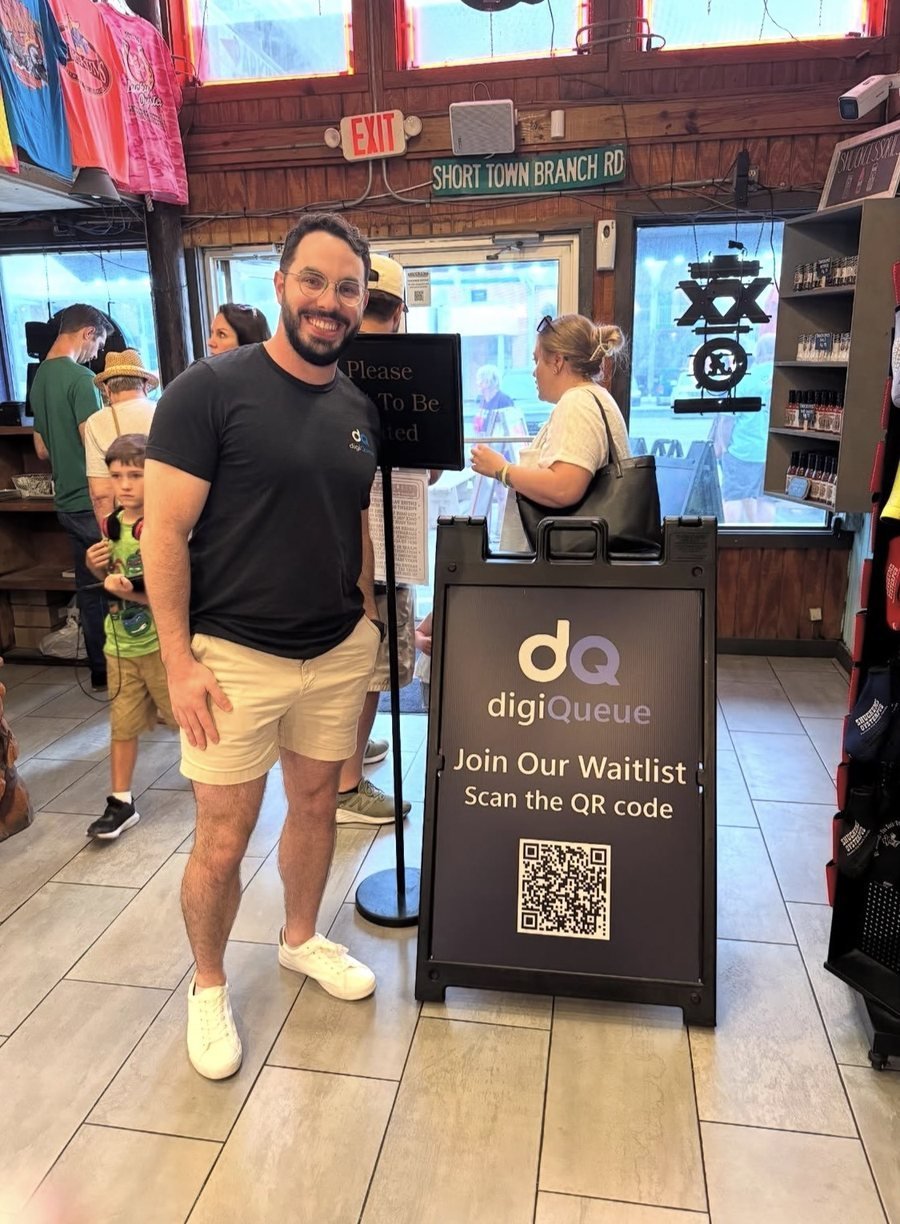
Startup.talk:What do you deliberately leave out of digiQueue?
Thompson:Auto-seating: the restaurant decides who sits where, not an algorithm. Guest profiles: names and phone numbers are only used during the visit, and we keep metrics, not personal data. And the all-in-one system: I don't want to be a POS or a reservation platform. digiQueue does one thing, lines and priority access, and the goal is to be THE queue management system. Think of what Stripe is for payments: the infrastructure anyone plugs into. That's what we're building for queues.
Positioning
Startup.talk:Who is digiQueue for, and what job does it do for them? Describe the person who gets the most value.
Thompson:digiQueue is for anyone with more demand than capacity. Its job is to take a line that frustrates everyone and turn it into something that works for everyone. Think about what happens when someone walks up to a 45-minute wait. Normally they have two choices: suffer through it, or leave and find somewhere else. digiQueue gives them a third option. They can pay to get in sooner, or join the line from their phone and wait wherever they want. Either way, the venue keeps a guest who was about to walk out the door. It redistributes demand instead of losing it:
Restaurants and nightlife: win back walk-aways and earn new revenue on the busiest nights.
Airports and travel: offer travelers a paid fast lane that funds the operation instead of costing it.
Ports: ships wait at sea instead of idling at anchor, saving fuel and smoothing berth traffic.
Government offices: walk-ins stop crowding the lobby, and staff can move urgent cases forward.
Events and attractions: guests explore and spend instead of standing still, with VIP and early-access options built in.
“It redistributes demand instead of losing it”Steven Thompson
Startup.talk:How do you view your positioning relative to Yelp Waitlist, Waitwhile, Qminder, OpenTable and Resy? Is there another competitor you think of first?
Thompson:Most of those platforms charge the venue through monthly fees, per-cover fees and add-on modules. digiQueue reverses that: the guest chooses to pay for priority, and the venue gets a share back. OpenTable and Resy are reservation-first. Waitwhile and Qminder are strong at general queuing but don't build their model around paid priority. The names I think about most are Toast in restaurants and CLEAR in travel, each a giant in its own industry. But digiQueue is built API-first, so it can plug into the platforms venues already use. If you can't beat them, join them: our goal is to be the priority layer underneath, not one more system competing for the counter.
Startup.talk:What is your core moat in queue and waitlist management?
Thompson:Three things. First, we were born on a real restaurant floor, built with an operator, not on a whiteboard. Second, our revenue model makes us something venues gain from instead of a cost they have to justify. Third, we work across industries, so as more venues use digiQueue, guests start to recognize it, and that cross-venue relationship is hard for single-industry tools to copy.
Startup.talk:What are some of the use cases for digiQueue that are not obvious and can add a lot of value to users? List as many as possible.
Thompson:Government ID and records offices: walk-in lines with staff-granted priority
Ships waiting for a berth: join the queue from sea and slow-steam to save fuel
Cruise terminal passenger flow: taxi lines, garage exits, drop-off
University offices: financial aid, registrar and advising during rush weeks
Pop-up events and brand activations: demo queues, early or pre-sale access
Nightclubs: skip-the-line passes without a cash-to-the-bouncer economy
Clinics and urgent care waiting rooms
Car dealership service drives
Licensing and permit counters
Food trucks and festival vendors
Retail product drops and sneaker launches
Rides and attractions at fairs and festivals
Multi-experience venues running several queues at once
Startup.talk:What is the one detail in digiQueue you are proudest of?
Thompson:That it gives back. Some of our restaurant clients have earned an extra $5,000–$8,000 a month during peak season from priority passes alone. That's money that was always there in the line, they just had no way to collect it. Putting real dollars back into small businesses is what I'm proudest of, and as we grow, I want that giving to reach the wider community through donations too.
Launch
Startup.talk:What did you learn from launching on Product Hunt?
Thompson:Product Hunt's audience is builders, not restaurant owners, so the feedback was more about the model than the product. That was valuable, because it pushed me to explain the “the waitlist pays you” idea in one sentence.
Startup.talk:Which feedback from the launch surprised you?
Thompson:How much of it there was, and how different it was depending on who it came from. When I launched with my first high-volume restaurant, paid priority was a brand-new concept to them. The GM, the hosts, the servers and the guests at the door all saw it differently, and I had to be open to all of it. That taught me to fail, and fail fast. Every rough edge they found on a Friday night was something I could fix by the next weekend, and that loop is still how I build today.
The hard part
Startup.talk:How many people use digiQueue today?
Thompson:More than 45 clients and growing. That covers restaurants, nightlife, events, a U.S. Air Force installation, and clients in both the US and the UK.
Startup.talk:What is a challenging time you had building digiQueue?
Thompson:Selling into big institutions as a one-person company. Many large organizations like the idea, but nobody wants to go first. I've heard “come back when you have pilot data” more times than I can count. The hard part is staying patient and disciplined: proving it out with smaller customers, building trust one client at a time, and not cutting corners to rush it.
Startup.talk:Who believed in you before there was anything to show? What did they say or do?
Thompson:Josh, the GM at Shuckums Oyster Pub & Seafood Grill in Panama City Beach. He gave me his host stand to build on before there was a polished product, and on real Friday nights during tourist season, he told me exactly what worked and what didn't. A lot of what digiQueue is today came from those nights. Since then he's written a review about how good our customer service has been, and that means a lot coming from the person who saw it at its roughest. I give Shuckums a lot of credit for taking a chance on digiQueue.
Startup.talk:How do you handle guests who feel that paid priority access is unfair?
Thompson:I hear it, and then I point out that paying for convenience is already everywhere: express lanes at theme parks, priority boarding on flights, expedited shipping. digiQueue just brings that option to places that never had it, and does it in the open instead of under the table at the host stand. Nobody loses their spot in a way they didn't sign up for. The standard line is always free, wait times are shown honestly, and the venue can comp priority to regulars or guests who need an accommodation. The money doesn't disappear either. It goes back into the venue, and when it improves operations and moves the line faster, everyone benefits, whether they paid or not.
What it is all for
Startup.talk:What would make you say digiQueue has succeeded?
Thompson:When “join the digiQueue” is as normal as “tap to pay,” and anyone running a line, in any industry or country, reaches for us by default. Personally, success is building something that supports my family and gives back, to communities around the world and to the veteran community.
Startup.talk:Will we still stand in lines when AI agents can book and wait for us?
Thompson:Lines won't disappear, because physical capacity is limited. There are only so many tables, gates and berths. What changes is who does the waiting. If an AI agent holds your spot, something still has to run the line, set the rules and decide who goes first. That's infrastructure, and that's what we're building. Agents make priority access more important, not less.
“Agents make priority access more important, not less.”Steven Thompson
The road ahead
Startup.talk:What are your milestones for the next 12 to 18 months?
Thompson:At the start of this year, my goal was to take digiQueue into government and airports. Government is done with our Air Force contract, and I'm in active conversations with major airports about implementation. Over the next 12 to 18 months, the milestone is getting that first airport live. I don't chase a revenue number. If I'm improving my clients' service, giving back, and it isn't coming out of my pocket, I'm happy. Of course I'd love for digiQueue to become a multimillion-dollar company, or a billion-dollar one. But the foundation is to be of service and give back first, and the growth follows that.
Startup.talk:And where do you want digiQueue to be in five years?
Thompson:The default queue and priority-access layer for the world: restaurants, airports, ports, government offices and events, whether guests see our name or it's running behind someone else's. And if you want the dream version, I want to see the digiQueue logo on a Formula 1 car.
Startup.talk:What are your hopes and fears for a post AGI world?
Thompson:My hope is that AI gives people back their time, which is the whole point of digiQueue. My fear is that the benefits pile up with people who already have access, while small operators and communities like the ones I came from get left behind. I want to build tools that help the small venue as much as the big airport.
This interview was conducted in writing and has been edited lightly for length and clarity.
About digiQueue
digiQueue is queue and demand management software with paid priority access, built by Steven Thompson, a U.S. Army veteran, for restaurants, venues, airports, ports and government offices.
| Attribute | Verified Detail |
|---|---|
| Company | digiQueue |
| Founder(s) | Steven Thompson |
| Country | USA |
| From | Georgia, USA |
| Service | U.S. Army veteran, 8 years |
| Background | Northrop Grumman (B-2 Spirit); University of Georgia |
| Funding | Bootstrapped, cash-flow positive |
| Status | Certified SDVOSB |
More founder interviews
 Watchflows
 Lensiq
 HoneyRuns
 LiliDi AI
For founders
Building something? Want to share your journey?
Tell us how it started, what nearly broke it and where it is headed. We will turn it into a story like this one.
Share your journeyFor readers
Want to read more human stories behind the startups?
New founder interviews and stories, as they are published.
Follow us on LinkedIn