
Christine Zafra was born in Parañaque City in Metro Manila and grew up in Davao City, an only child who made flashlights out of loose bulbs and batteries at eight and wired a phone extension into the family landline at nine. Zafra's career began in 2008 as an academic writer working to three-hour deadlines, then moved into virtual assistant work, where most of the day is spent in client meetings.
Jotted grew out of those meetings. Recorders quit mid-call, notetaker bots were refused entry, and action items slipped while Zafra tried to listen and take notes at the same time. So Zafra built a Windows recorder that captures the call from your own screen with no bot, keeps the full video, and gives the free plan no limits. We spoke about a 2e ADHD diagnosis at 38, a launch day that looked like a flop, hours spent counting to 30 into different microphones, and why people should own their meetings.
Key takeaways
- Jotted is a Windows meeting recorder that captures Zoom, Microsoft Teams and Google Meet calls from your own screen, with no bot in the call, and keeps the full video alongside the transcript.
- The free plan records locally with no account and no limit on length or number of meetings. Pro, at $14 a month, adds AI notes, action items and Quill, which searches past meetings and jumps to the exact moment in the video.
- Zafra built it alone, without telling anyone until it was finished. It launched mid-year, has 18 subscribers, and most updates since launch came from what users asked for.
- The targets: 50 paying customers and a Mac version within 12 months, and 200 paying customers within 24.
Before any of this
Startup.talk:Where did you grow up, and what was childhood like?
Zafra:I was born in Parañaque City in Metro Manila, but I grew up in Davao City, one of the major cities in the south of the Philippines. It’s a big city, but life there was pretty laid back. My playmates were my neighbors, and I only had two or three real friends out of them. We played outside until 6 PM because my grandmother was strict about it, and once it hit 6 I had to be inside the house.
I’m an only child, so I played on my own a lot. I was also the youngest of all my cousins, and the next one up from me was about ten years older. So at family reunions or when we all went out together, I sometimes felt isolated because there was nobody my age to talk to. I got used to doing things by myself pretty early.
Startup.talk:What first got you into building things?
Zafra:I’ve been curious about how things work for as long as I can remember. When I was about 8, I made flashlights out of bulbs I found lying around and strapped batteries to them, and that’s how I figured out something about voltage, because one battery wouldn’t light the bulb but two would.
At 9, I installed a phone extension for our landline. A phone extension was an added subscription, and my mom didn’t want to pay for one, so I found an old phone that still worked and wired it into the same line myself.
At 10, I put together my first computer. Nobody showed me how, and I got it from the shapes, because every part only goes in one way and if something won’t fit a slot then it wasn’t made for that slot. I remember my mom let me stay home from school that day so I could keep playing with it.
Startup.talk:What was your first job, and what did it teach you?
Zafra:My first job was as an academic writer, and that’s really how my career started. This was around 2008, long before AI, and I was writing for students in the US, the Middle East, and Europe. The projects came with a three-hour deadline, and that covered everything: reading the sources, making sure I understood them, writing the whole paper from scratch, and adding the citations as I went. It taught me how to work under intense pressure.
The road to Jotted
Startup.talk:What made you start Jotted?
Zafra:I went from being a writer to being a virtual assistant, and I know how it is at the entry level in the Philippines. The hourly rates start really low and you can be strapped for cash, which is why I built Jotted with a very generous free plan. I wanted VAs who are just starting out to be able to use it without paying.
As a VA you do everything, and a big part of that is sitting in meetings all day. So I built Jotted to fix my own problem first. I was using a different tool for each part of a meeting. There are plenty of recorders out there, but some don’t keep the video, some only keep the transcript, and some only give you the audio.
The tools that do all of it put a bot in the meeting, and that gets awkward. A lot of the time my bot wasn’t allowed in, which meant I didn’t get the whole recording. Some of the action items and to-dos got missed too, because I was in the meeting and trying to jot down notes at the same time.
Startup.talk:What happened on client calls that convinced you the conversation itself was being lost?
Zafra:I’m not going to name any tools, but I’ve lost a lot of meetings to recorders that quit on me. One AI transcription tool just stopped recording in the middle of a call. Another one froze mid-meeting, so I never got the rest of the conversation.
My AirPods died on me during a call, and my laptop switched to a different audio input the way it’s supposed to, but the recorder never followed it to the new default Windows input. It stopped recording my voice, and I only found out afterward. I’ve lost a lot of meetings because of things like this.
Startup.talk:How does being 2e ADHD shape the way you find problems and build products?
Zafra:I’m a late diagnosis. I’ve always known my IQ, but the ADHD part was new to me. In high school and college that was really perplexing, because I knew I was smart but I couldn’t seem to follow through, and my grades weren’t good.
Once I got into the workforce, I started noticing things I’d done in the past that leaned toward ADHD, but I didn’t have a name for it yet. I got my diagnosis at 38, and that’s when it finally made sense.
I tunnel into things. When I’m really interested in something, I can learn in three hours what takes other people three weeks. I also don’t take no for an answer, so I go all the way to the bottom of a problem before I start building. And I have a lot of ideas, so I tend to start multiple projects at the same time. That kind of creativity is the good side of being 2e ADHD.
Startup.talk:What is it like to build Jotted solo from the Philippines?
Zafra:Building Jotted solo from the Philippines has been a good experience. There aren’t many Filipino creators out there, so being one of them feels like an honor.
The product
Startup.talk:Why the name Jotted?
Zafra:I named it Jotted because it jots down the notes and action items for you, so the name says exactly what it does.
Startup.talk:Why record without a bot, and how do you explain that choice to people worried about consent?
Zafra:A bot in the call changes the room. An extra tile shows up with a notetaker’s name on it and sits there while everyone talks, and that gets awkward fast. If I’m not the host, the bot sometimes doesn’t even get let in, so the first thing I’d say on the call is a request to admit my notetaker.
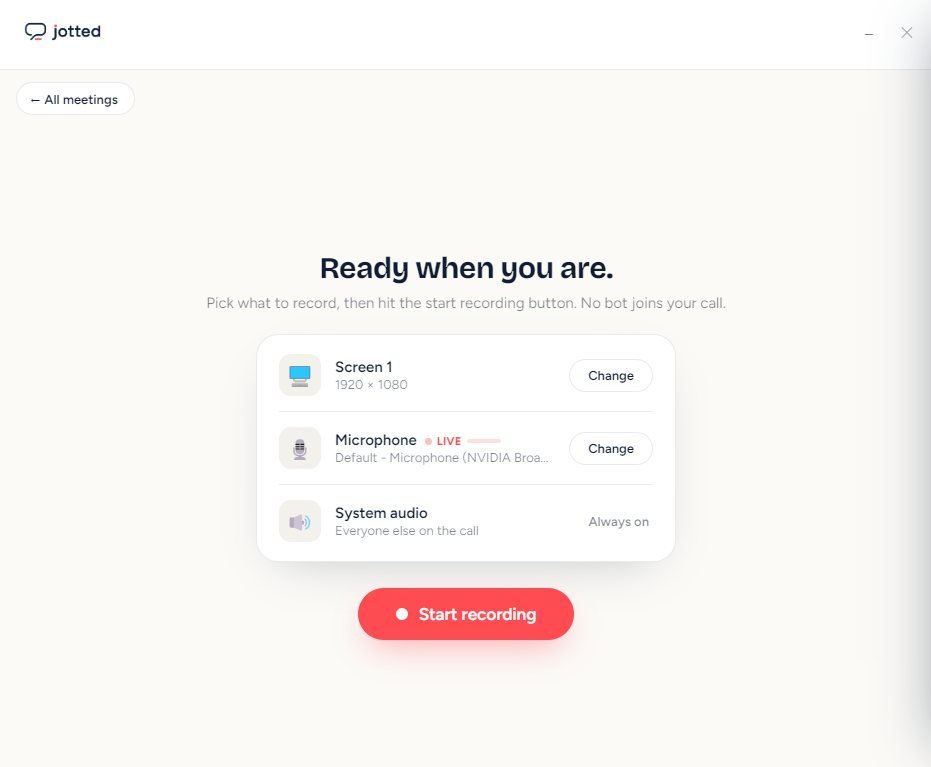
Jotted records from my side of the screen, so nothing joins the call at all.
When it comes to consent, I always tell people out loud that I’m recording. It’s one of my must-dos. I tell them what the recording is for, and if they’d rather I didn’t record, I don’t.
“A bot in the call changes the room.”Christine Zafra
Startup.talk:Why keep the full video when most bot-free tools keep only a transcript?
Zafra:A transcript can’t read emotion. You can go through every word of a call and still have no idea how the person reacted when something came up, like the price. The video is where you see the micro-expressions and the non-verbal cues, and I wasn’t willing to leave those out, so Jotted keeps the entire video.
“A transcript can’t read emotion.”Christine Zafra
Startup.talk:Why start with Windows when most bot-free recorders are Mac-first?
Zafra:Most bot-free recorders are Mac-first, which leaves a gap for people on Windows, so that’s where I started. It’s also what I use myself. Mac is next.
Startup.talk:How does Quill change the way people go back to a past meeting?
Zafra:Quill lets you keep all your meetings in one tool, Jotted, no matter how many clients you have, and ask questions across every recording. You don’t have to remember when something came up. You ask Quill about it, and if it finds the moment, it gives you the timestamp from the video. Click it and you jump to that exact spot in the recording, so you can watch it again for yourself.
Positioning
Startup.talk:Who is Jotted for, and what job does it do for them? Describe the person who gets the most value.
Zafra:Jotted is for people who spend their day in client meetings and are also the one who has to remember everything that was said. I started with virtual assistants because that’s the job I came from. As a VA you do a bit of everything, you’re on calls all day, and you still have to turn those calls into to-dos afterward.
The person who gets the most value is someone like that, usually early in their career or freelancing, who doesn’t have much room in the budget and doesn’t want a bot sitting in their client’s call. Jotted records the video and audio from your side of the screen and gives you the transcript, and on Pro it also pulls out the notes and action items. That means you can be in the conversation instead of typing through it, and you can go back and check anything later.
Startup.talk:How do you view your positioning relative to Otter.ai, Fireflies, Fathom, Granola, tl;dv and Zoom's own AI Companion? Is there another competitor you think of first?
Zafra:Most of the tools on that list, like Otter, Fireflies, Fathom, and tl;dv, started out by sending a bot into your call. I built Jotted because that got awkward for me, and sometimes the bot didn’t even get let in.
The one I think of first is Granola, because it doesn’t use a bot either. The difference is that Granola keeps the text and not the recording, and I wanted the full video so you can see how the person reacted. Zoom’s built-in AI is tied to Zoom, while Jotted is its own app that records from your side of the screen.
Startup.talk:What is your core moat in AI meeting recording?
Zafra:I’d say my moat is that the recording stays on your computer. Most of these tools run everything on their own servers, so they have costs on every recording, and that’s usually why free plans get limits. Jotted doesn’t work that way, so I can keep the free plan open with no limits. That’s hard for a company built around the cloud to copy without changing how it works.
The other part is speed. I’m one person, so when I get an idea I can build it and ship it the same day.
Startup.talk:What are some of the use cases for Jotted that are not obvious and can add a lot of value to users? List as many as possible.
Zafra:A lot of people use Jotted just to have the notes, but there’s a lot more you can do with the recordings. If a client says that’s not what we agreed on, you can go back and watch what was said instead of arguing about it. You can also see how someone reacted when the price came up, which a transcript can’t show you. Quill searches across all your meetings, so you can find something from months ago without remembering which call it was in, and it takes you right to that spot in the video.
It helps with people too. A new VA or teammate can watch how a client talks and what they care about, as long as the client knows it was recorded, and when you hand a client over to someone, the recordings give them the whole history. You can watch your own calls back to see where you talked too much or missed a question. If you bill by the hour, the recording shows when a call started and how long it ran.
I have ADHD, so for me it’s also a way to catch up when my attention drifts. I can read the transcript for the minute I missed instead of asking someone to repeat it. It helps when English isn’t everyone’s first language, too, because the transcript and the video together make it easier to check what someone meant. And I’d use it for interviews, whether that’s hiring calls or interviews for an article, where you want the video and the words in one place.
Startup.talk:What is the one detail in Jotted you are proudest of?
Zafra:The detail I’m proudest of is that the free plan has no limit on how long you can record or how many meetings you record. That works because the recording is a file on your own computer, so I’m not paying to store your video on a server, and I don’t have to cut people off to cover the cost.
A lot of the people I know are freelancers and virtual assistants who watch every dollar, and I think many of them would skip a tool like this if the free version stopped at 40 minutes. I wanted the free plan to be good enough for real client work, so more people can use it without paying for anything. I’m a solo founder and I still get a little kick out of that.
Launch
Startup.talk:What did you learn from your launch?
Zafra:The launch itself didn’t go well. I didn’t get the numbers I was hoping for on the day, and I’ll say that plainly.
What I didn’t expect is what happened after. In the days that followed I got emails and inquiries from people asking about Jotted, and some people sent me LinkedIn connection requests too. So the launch day looked like a flop, but the people who found it later were the ones who actually reached out.
I’d also say a launch is just the first time people see it, and what happens over the next few weeks tells you more than the first day does.
“the launch day looked like a flop, but the people who found it later were the ones who actually reached out.”Christine Zafra
Startup.talk:Which feedback after the launch surprised you?
Zafra:I expected mostly bug reports after launching, and what came in was mostly small ideas. We went live on a Sunday at 0.1.2 and we’re on 0.1.7 already, and most of those updates came from people telling me what they wished it did, like a setting they wanted somewhere else or a step they wanted to skip. I thought I’d spend that week fixing things, and it turned out I spent a lot of it adding things people asked for.
The hard part
Startup.talk:How many people use Jotted today?
Zafra:We launched mid-year, and so far we have 18 subscribers, and that number keeps growing. It’s a small number, but each of them came to us on their own, and a few of them have emailed me directly with ideas.
Startup.talk:What is a challenging time you had building Jotted?
Zafra:The hardest part was the audio switching. The recording was locked to whatever device was active when I pressed start, so if Windows changed devices halfway through a call (Bluetooth dropping is the usual one), the recording kept listening to a device that was no longer there. The fix is that Jotted now follows whatever Windows says is the active device and keeps going in the same file, with no gap. Testing it meant sitting in my room talking to myself for hours and counting to 30 into different microphones while I unplugged things, which looked as silly as it sounds. It took a lot of bug fixes before it held up, because every new device combination found something I hadn’t thought of.
The payment providers falling through was the other one. The first provider had fees that didn’t work out at $14 a month, and the second wanted a live, downloadable product before they would approve me, which I couldn’t give them because I needed payments working to launch. So I was stuck between two providers and a launch date, and I ended up on Dodo Payments.
Startup.talk:Who believed in you before there was anything to show? What did they say or do?
Zafra:I kept Jotted to myself the whole time I was building it. I didn’t tell anyone until it was a finished product, partly because I wanted to know it worked before I had to explain it to somebody. When I finally showed the people close to me, they were really proud of me, and it meant a lot because they hadn’t known I was working on it.
Startup.talk:How do you keep a free plan with no account sustainable?
Zafra:The biggest reason is that the recording stays on your own computer. I’m not paying to store your video on a server, so a long recording costs me nothing, and that’s why the free plan has no limit on how long you record or how many meetings you record.
The part that does cost me money is the AI notes and action items, because each one is a request I pay for. That’s what’s in Pro, at $14 a month, and there’s a seven day trial so people can try it before they pay. So the people who use the most of what costs me money are the ones paying for it, and everyone else can record for free as long as they like.
What it is all for
Startup.talk:What would make you say Jotted has succeeded?
Zafra:I’d say Jotted succeeded when it’s the thing people open before every client call without thinking about it, like they would with their mic or their calendar. I’d also want enough people paying for Pro that I can keep the free plan open for everyone else, because that’s the part I care about most. And it would mean a lot to hear from a freelancer or a VA like me who said a recording saved them from an argument with a client or from a task they would have forgotten.
Startup.talk:What will meetings look like when AI agents attend, take notes and act on what was agreed?
Zafra:I think agents will be in a lot of meetings, and some of them will take notes and do the follow up work too, which would save people a lot of time. What I worry about is what it does to the room. I’ve seen how a bot in the participant list changes how people talk, so if every meeting has several agents in it, I think people will get more careful about what they say, and the meetings will get worse for it.
The other part is that someone still has to be accountable. If an agent promises something to a client on my behalf, I’d want to go back and see exactly what was said and how it was said, and I think a recording with the video does that better than a summary. So I think the people in the meeting will still matter, and the agents will mostly work around them. Whatever happens, everyone in the meeting should know who and what is listening, and agree to it first.
The road ahead
Startup.talk:What are your milestones for the next 12 months, in users and revenue?
Zafra:In the next 12 months I want to go from 18 subscribers to 50 paying customers. I also want a lot more people using the free plan, because those are the people who tell others about it. I’d like to have the Mac version out by then too, since a lot of people have asked and I can’t help them until it exists.
Startup.talk:And for the next 24 months?
Zafra:In 24 months I want Jotted to be on both Windows and Mac, with 200 paying customers. I’d also like to have built the things people ask me for most, because most of the updates so far have come from people telling me what they wish it did.
Startup.talk:Where do you want Jotted to be in five years?
Zafra:In five years I hope Jotted is something freelancers and small teams all over the world use for their client calls, on both Windows and Mac, and that the free plan is still as open as it is today. I’d like the recording to still be a file that sits on your own computer, because I think people should own their meetings and not just have a login to them. I’m not sure yet if it will still be only me by then or a small team, and I’m okay with either one as long as I can keep shipping at the pace I do now. I’d also like the people who were using it in the first year to still be using it, because that would tell me we got the basics right.
Startup.talk:What are your hopes and fears for a post AGI world?
Zafra:My biggest hope is that more people can build the things they need. I built Jotted by myself, from the Philippines, as one person, and a few years ago that would have taken a team. If AI keeps getting better at that, I think a lot more people with ideas will be able to make them real and give them away or sell them cheaply, and not just the people who can afford a team.
My biggest fear is about consent and ownership. If agents are listening in on every call and every message, I want people to know who is listening and where the recording goes, and I want them to own it. I also worry about people like me. I work as a virtual assistant, and a lot of that work is the kind that AI is getting good at, so I don’t know what it means for me yet. I’m not sure how it will go, and I think anyone who says they are sure is guessing.
“I think anyone who says they are sure is guessing”Christine Zafra
This interview was conducted in writing and has been edited lightly for length and clarity.
About Jotted
Jotted is a Windows meeting recorder built by Christine Zafra in the Philippines. It records Zoom, Microsoft Teams and Google Meet calls from your own screen, with no bot joining the call, and keeps the full video, audio and transcript on your computer. The free plan needs no account and has no limit on recording length; Jotted Pro ($14 a month) adds AI summaries, action items and Quill, which answers questions about past meetings. A Mac version is planned. getjotted.com
| Attribute | Verified Detail |
|---|---|
| Company | Jotted |
| Founder(s) | Christine Zafra |
| Country | Philippines |
| Based | Philippines |
| Grew up | Davao City (born in Parañaque City, Metro Manila) |
| Studied | De La Salle University; St. Scholastica's College, Manila |
| Before | Academic writer (from 2008); virtual assistant |
| Pricing | Free plan with no limits; Pro $14 a month |
More founder interviews
 TruTalk
 Decklit
 ATS Engine
 VoCalm
For founders
Building something? Want to share your journey?
Tell us how it started, what nearly broke it and where it is headed. We will turn it into a story like this one.
Share your journeyFor readers
Want to read more human stories behind the startups?
New founder interviews and stories, as they are published.
Follow us on LinkedIn