
Luca Simeone grew up in a small town in Italy and spent most of his childhood outside on a bike, always looking for the blue ocean, the place nobody else had gone yet. A degree in Marketing took him to the UK, and from there to Barcelona, Stockholm, Amsterdam and, since 2019, Singapore, where he lives with his family. Before Decklit he led marketing and commercial work across Europe and APAC in travel, technology and crypto.
Decklit grew out of years of watching good decks fail on bad screen shares, and out of an MSc in Computer Science at the University of Liverpool, where Simeone measured how slides travel over real networks in Asia. The platform handles everything after a deck is made: share it as one secure link, present live in the browser with nothing to install, take questions on each slide, and see afterwards who engaged and with what. We spoke about why Decklit leaves slide creation to others, what Dual View makes possible, and building a company alongside a full-time job and a family.
Key takeaways
- Decklit does not make slides. It takes a finished deck and handles sharing, live presenting, audience questions, notes, AI summaries and analytics, all tied to the slide they belong to.
- Slides are synced in each viewer's browser instead of screen shared. In Simeone's dissertation tests this sent about 80% less data, so sessions hold up on weak connections.
- Dual View keeps the deck, a shared screen and the participants in one window, so a live demo never makes the slides or the faces disappear.
- Simeone built Decklit in evenings and weekends alongside a full-time job, a master's degree and a family. It has hundreds of free users and a small number of Pro users, with a free trial and a Business plan for teams planned.
Before any of this
Startup.talk:Where did you grow up, and what was childhood like?
Simeone:I grew up in a small town in Italy. I was an adventurous kid and spent most of my time outside, riding around on a bike with friends. I was always drawn to the unusual things, and in almost everything I did I was looking for the blue ocean, the place nobody else had gone yet. I was fascinated by the world outside the one I lived in. I had this urge to be the different one for once, and to test myself in places where I would not feel comfortable at first. It came from within, and I think it is what eventually brought me to the East.
At secondary school I studied computer science and accounting. My family always encouraged us to go abroad, so I moved to the UK for university, took a BA in Marketing and stayed for five years.
From there I kept moving. I worked for a digital advertising agency in Barcelona, then went to Stockholm for a project with my sister, which I developed through the Erasmus for Young Entrepreneurs programme, and worked in email marketing for an e-commerce business there. Next came Amsterdam and several years with international companies. In 2019 I had the chance to move to Singapore, and I have been here with my family ever since.
Having spent more than half my life abroad, I do not feel I belong to one specific place, though I consider where I am now a place to stay. I kept studying alongside work, first an MBA and then an MSc in Computer Science with the University of Liverpool, where my dissertation became the starting point for Decklit.
Startup.talk:What first got you into building things?
Simeone:I never had one specific passion. What I had was a wish to be independent, and to build a company, not only work for one, and to create something people would use. That, and a fair amount of grit, is what got me here.
Startup.talk:What was your first job, and what did it teach you?
Simeone:Apart from the odd jobs I did when I was young, my first real job was at a Starbucks in London, right across from Harrods, one of the busiest around. My English was not good at the time, so I made up for it with speed, with knowing the coffees, and with how I treated customers. That is where I learned to work under pressure, and it kept me going while I got started in the UK.
My first corporate job was at an international email marketing company, one of the best in its field. That is where I learned the basics of CRM and of corporate life, and where I became meticulous and structured, thanks in large part to my manager at the time.
The road to Decklit
Startup.talk:What made you start Decklit?
Simeone:It was several things adding up. In corporate life, clients kept asking the same question, “Can you share the deck before the presentation?” Then came the calls themselves, with “let me share my screen” or “can you see my screen?”, the glitches and the blurry slides. Presenting across Southeast Asia made it worse. In remote areas, in parts of the Philippines for example, the bandwidth is weak, and a screen share simply does not hold.
All of that made me ask whether there was a better way. Screen sharing does what its name says, it shares a screen. It was never designed for presenting a deck. Similar technology existed, but we focused on one idea and refined it. We put the deck, every single slide of it, and the audience at the centre, and wrapped the call around them. In Decklit the call comes second. The deck and the people watching it come first.
Startup.talk:What did years of presenting to clients across Europe and APAC teach you about how decks get delivered?
Simeone:That a deck deserves more than a screen share. So much time and effort goes into one, and then it is delivered through a tool that was never made for it, on connections that often cannot carry it.
It also taught me that we put all our attention on the session itself and barely think about what comes before and after. There was no single place to share the deck in advance, present it, deliver it and collect feedback, in a simple way and with nothing to download. Expensive solutions exist for large enterprises, but there was nothing like that for small and mid-size companies and startups. An affordable one can empower a lot of people.
I call it the last mile of the presentation flow, which is sharing, presenting, following up and analysing. Analysing is the part we miss most often. We guess how long people spent on a slide or what was said about it. For me, everything needed to be connected, and it was not.
Startup.talk:Why did you decide to focus on what happens after a deck is made, rather than on making slides?
Simeone:Because everyone is focused on making slides, and very few are working on what happens after. I do not mean delivery alone, or the call alone. I mean everything around the deck, combined in one place.
A deck should arrive crisp. The audience should be involved and engaged, not just watching. They should be able to play the videos in it at their own pace, leave feedback without friction, and come back later to one place where the questions, the notes and the files are easy to find. The large suites do offer most of this, but spread across several products, and finding anything has become cumbersome.
There is also a practical reason. Many companies rely on their own teams to create slides, and slides are hard to get right. Even with AI you always have to retouch them. Several models already do an excellent job, and that market is moving so fast and is so crowded that entering it now would be a losing battle. The space after the deck is made is where not many were looking, and it is where I knew I could build something useful.
“The space after the deck is made is where not many were looking”Luca Simeone
Startup.talk:What is it like to build Decklit from Singapore?
Simeone:It suits the product. Singapore sits in the middle of a region where audiences are spread across countries, languages and very different internet connections, which is exactly the situation Decklit was designed for. I can test an idea with someone in a modern office here and with someone on a weak mobile connection elsewhere in the region in the same week.
It is also a serious place to start a company, with a strong startup community and clear rules. My developers are in Italy, so the time difference works in our favour. I brief them in my evening and wake up to progress. The other side of that is being the only one awake when something breaks. I have lived here since 2019 with my family, and building for the whole region from here feels natural.
The product
Startup.talk:Why the name Decklit?
Simeone:It means a deck that is lit, as in under the spotlight. In most tools the call is the main event and the slides are a guest. I wanted the opposite, with the deck in the light and everything else arranged around it. The name also had to be short, easy to say in any language and easy to remember, and Decklit does all three.
Startup.talk:Why present without screen sharing and with nothing to install?
Simeone:Because every extra step loses part of your audience. With Decklit the viewer clicks a link and is in. There is nothing to download, and they do not even need an account, since they can join with a nickname.
Presenting without screen sharing changes the quality too. The viewer’s browser shows the real slide and not a video of my screen, so the text stays sharp, videos in the slides play smoothly on their side, and the session uses far less data. In the tests for my dissertation, syncing slides sent about 80% less data than sharing a screen on a video call. Nobody sees my desktop or my notifications either. Screen sharing is still there when you need to show something else, but it is no longer what the presentation depends on.
Startup.talk:What does a Decklit session look like from the audience’s side?
Simeone:Most tools are designed for the presenter, and the audience gets whatever is left. In Decklit the viewer clicks a link and is in, with nothing to install and no account needed. They see the real slide, sharp on any screen, including a phone. They can ask a question on the slide it relates to, take private notes that stay attached to that slide, and play any video in the deck on their own device.
After the session they have a place to go back to. The Deck Room for that deck holds the questions, their notes, the files the presenter shared and the recording, and they can leave feedback there, even if they could not attend. I wanted the audience to feel that the session was built for them as much as for the person presenting.
Startup.talk:You researched the environmental side of presenting. What did you find, and does it matter to customers?
Simeone:My master’s dissertation compared screen sharing with sending the slides themselves and keeping them in sync, and measured bandwidth, energy use and quality of experience, with a focus on Asia. In my prototype tests, syncing slides sent about 80% less data than sharing a screen on a video call.
Less data means less strain on networks and less energy, and it also means the presentation works for people on weak connections. So the sustainable choice and the practical choice turn out to be the same one. Most customers come for the second reason. I think more of them will care about the first as companies start to count the footprint of how they work online.
Startup.talk:How do you keep a shared deck secure when you never send the original file?
Simeone:Not sending the file is the security. The original stays with you, and people view the deck through Decklit, so there is no attachment travelling from inbox to inbox and being forwarded without your knowledge.
On top of that, you decide how people see it. They can browse freely, or only follow you slide by slide during the session, so nobody reads ahead to the pricing page. You can protect a deck with a password, and you can see who opened it and when.
And if a deck or a file does need to be handed over, that happens inside the platform too. Every deck has its own Deck Room, a private space where the presenter shares files, recordings and summaries with the audience, so nothing has to leave the system to reach the right person.
With email, your control ends the moment you press send. With Decklit it continues afterwards.
Startup.talk:What do the AI summaries and analytics tell a presenter that they could not see before?
Simeone:They show you what happened in the room when you could not see the room, and they do it slide by slide.
From the moment a live session starts, Decklit follows the deck. Every slide is analysed on its own. You see how long you stayed on it, how many people were with you, and which questions were asked while it was on screen. The transcript works the same way. It is a smart transcript that knows which slide you were on when you said something, so you can go straight to what was said on slide seven without scrolling through an hour of text. It also looks at whether what you were saying was relevant to the slide in front of the audience, which tells you where you stayed on message and where you drifted.
The AI summary then pulls the session together. It gives you the key points, the questions that came up and what needs a follow-up, without anyone taking notes. Outside the live session, the analytics show who opened the deck, when, and how much time they spent on each slide.
Before this, a presenter finished a session with a feeling about how it went. Now they finish with a record of what was said, what was asked and what held attention, all connected to the slide it belongs to and saved in the Deck Room for that deck. And there is more to come!
Startup.talk:You described Decklit many ways before it clicked. What did you learn from that?
Simeone:I learned that people understand what you are not faster than what you are. I tried “the last mile of presentations”. I tried “the deck is the hero”. I tried lists of features, and I tried comparing us to tools people already knew. Each description was accurate, and none of them landed in the first ten seconds.
What clicked was the simplest line: creation is solved and delivery is fragmented. The moment I said that we do not make slides and that we look after everything that happens after, people stopped comparing us to PowerPoint and started telling me their own stories about screen sharing going wrong.
The second lesson was to stop describing the technology. Nobody outside the industry cares how slides are synchronised. Everyone has lived the moment of asking “can you all see my screen?”, or of sending a deck and hearing nothing back. When I describe that moment, people recognise themselves, and the product explains itself from there. It also forced me to be disciplined about the product. If I cannot explain a feature through a moment people recognise, it probably should not be there.
“people understand what you are not faster than what you are.”Luca Simeone
Startup.talk:What do you deliberately leave out of Decklit?
Simeone:Slide creation, first of all, and I intend to keep it that way. You bring the deck from PowerPoint, Google Slides, Keynote or an AI tool, and Decklit takes it from there. Companies are protective of how their decks are made, the tools for making them are already excellent, and that market is crowded enough.
I also resist turning Decklit into a general meeting tool. If your meeting is not about a deck, another product will serve you better, and I would rather be very good at one thing.
We leave out anything the audience would have to install. No plugin, no desktop app, no account required to join. And we leave out the weight of an enterprise suite, where every feature exists somewhere but you need training to find it. Every feature we add has to answer one question, which is whether it helps the deck land. If it does not, it stays out, however popular it is elsewhere.
Positioning
Startup.talk:Who is Decklit for, and what job does it do for them? Describe the person who gets the most value.
Simeone:Decklit is for people whose work depends on a deck landing well. That includes consultants presenting findings to a client, trainers and learning teams running sessions, sales teams walking a prospect through a proposal, founders pitching to investors, speakers at conferences, and leaders presenting to their own organisation.
Most of them work in small and mid-size companies or on their own. They do not have an IT department to roll out an enterprise platform, and they should not need one. They are good at what they do and tired of fighting their tools.
The job Decklit does for them is to take the deck from finished to delivered. They share it with a secure link, present it live in the browser, take questions on each slide, let the audience make notes and leave feedback, and afterwards they know who engaged and with what. Everything for that deck, including the recording, the transcript, the summary and the files, stays together in its Deck Room.
The person who gets the most value is the one who presents often and follows up seriously. For them, knowing which slide raised the most questions is the difference between a second meeting and silence.
Startup.talk:How do you view your positioning relative to DocSend, Pitch, Google Slides sharing, Brieflink and Zoom screen share? Is there another competitor you think of first?
Simeone:Each of them owns one piece of the journey, and each does that piece well.
DocSend and Brieflink are about what happens to a document after you send it. They tell you who opened it, but they stop when the live presentation begins. Pitch and Google Slides are where the deck is made, and their sharing is an extension of the editor. Zoom is where you talk over the deck, and to do that it turns your slides into a video of your screen. A presenter ends up moving between three or four tools for one presentation, and the information is scattered across all of them.
Decklit connects those moments around the deck itself. You share, present, engage and analyse in one place, and it works alongside the tools people already create in. We complement them more than we replace them, and many of our users still use a call tool for meetings that have nothing to do with a deck.
The competitor I think of first is not a product. It is the habit of attaching a PDF, sharing a screen and hoping for the best. That habit is free, everyone knows it, and it is what we are up against every day.
Startup.talk:What is your core moat in presentation delivery?
Simeone:The first part is how the product is built. Everything in Decklit is tied to the slide. Questions, notes, analytics, transcripts and summaries all know which slide they belong to, because the deck was at the centre from the first line of code. A tool built around a call or around a document would have to be rebuilt to work that way. It cannot be added as a feature.
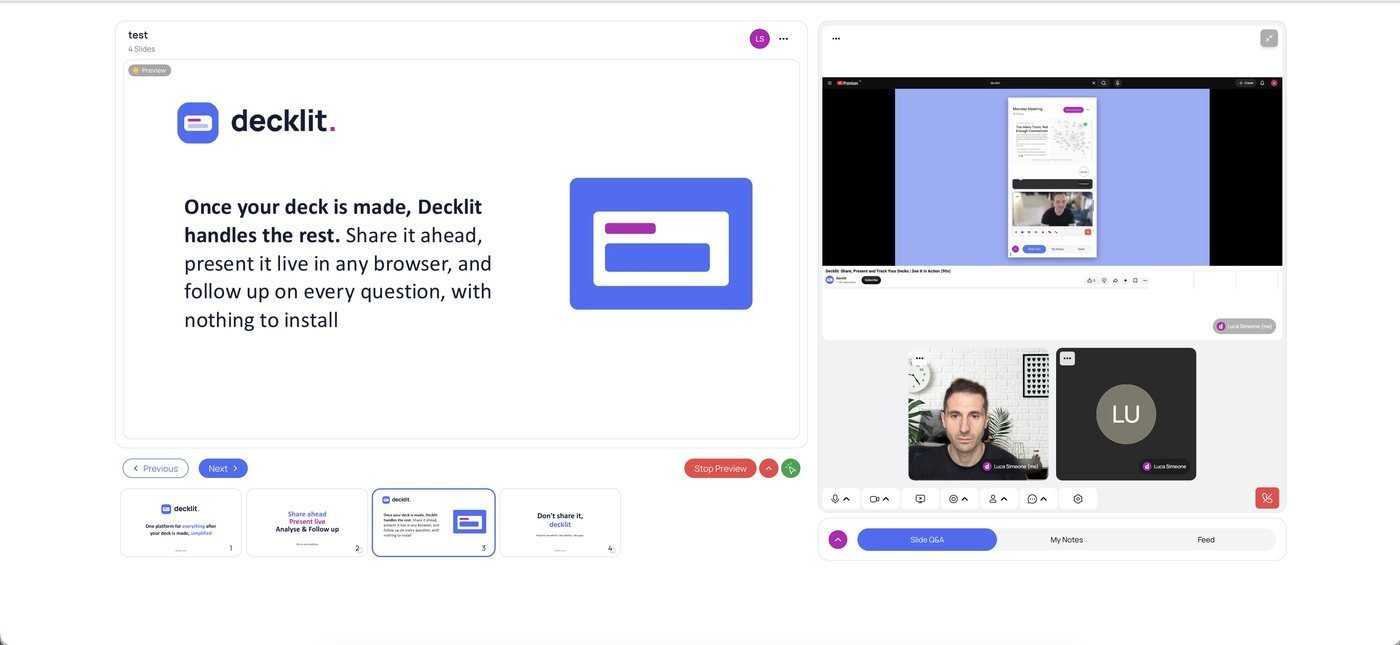
The second is Dual View. The deck, a shared screen and the participants stay together in one window, so a presenter can open a demo without the slides or the faces disappearing. I have not seen that anywhere else.
The third is that you can present from anywhere and on any device, including a phone, even on the road. We tested it in the Philippines on a 4G connection and it worked very well. The reason is simple. The deck is not being sent as a video of someone’s screen. It is already there, in each viewer’s browser, and only the slide change has to travel.
Behind that is the research. I did not start from an opinion. I measured how slides travel over real networks for my master’s dissertation, with a focus on Asia, and that work shapes every technical decision.
The last part is focus. We serve small and mid-size companies at a price they can afford, in a region the large players treat as an afterthought. Being close to those users, and building only for the deck, is hard to copy for a company with a hundred other priorities.
Startup.talk:What are some of the use cases for Decklit that are not obvious and can add a lot of value to users? List as many as possible.
Simeone:Pitching on the spot at a conference, where you meet an investor, share a link, and they follow the deck on their own phone while you talk them through it
Large conferences and company presentations, where people at the back squint at a screen far away, and with Decklit everyone has the deck sharp on their own phone, in sync with the speaker
Asking questions from the audience on the slide itself, without raising a hand or interrupting the speaker
Presenting from a phone while travelling, on a 4G connection, because the deck is already in each viewer’s browser and nothing is being screen shared
Reaching audiences in areas with weak bandwidth, where a screen share freezes and a Decklit session keeps running
Sending the deck before the meeting with browsing locked, so people can open it and prepare questions but cannot read ahead to the end
Showing a live demo, a spreadsheet or a website beside the deck with Dual View, so the audience keeps the slide that gives it context
Letting each viewer play a video in a slide on their own device and at their own pace, in full quality, because the video is not travelling through someone’s screen
Rehearsing a pitch alone, then checking slide by slide whether what you said matched the slide you were on
Reading back what was said on one specific slide weeks later, because the transcript is organised by slide and not as one long text
Turning that slide-by-slide transcript into speaker notes for the colleague who presents the same deck next time
Replacing the follow-up email with the Deck Room, where the recording, the summary, the files and the feedback for that deck are already waiting
Collecting feedback and questions from people who could not attend, attached to the slides they are about
Reviewing a confidential deck with a board or a client without the file ever leaving your control
Giving trainees private notes saved against each slide, so their notes and the trainer’s material stay together
Improving the next version of a deck by seeing which slides drew questions and which lost attention
Startup.talk:What is the one detail in Decklit you are proudest of?
Simeone:Dual View. In every other tool, the moment you share your screen the slides disappear, and usually the faces with them. In Decklit the deck stays where it is, the shared screen sits beside it and you still see the people you are talking to.
It sounds like a small thing until you present with it. You can jump into a live demo, open a spreadsheet or show a website, and the audience never loses the slide that gives it context. You never lose your place in the story either.
It was also one of the hardest things to build, because it means running the deck, the call and a shared screen together in the browser without one slowing down the others. If I can name a second detail, it is the transcript that knows which slide you were on. It is the feature that best shows what building around the deck makes possible.
Launch
Startup.talk:Which feedback from the launch surprised you?
Simeone:What surprised me most was how many people arrived expecting something else. A good share of the early sign-ups came looking for a tool to create decks. I had spent months explaining that we take care of everything after the deck is made, and still the first instinct of many visitors was to look for a slide editor.
At first that was frustrating. Then I understood it was the most useful feedback I could have received. It told me the market thinks of presentations almost entirely in terms of creation, and that nobody had given people a name for the part that comes after. It was not their misunderstanding. It was my message that was not clear enough.
So we changed the design and the narrative of the site to make it obvious from the first screen what Decklit is and what it is not. The other surprise came from the people who did understand it straight away. They did not just say it was a nice tool. They started describing their own presentations going wrong, in detail, which told me the problem was real for them.
The hard part
Startup.talk:How many people use Decklit today?
Simeone:We have hundreds of free users, and a small number of Pro users who are testing Decklit in real situations, with real clients and real audiences. Those Pro users matter a great deal to me at this stage, because what they tell us shapes what we build next.
I will be open about one thing we learned from those numbers. Many of the early sign-ups came expecting a tool for creating decks, which is the one thing Decklit does not do. We have addressed that with a new design and a clearer narrative on the site, so people understand from the first screen that we take care of what happens after the deck is made.
The free trial is the other part of the answer. We are about to release it, and it lets anyone use every feature for a limited time, which we have not offered until now. I expect it to bring the right people into the full product and to help with monetisation.
We were also in Bangkok recently for the Telecoms World Asia conference. The feedback there was very encouraging, and several people offered to collaborate and to contribute their services at no cost. That kind of response from people who had just seen the product for the first time is something I am excited about.
Startup.talk:What is a challenging time you had building Decklit?
Simeone:Most of it, in fairness. I built Decklit alongside a full-time job and a master’s degree, so for more than a year every decision was made late at night or at the weekend, with my developers in Italy and me in Singapore. There is no team to hand things to when you are a solo founder. Product, pricing, support, testing and marketing all land on the same desk.
The hardest part technically was the live side. Video in the browser behaves perfectly in a test and then surprises you the moment real people join from real networks and real devices. Someone joins late, someone shares a screen, someone switches microphone, and each of those can break something you thought was finished. There were weeks when one fix uncovered two new problems.
What got me through was treating each failure as information. Every one of them showed me something about how people present in practice, and the product is more solid because of it. I also learned to ask for help. Some of the best progress came from reaching out directly to people who knew the technology better than I did.
Startup.talk:What would you tell someone building a company alongside a full-time job?
Simeone:That it is doable. It might take longer than you would like, but it can be done.
I built Decklit in the evenings and at weekends, while working full time, finishing a master’s degree, raising a family and living abroad. None of those make it easier, and all of them together teach you to be very careful with your time. You have to accept your own pace and protect the few hours you have. I learned to decide quickly, to write things down clearly for my developers because I could not be in every conversation, and to ask for help from people who knew more than I did.
It also gives you something. You are not spending someone else’s money, so you build only what matters. You keep one foot in the working world your customers live in, which keeps you close to the problem you are solving. And having a family beside you reminds you every day why you are doing it.
Startup.talk:Who believed in you before there was anything to show? What did they say or do?
Simeone:First and foremost, I did. It may sound like an odd answer, but when you start something on your own, with a full-time job, a degree to finish and nothing to show anyone yet, the first person who has to believe in it is you. If I had waited for someone else to be convinced before I was, Decklit would not exist.
Right after that comes my wife. Her encouragement and her support, through all the evenings and weekends this has taken, are what made it possible to keep going. My family has been next to me the whole way as well.
So the answer is the two of us, in that order. Without my own conviction and without her behind me, I do not think any of this would have happened.
Startup.talk:How do you convince people to change a habit as old as sending a PDF?
Simeone:By not asking them to change much. They keep making the deck exactly as they do today, in the tool they already know. The only difference is that they send a link in place of an attachment.
Then the link does things a PDF never could. It tells you who opened it and which slides they read. It lets you present from it, live, without sharing your screen. It keeps the questions, the notes and the follow-up in one place, and it lets you take the deck back if you need to. A PDF, once sent, is gone.
People do not give up a habit because you tell them to. They give it up when the new way is easier and shows them something they were missing. So I do not argue against the PDF. I ask people to send their next deck as a link, once, and look at what comes back. Once someone has seen who read their proposal and for how long, they do not go back to guessing. Both the free plan and free trial exist for that reason, so the first try costs nothing. Ultimately, persistence is key, and that is something I have plenty of.
What it is all for
Startup.talk:What would make you say Decklit has succeeded?
Simeone:When “send me the deck” and “can you see my screen?” start to sound old. I would call it a success when presenting from a link is simply how it is done, and people have forgotten it used to be harder.
On a personal level, success is a presenter telling me they managed to engage their audience and win them over, thanks to the platform and to what they learned from running their sessions on Decklit. I want people to get better at presenting because of what the product shows them, session after session.
The third measure comes from the other side of the screen. It is the day the audience starts asking for it. When a client or an investor says “can you send that as a Decklit link?”, because they prefer following a deck that way, the product no longer needs me to explain it.
Startup.talk:What will presenting look like when AI can pitch on your behalf?
Simeone:AI will take over the parts of presenting that are logistics. It will prepare the session, summarise it, follow up, and answer the routine questions at two in the morning. Some of that is already here, and Decklit does part of it today with summaries and transcripts.
The next step is an agent that knows the deck and the history of every session. It can tell you which slide loses people, who to contact first, and what to change before the next meeting. Eventually it will walk someone through the deck when you are not there, and answer their questions from what you have said before.
I think that makes the human part matter more. A deck can be delivered by an agent, but trust is still built by a person who stands behind what the deck says. The presenters who do well will be the ones who let AI handle the preparation and the follow-up, and spend their own time on the conversation. I want Decklit to take care of the first so people have more time for the second.
“trust is still built by a person who stands behind what the deck says.”Luca Simeone
The road ahead
Startup.talk:What are your milestones for the next 12 months, in users and revenue?
Simeone:I prefer not to put public numbers on users or revenue at this stage. What I can share is what the next twelve months are for.
The first goal is to turn free users into paying ones. The free trial of the Pro plan is the main step, because for the first time anyone can use every feature before deciding. The second is to make the core dependable, with reliable recordings and smart transcripts that follow the deck slide by slide. The third is the Business plan for teams in 2027, with shared workspaces, roles and permissions, and custom branding and domains.
If I had to name one measure, it would be the number of people who present on Decklit every week. Sign-ups are easy to count and tell you very little. Regular presenters tell you the product has become part of how someone works.
Startup.talk:And beyond the first year, where do you want Decklit to go?
Simeone:Over two years, the focus moves from individuals to teams, and from showing presenters what happened to helping them act on it.
On the product side, I want presenting together to feel natural, so two or three people can run a session as one. I want the intelligence in Decklit to take real work off a presenter’s hands, before a session and after it. And I want Decklit to fit into the tools companies already rely on, so the deck and everything learned from it can move to where the work happens.
On the business side, I want our first larger customers across Asia Pacific, with the security and integration features they expect, and a company that sustains itself on subscriptions. I would rather grow steadily with customers who stay than chase a headline number.
Startup.talk:What are your hopes and fears for a post AGI world?
Simeone:My hope is that it removes the busywork around communication, so people spend their time on the idea and on each other. If the preparation, the notes and the follow-up take care of themselves, a meeting can go back to being a conversation. I also hope it levels the field. A small company with a good idea should be able to present as well as a large one with a team of twenty behind every pitch.
My fear is the opposite. Content made by machines, sent to machines that summarise it, with nobody listening at either end. We could end up producing more presentations than ever and communicating less.
Presenting is one of the few moments where a person still has to show up and stand behind their words. I would like the tools we build, Decklit included, to protect that moment and make it better, and not replace it.
This interview was conducted in writing and has been edited lightly for length and clarity.
About Decklit
Decklit is a presentation delivery platform founded by Luca Simeone in Singapore. Upload a PowerPoint or PDF once, share it as one secure link, present live from any browser without screen sharing, and get AI summaries and slide-by-slide analytics. decklit.com
| Attribute | Verified Detail |
|---|---|
| Company | Decklit |
| Founder(s) | Luca Simeone |
| Country | Singapore |
| Based in | Singapore (since 2019) |
| Grew up | Italy |
| Studied | BA Marketing (UK); MBA; MSc Computer Science, University of Liverpool |
| Official Website | decklit.com |
| Interview Published | 2026-11-18 |
More founder interviews
 PackProof
 Lensiq
 VoCalm
 PickMyVibe
For founders
Building something? Want to share your journey?
Tell us how it started, what nearly broke it and where it is headed. We will turn it into a story like this one.
Share your journeyFor readers
Want to read more human stories behind the startups?
New founder interviews and stories, as they are published.
Follow us on LinkedIn