
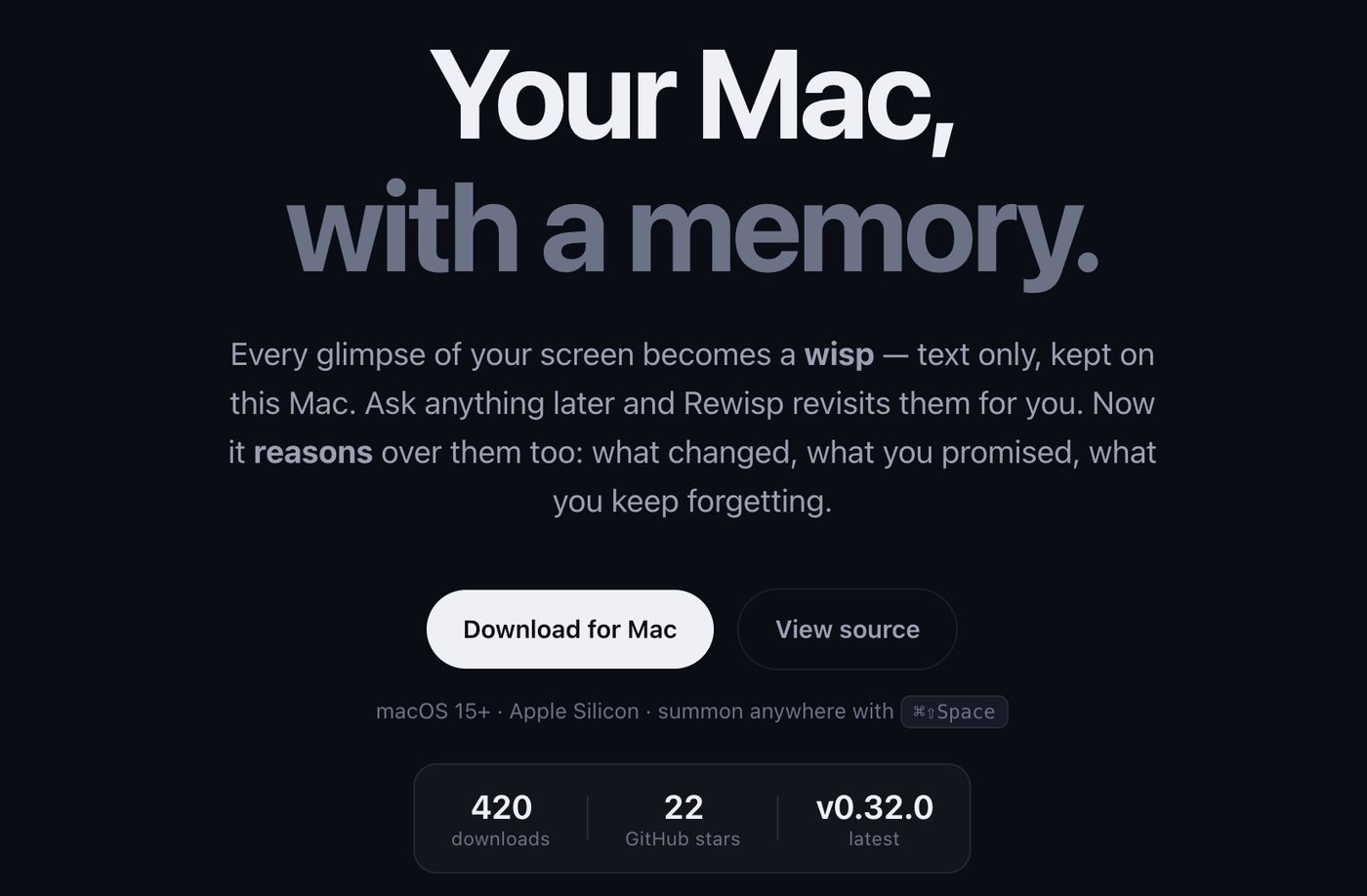
Yashmit Bhaverisetti kept making small promises on screen, the “I’ll send it Friday” kind, and then forgetting them. The promise was right there in a chat or an email, and then it was gone. Rewisp is the fix: a free, open-source macOS menu bar app that reads the text on your screen with on-device OCR, keeps it in a local database, and answers questions about what you saw.
Bhaverisetti builds it solo. Rewisp catches the promises you make, shows what changed on a page you saw before, and lets Claude Desktop and Cursor look things up in your screen memory through read-only MCP tools. It launched in July 2026 at version 0.9 and now has more than 400 users. We spoke about why text beats screenshots, admitting an unencrypted database in public, the strangers who helped design the fix, and everything Rewisp deliberately leaves out.
Key takeaways
- Rewisp is a free, open-source macOS menu bar app that reads on-screen text with on-device OCR, keeps it in a local database and answers questions about what you saw. Screenshots are never saved.
- Its promise catcher spots lines like “I’ll send it Friday” and turns them into reminders, and it can show how a page changed since you last saw it.
- Claude Desktop and Cursor can query it through read-only MCP tools: they can look at your memory but never change or delete it.
- It launched in July 2026 and has more than 400 users. Privacy questions dominated the launch, and admitting the database was not yet encrypted earned more respect than any feature.
The product
Startup.talk:Why the name Rewisp?
Bhaverisetti:A wisp is a small, faint trace of something. That’s what most of what we read is. We see it for a second and it fades. Rewisp brings that trace back.
Startup.talk:Why capture on-screen text instead of screenshots?
Bhaverisetti:Text is what people actually want back. You remember a number, a name, or a line. You don’t remember pixels. Text is small, so I can keep months of it on a normal Mac. It’s also easy to search and easy for an AI to read. Screenshots eat disk space and are harder to search.
Startup.talk:Why catch promises like “I will send it Friday”?
Bhaverisetti:I kept saying things like that and then forgetting. The promise was right there on my screen, in a chat or an email. Then it was gone. Rewisp spots those lines and lists them for you. It’s a to-do list that writes itself from what you already said.
Startup.talk:Why diff a page to show what changed?
Bhaverisetti:Pages change quietly. A price goes up. A due date moves. A doc gets edited. You’d never notice. Since Rewisp already saw the old version, it can show you exactly what’s different. You don’t have to remember what it said before.
Startup.talk:Why expose read-only MCP tools to other AI apps?
Bhaverisetti:People already live in Claude Desktop and Cursor. I didn’t want to build another chat box. With MCP, those apps can ask Rewisp things like “what was I looking at this morning?” It’s read-only on purpose. Other apps can look at your memory. They can never change or delete it.
Startup.talk:Why make it free and open source?
Bhaverisetti:A tool that sees your whole screen needs trust. The best way to earn that is to let anyone read the code. You don’t have to take my word that nothing leaves your Mac. You can check. Free also means more people try it, and I learn faster from them.
“A tool that sees your whole screen needs trust.”Yashmit Bhaverisetti
Startup.talk:What do you deliberately leave out of Rewisp?
Bhaverisetti:No cloud sync. No accounts. No audio recording. No video timeline. No tracking. Each one would make the app bigger and less private. I’d rather do one thing well: remember the text you saw, and let you ask about it.
Positioning
Startup.talk:Who is Rewisp for, and what job does it do for them? Describe the person who gets the most value.
Bhaverisetti:People who read a lot on their Mac and lose things. Students, engineers, researchers, anyone juggling many tabs. The person who gets the most out of it reads all day across email, docs, Slack, and the web. They often think “I saw that somewhere.” Rewisp’s job is to answer “where?”
Startup.talk:How do you view your positioning relative to Rewind-style memory apps and Reflect? Is there another competitor you think of first?
Bhaverisetti:Rewind proved people want this. But it moved to the cloud, then to a pendant. Then Meta bought the company and shut the Mac app down. Lots of users lost a tool they relied on. That’s the risk with a closed app. Rewisp is local and open source, so it can’t be taken away like that. Reflect is a great notes app, but you have to write the notes. Rewisp works with zero effort. The one I think about most is Screenpipe. It’s also open source. It does more, like audio and other platforms. Rewisp is smaller and Mac-only, and it focuses on recall, promises, and changes.
Startup.talk:What is your core moat when memory features keep landing inside the operating system?
Bhaverisetti:Honestly, the moat is trust and focus. An OS feature has to work for everyone, so it stays general. It also ties you to one company’s AI. Rewisp works with whatever AI you like through MCP. And it’s open source, so you can see what it does and change it. I’d also rather move fast as one person than wait for a yearly OS update.
Startup.talk:What are some of the use cases for Rewisp that are not obvious and can add a lot of value to users? List as many as possible.
Bhaverisetti:Finding a number you saw once: a price, an order number, a confirmation code
Getting back a tab or article you closed weeks ago
Remembering what someone said in a chat when you can’t recall which app
Writing a daily standup from what you actually worked on
Tracking promises you made to friends, teammates, or professors
Seeing how a job post, price, or policy page changed
Letting Cursor know which docs and errors you looked at while coding
Rebuilding your notes after a lecture or meeting you only half followed
Answering “when did I first see this?” for research
Catching a deadline that was only mentioned in passing
Startup.talk:What is the one detail in Rewisp you are proudest of?
Bhaverisetti:The promise catcher. It’s a small feature, but it’s the one that makes people say “oh, that’s useful.” It turns something you said without thinking into a reminder you didn’t have to set.
Launch
Startup.talk:What did you learn from your launch?
Bhaverisetti:I learned that people care about privacy first. Almost every serious question was about it. Is the data local? Is the file encrypted? What happens if my Mac gets stolen? Features got people interested. Privacy decided if they would trust it.
I also learned to be honest about gaps. Someone asked if the database was encrypted. At the time it wasn’t. I said so plainly. That reply got more respect than any feature. One person even thanked me for admitting it. Then they helped me think through how to fix it.
And I learned that a launch is a free design review. People asked smart questions about search speed, false reminders, and memory decay. Each one made me explain my choices. Some made me change them.
I ended up #5 of the day on July 19, 2026, with 167 upvotes. For a solo project at v0.9, I was really happy with that.
“That reply got more respect than any feature.”Yashmit Bhaverisetti
Startup.talk:Which feedback from the launch surprised you?
Bhaverisetti:How deep it got. I expected “cool app” comments. Instead people asked about SQLite, FTS5, and key storage. One commenter and I went back and forth on how to encrypt the database without breaking search. They even suggested a design where the capture process can write but never read back. I didn’t expect that level of help from strangers.
I was also surprised by what people liked most. I thought search would be the hook. But the promise catcher came up again and again. People said small promises like “I’ll send it Friday” matter more than the tasks they write down. That changed how I think about what Rewisp is for.
The hard part
Startup.talk:How many people use Rewisp today?
Bhaverisetti:400+
Startup.talk:What is a challenging time you had building Rewisp?
Bhaverisetti:The hardest part was encryption. At launch, the database was a plain SQLite file. FileVault protected it, but any process running as you could read it. People on Product Hunt asked about it right away. I had to admit the gap in public.
Startup.talk:Who believed in you before there was anything to show? What did they say or do?
Bhaverisetti:Myself
Startup.talk:How do you keep a local memory of everything on screen safe?
Bhaverisetti:I start by saving less. You can’t leak what you never captured.
Screenshots are never saved. Rewisp pulls out the text and throws the image away right away.
Messages, password managers, banking sites, and incognito windows pause capture fully.
Text that looks like a password or credential is refused.
You can add any app or site to the block list.
You can pause with a shortcut, or “nuke” the last 10 minutes.
Old text expires after about six months.
“You can’t leak what you never captured.”Yashmit Bhaverisetti
This interview was conducted in writing and has been edited lightly for length and clarity.
About Rewisp
Rewisp is a free, open-source macOS menu bar app built by Yashmit Bhaverisetti. It reads the text on your screen with on-device OCR, keeps it in a local database, answers questions about what you saw, catches promises you made, shows how pages changed, and exposes read-only MCP tools to Claude Desktop and Cursor. Screenshots are never saved and nothing leaves your Mac. yashmitb.github.io/Rewisp
| Attribute | Verified Detail |
|---|---|
| Company | Rewisp |
| Founder(s) | Yashmit Bhaverisetti |
| Country | USA |
| Built | Solo |
| Launched | July 2026 |
| Platform | macOS 15+, Apple Silicon |
| Pricing | Free and open source |
| Users | 400+ |
More founder interviews
 TruTalk
 ScaScan
 VoCalm
 Dots
For founders
Building something? Want to share your journey?
Tell us how it started, what nearly broke it and where it is headed. We will turn it into a story like this one.
Share your journeyFor readers
Want to read more human stories behind the startups?
New founder interviews and stories, as they are published.
Follow us on LinkedIn