
MD Samiul Basir’s first job was an HR internship at Asian Apparels, watching people read applications and forms one by one while useful information got lost. Years later, after delivering seven products for clients with co-founder Shaik Arshad Rahman through their agency, Markup-Media, that problem became Formzed.
Formzed is built on one idea: collecting answers is easy, understanding them is not. Teams build forms from a text prompt, run AI interviews by voice or text in 20 languages, and ask Medusa, Formzed’s AI analyst, plain-language questions across up to 10,000 responses and uploaded CVs, with exact counts that link back to the answers behind them. The first version reached 2,175 sign-ups and 4,875 forms in four months, and Formzed is part of the Claude Startups Program and NVIDIA Inception and an ElevenLabs Startup Grant recipient.
Key takeaways
- Reading 5,000 responses at 30 seconds each takes about 42 hours and still misses patterns; Formzed reads every answer in minutes.
- Every number Medusa gives links back to the exact responses, so nothing in a summary has to be taken on trust.
- Forms are only the start: responses can trigger 60+ integrations and 120+ automation templates.
- Formzed sits between form builders like Typeform and AI research platforms like Outset and Conveo, at a price small teams can afford.
- The team publishes its AI benchmarks, including one on keyword stuffing and hidden text in CV screening.
Before any of this
Startup.talk:What first got you into building things?
Samiul:I’ve been a full-stack developer for three years now. Arshad and I built software together through our agency, Markup-Media, and delivered seven products for clients before Formzed. That taught me more about shipping than anything else. I also like writing up what I build and test. I’ve published two preprints: “CodePilot: A Multi-Agent Agentic Coding Assistant with Hierarchical Orchestration, Adaptive Execution Modes, and Zero-Cost LLM Access” (March 2026), and “Keyword Stuffing and Hidden Text in CV Screening”, a benchmark of AI CV matching against keyword search in an open-source applicant tracking system (November 2026).
Startup.talk:What was your first job, and what did it teach you?
Samiul:My first job was an HR internship at Asian Apparels. I saw how much time went into reading applications and forms one by one, and how much useful information got lost because nobody had time to read it properly. That problem stayed with me.
The road to Formzed
Startup.talk:What made you start Formzed?
Samiul:Collecting answers has become easy. Understanding them hasn’t. Teams send a form, get thousands of responses, applications or CVs, and then someone reads them by hand, often for days. I wanted a tool where the answers are understood the moment they arrive, not weeks later.
“Collecting answers has become easy. Understanding them hasn’t.”MD Samiul Basir
Startup.talk:What frustrated you about traditional form builders?
Samiul:They stop at collection. You get a spreadsheet and you’re on your own. If you want to know why people answered the way they did, you need a separate research tool, a separate analysis tool and a lot of copying between them.
Startup.talk:How did the idea of an AI agent that reads every submission come about?
Samiul:From watching people read CVs and survey answers one at a time. A person reading 5,000 responses at 30 seconds each spends about 42 hours and still misses patterns. An AI that reads every answer, counts exactly and points back to the responses it used does that job in minutes, and you can check it.
“A person reading 5,000 responses at 30 seconds each spends about 42 hours and still misses patterns.”MD Samiul Basir
Startup.talk:How do you and your co-founder Shaik Arshad Rahman split the work?
Samiul:We’re both technical, and we’ve each been full-stack developers for three years, so we both write code. Arshad built the first version of Formzed. I built the second version, the one people use today, with AI interviews, Medusa, the API and the MCP server. I lead the architecture and system design, along with strategy, sales, fundraising and partnerships. Arshad leads infrastructure and keeps the product stable, finding and fixing bugs. We’d already built seven products together through Markup-Media, so we knew how each other works before we started.

The product
Startup.talk:Why the name Formzed?
Samiul:It’s form + zepto, the metric prefix for 10⁻²¹. A zeptosecond is about as short as time gets, and that’s how fast we wanted answers to be read and understood once they come in.
Startup.talk:How does building a form from a text prompt work in practice?
Samiul:You describe what you need, like “a feedback form for our design workshop with a rating, pace and what to improve”, and Formzed writes the questions, picks the right question types and adds logic. You can edit everything afterwards, or keep changing it by chatting.
Startup.talk:How does an AI customer interview work, and why not just send a survey?
Samiul:A survey tells you what people chose. An interview tells you why, but interviews are slow: one researcher can do a handful a day, and then the transcripts still need coding. With Formzed you write a short guide, share a link, and the AI interviews everyone at once, by voice or text, in 20 languages. It asks a follow-up when an answer is vague, the way a good researcher would. When the interviews are done, you get themes with exact counts and the quotes behind each one, and you can ask the whole study questions in plain language. A study that used to take weeks of calls and coding can be done in a few days.
Startup.talk:What can Medusa AI tell a user about their submissions that they would miss?
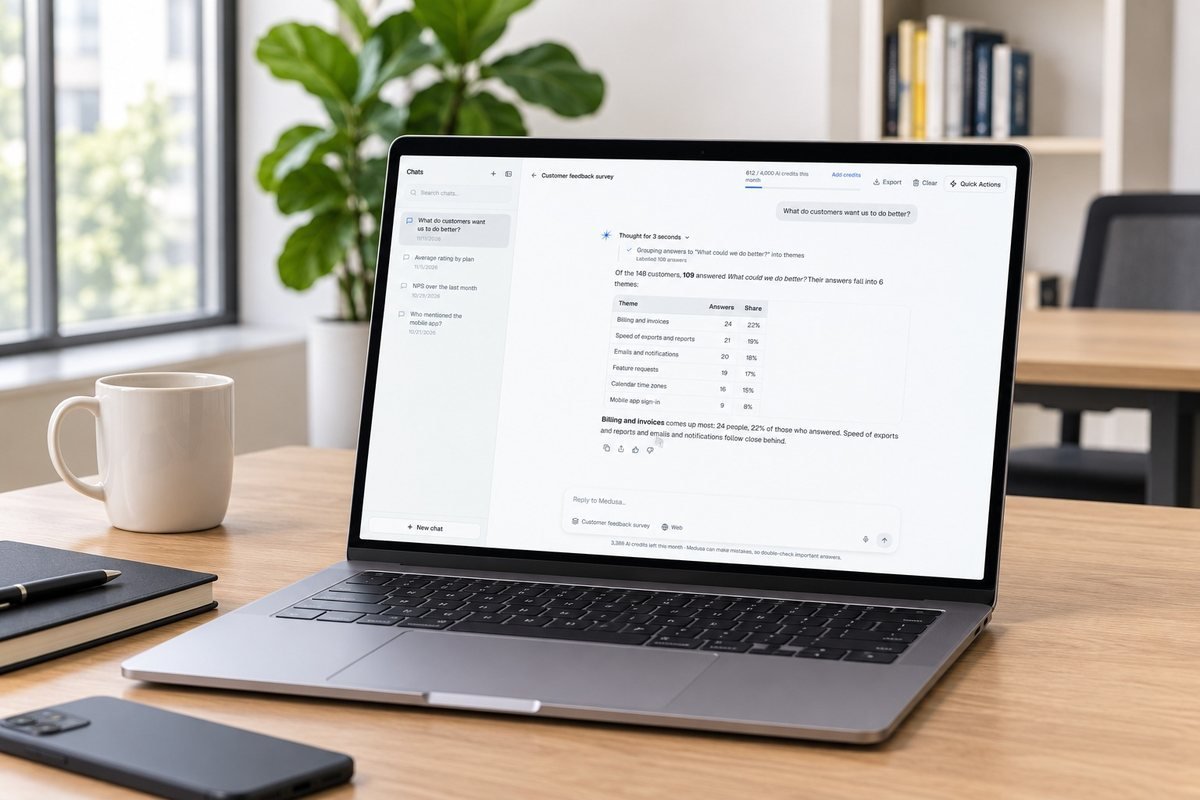
Samiul:The things that hide in free text. Medusa answers plain-language questions across up to 10,000 responses, like “which candidates studied at MIT and have the most experience?” or “what do customers who left mention most?”, with exact counts and charts that point back to the responses. It also reads uploaded CVs and documents, so a fact buried on page two of a CV still shows up.
Startup.talk:What does it mean to turn a form into a workflow engine?
Samiul:A response shouldn’t just sit in a table. In Formzed it can start the next step: post to Slack, add a row to a sheet, update a CRM, email someone, or run an AI step that sorts or summarises it. There are 60+ integrations and 120+ automation templates, and the form, the analysis and the follow-up live in one place.
Startup.talk:What is Formzed's Simulation, and how is it different from real interviews?
Samiul:Simulation does two jobs. Before a study goes live, a Test run sends simulated respondents through your interview guide, so you can see where questions confuse people or lead them before a single real participant sees it. After you’ve run real interviews, Simulate builds personas from those participants, and you can ask them new questions, like “which of these three pricing pages would you pick?” Every simulated answer cites the real interview quotes it’s based on. Simulated results are always marked as simulated and kept apart from real data, so they never end up in your counts.
Startup.talk:Which teams use Formzed the most?
Samiul:Research and marketing agencies, staffing and recruitment firms, and education providers. Agencies use the AI interviews to talk to many people at once; recruiters use application forms and CV search; education teams use forms, quizzes and AI interviews for student practice.
Startup.talk:What do you deliberately leave out of Formzed?
Samiul:We don’t do product tours or pop-ups that interrupt people. We don’t add an AI feature unless its numbers can be checked: if Medusa says 24 people mentioned billing, you can click and see those 24 answers.
Positioning
Startup.talk:Who is Formzed for, and what job does it do for them? Describe the person who gets the most value.
Samiul:The person who has to turn a pile of answers into a decision: a researcher at an agency with 40 interviews due next week, a recruiter with 2,000 applications, a programme manager with a feedback survey nobody has time to read. Formzed collects the answers, asks the follow-up “why” with AI interviews, and gives them findings they can check.
Startup.talk:How do you view your positioning relative to Typeform, Tally, Google Forms, Jotform and Fillout? Is there another competitor you think of first?
Samiul:They’re good at collecting answers, and we respect them. We focus on what happens after: AI interviews, reading every response and CV, and automating the next step. The tools we think about most are AI research platforms like Outset and Conveo. Formzed sits between the two: forms and AI research in one workspace, self-serve, at a price agencies and small teams can afford.
Startup.talk:What is your core moat in AI-powered forms?
Samiul:Accuracy you can check. We test our AI publicly: in our AI research benchmark, Medusa found all 12 hidden themes in 100 interviews with exact counts, and we’ve published benchmarks on CV matching, fairness and resistance to hidden prompt injection in CVs. One of them, on keyword stuffing and hidden text in CVs, is also out as a preprint. Combined with having forms, interviews and analysis in one product, that’s hard to copy quickly.
Startup.talk:What are some of the use cases for Formzed that are not obvious and can add a lot of value to users? List as many as possible.
Samiul:1. Viva and interview practice for students: an AI interviewer asks questions and staff see where each student struggles
2. Mock job interviews for career centres
3. Following up a survey with an AI interview that asks people why they answered as they did
4. Reading every CV in an application round and asking “who has X and Y?”
5. Event feedback that turns into a theme report the same day
6. Customer churn interviews at scale, in 20 languages
7. Pricing research with conjoint plus the reasons behind each choice
8. Employee and volunteer onboarding forms that create tasks automatically
9. Coaching centres and schools running quizzes and exams
10. Lab studies: participant ID in the link, short AI debrief interview after the experiment
11. Grant or programme applications with file uploads and AI summaries for reviewers
12. Simulated respondents to test a survey before sending it
Startup.talk:What is the one detail in Formzed you are proudest of?
Samiul:That every number Medusa gives you links back to the exact answers behind it. Nothing in a summary has to be taken on trust.
“Nothing in a summary has to be taken on trust.”MD Samiul Basir
The hard part
Startup.talk:How many people use Formzed today?
Samiul:Our first version had 2,175 sign-ups and 4,875 forms in its first four months, and we have paying customers across agencies and education providers.
Startup.talk:What is a challenging time you had building Formzed?
Samiul:For us, making AI counts exact was one of the hardest parts: a summary that says “about 20 people” isn’t good enough for research, so we rebuilt how Medusa counts until it matched the data exactly.
Startup.talk:How do you compete with free form builders?
Samiul:We have a free plan too, so people can start the same way. Where we win is time: if Formzed saves a team hours of reading, coding or follow-up calls every week, the paid plan pays for itself. A coaching centre we work with said work that took 2 hours now takes 2 minutes.
What it is all for
Startup.talk:What would make you say Formzed has succeeded?
Samiul:When teams stop treating open-ended answers as too much work to read, because every answer gets read, counted and turned into a decision.
Startup.talk:Will people still fill in forms when AI agents can talk to each other directly?
Samiul:Forms will change, but the need behind them won’t: someone needs structured, honest information from someone else. More of it will become a conversation, which is why we built AI interviews, and more of it will be read by AI. Formzed already works with AI agents through our MCP server, so an agent can create a form or read results directly.
The road ahead
Startup.talk:What are your milestones for the next 12 months, in users and revenue?
Samiul:Grow from our first paying customers to hundreds of paying teams, with a focus on research agencies, recruitment firms and universities in the US.
Startup.talk:Where do you want Formzed to be in five years?
Samiul:The place where any team asks people questions and gets answers they can trust, whether the person answering types, speaks, or is represented by their own AI agent.
Startup.talk:What are your hopes and fears for a post AGI world?
Samiul:My hope is that understanding people gets cheaper, so more decisions are based on what people actually said. My fear is the opposite: confident AI summaries that nobody checks. That’s why we build everything so it can be checked.
“My fear is the opposite: confident AI summaries that nobody checks.”MD Samiul Basir
This interview was conducted in writing and has been edited lightly for length and clarity.
About Formzed
Formzed, co-founded by MD Samiul Basir and Shaik Arshad Rahman, is a platform for forms and AI interviews that reads every answer and turns responses into decisions, with exact counts that link back to the responses behind them.
| Attribute | Verified Detail |
|---|---|
| Company | Formzed |
| Founder(s) | MD Samiul Basir and Shaik Arshad Rahman |
| Country | USA |
| Leads | Architecture, strategy, sales |
| Company | Formzed Corporation, Delaware |
| Leads | Infrastructure and stability |
| Official Website | formzed.com |
| Interview Published | 2026-11-26 |
More Startups in Spotlight
For founders
Building something? Want to share your journey?
Tell us how it started, what nearly broke it and where it is headed. We will turn it into a story like this one.
Share your journeyFor readers
Want to read more human stories behind the startups?
New founder interviews and stories, as they are published.
Follow us on LinkedIn