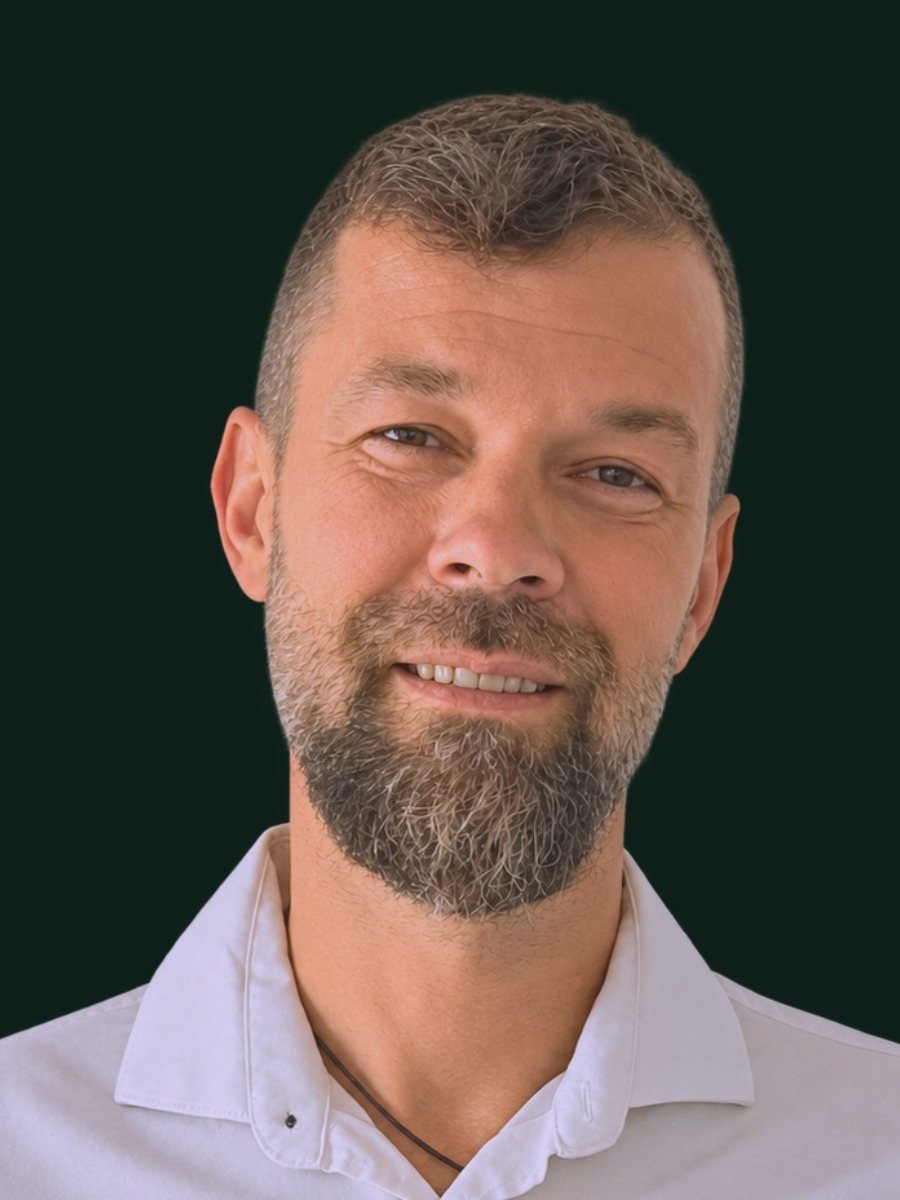
Christoph Karl Knoll grew up in Wriezen, a small East German town 10 km from the Polish border, in the years right after the wall came down. Sixteen years in corporate roles across four countries followed, from Director of Graphic Design at a German cosmetics brand to Account Manager for the DACH market at Criteo. So did two burnouts: one in 2012, and one in 2018 that ended on a bathroom floor.
Lead Yourself First, launched in 2024 and based in Barcelona, is what Knoll built from rewriting those defaults: mental fitness coaching for leaders, founders and high performers, built on neuroscience, Cognitive Behavioural Coaching and NLP, and organised around one sequence: See, Interrupt, Rebuild. It runs 1:1 coaching and an 8-session Mental Fitness System, workshops for teams at companies such as Criteo and Boomi, the RepFit behavioural rehearsal app, the free Signal-Hub library and The Human Layer newsletter.
Key takeaways
- The work targets the pattern layer: the automatic behaviour that fires before thought gets a vote, below therapy, executive coaching and apps such as Headspace and BetterUp.
- The method has a strict rule for what gets left out: if it needs belief to work, if the client can’t rehearse it alone, or if it talks about “energy”, it goes.
- Three sessions in, most clients can run See, Interrupt, Rebuild on themselves. The practice is designed to make the coach unnecessary.
- The loudest burnout signal in founders is one sentence repeated: “once this round closes, then I’ll rest”.
- Summer 2026 showed that nobody outgrows their defaults: building RepFit crowded out selling until Knoll ring-fenced sales time as infrastructure.
Before any of this
Startup.talk:Where did you grow up, and what was it like growing up in East Germany?
Knoll:I grew up in Wriezen, a small town of about 7,000 people, 10 km from the Polish border. In the 90s, right after the wall came down, it was a remarkable place to be a kid. The whole region was in transition. It felt like there were no real rules, so we got to explore the world as it actually is, not as someone decided it should be. That window closed with time, of course, but getting my first colour TV and tasting my first banana in 1993 or 1994 was a good start.
Looking back, I think growing up there was the best thing that could have happened to me. We were raised in equality. Men and women worked side by side, same rights, same laws, same expectations. Not everything about socialism was bad. The parts that worked are things most of the world is still trying to figure out today.
Probably a good place to grow old too, though I haven't tested that yet. For everything in between, there are better places.
Startup.talk:What first got you interested in how people think and perform?
Knoll:It started in my last two corporate jobs, when I took on the mentor and buddy role for new hires and interns. I had always enjoyed analysing myself, which was useful but limited. Helping someone else see themselves was a different kind of work. It made a bigger difference, and it was more interesting to me. That shift from working on my own head to working on someone else's was the thing that pulled me in.
Startup.talk:What did 16 years in corporate roles teach you about high performers?
Knoll:The biggest lesson was adaptation. The highest performers I worked with were the ones who adapted fastest when the context around them changed. Performance stays capped for the rest of us when we don't.
The road to Lead Yourself First
Startup.talk:What happened in 2012 and 2018, and how did those two burnouts lead to Lead Yourself First?
Knoll:In 2012 I was Director of Graphic Design at a German cosmetics brand. Fourteen to sixteen hour days. More nights in hotels than in my own bed. Barely saw my partner or my dog.
One afternoon my CEO shouted at me for the fifth time in a week. This time over t-shirt printing prices someone on my team had presented. Fists clenched. The Marketing Director physically pulled me out of the office before anything happened.
I left the company soon after. Changed job. Didn't change the pattern.
The burnout found me anyway. I didn't see it coming.
2018 looked nothing like 2012 on the surface. New country, new industry, new title. Same loop underneath. Perform, adapt, push through, repeat.
One morning I collapsed on the bathroom floor.
That was the moment it stopped being about the next role. The problem wasn't the job. It was me running on defaults I'd never questioned.
I spent the next years rewriting them. Breathwork. Nervous system work. Looking at the patterns under the behaviour instead of chasing the behaviour itself.
Lead Yourself First came out of that. The thing I needed in 2012 and didn't have in 2018. A way to catch yourself before the floor catches you.
“A way to catch yourself before the floor catches you.”Christoph Karl Knoll
Startup.talk:When did you decide to turn what you learned about yourself into a practice for other people?
Knoll:Criteo was my last 9-to-5. Account Manager for the DACH market, buddy and mentor for EMEA. By then I already knew how to regulate myself under pressure. I was growing my portfolio by over 26% year on year and helping mentees get clearer on themselves and the opportunities around them.
At some point it clicked. If this works inside a performance machine like Criteo, it works outside it too.
Startup.talk:Why build the practice in Barcelona?
Knoll:I've called Barcelona home for over 8 years. 300 days of sun, a big expat scene, loads of companies, and plenty of pressure running from those companies down to the people inside them.
That last bit is why the practice lives here. The city looks relaxed on the surface. The people I work with are carrying the same weight they'd carry anywhere else, often more, because they also had to rebuild a life in a new country.
Startup.talk:How has the practice grown, from 1:1 coaching to workshops for teams at companies such as Boomi and Criteo?
Knoll:Slowly, honestly. 1:1 coaching came first. Sales reps, account managers, customer support managers, a founder here and there. All carrying their own performance pressure.
The workshops started inside Criteo in late 2025. The first one ever was with my own team, on breathing. The second was online with about 35 people, on mental energy going into peak season. Both internal, both a test.
From there it opened up. A July keynote at the Mindful Mentors Club on "Why Time Management is a Waste of Time". A workshop for Boomi's Barcelona sales team called "Rise and Fall by Your Defaults". A workshop for the Barcelona Entrepreneurs community on "The Founder is the Bottleneck". A master class at ESEI Business School. Somewhere in between, a spot in Favikon's top Corporate L&D ranking in Spain.
The Boomi one also became a productised online version, built as a lead magnet for sales teams.
The 1:1 work is still the spine. The workshops are where the pattern gets taught at scale. Both feed each other.
The approach
Startup.talk:Why the name Lead Yourself First?
Knoll:Because that's the lesson I had to learn twice before it stuck.
You can lead a team, a region, a company. None of it holds if you can't lead the patterns running underneath your own behaviour. Those patterns were set up a long time ago, usually to protect you, usually in a situation that isn't your life anymore. Left alone, they run the show.
Lead Yourself First is the order of operations. See your defaults. Interrupt them. Rebuild better ones. Then whatever you're leading on the outside has a chance.
Startup.talk:How does See, Interrupt, Rebuild work in practice for a client?
Knoll:Take a common one for sales people. A tough email lands from a client. Body tenses. They fire back a defensive reply within 60 seconds. The relationship takes a small hit. Next tough email, same loop.
See. We map it together. When it fires. What triggers it. What the body does before the fingers move. Most clients have never looked at this before. The pattern lives below the thinking brain, so the thinking brain doesn't know it exists. Naming it is often half the work.
Interrupt. We engineer a specific if-then trigger. When a tough email lands and the body tenses, the rule kicks in. Don't reply yet. Stand up. Two slow exhales. Water. The rule works when the prefrontal cortex is offline, because it doesn't ask the client to be mindful. It asks them to do a thing.
Rebuild. We install the better default. A new sequence the client rehearses enough times that it becomes the automatic one. When the body spikes now, the breath comes before the reply. They stop paying what I call the Default Tax.
Three sessions in, most clients can run the loop on themselves without me in the room. That's the whole point.
Startup.talk:Why neuroscience, Cognitive Behavioural Coaching and NLP, and what is your rule for leaving a method out?
Knoll:Each one does a specific job.
Neuroscience tells me why the pattern exists and what it takes for a new one to beat it. How the brain lays down new paths through repetition. The fact that the prefrontal cortex goes offline when the body perceives threat. Without that, we're guessing why the client keeps falling into the same hole after agreeing not to.
Cognitive Behavioural Coaching gives me the structure to work with the thoughts around the pattern. What the client is telling themselves before, during and after. Where the interpretation is distorted and what a cleaner read would look like.
NLP gives me the state-level tools. Language precision, anchoring a new felt state to a cue, breaking the old loop in real time. It gets a bad rep because a lot of people oversell it as magic. Handled honestly, it moves state in ways nothing else does.
The rule for leaving a method out is simple. If it needs belief to work, it's out. If the client can't rehearse it without me in the room, it's out. If it talks about "energy", "drains" or "frequencies", it's out.
What stays is what still works on a Monday morning when nobody is watching.
“What stays is what still works on a Monday morning when nobody is watching.”Christoph Karl Knoll
Startup.talk:What is RepFit, and why build behavioural rehearsal as a product?
Knoll:RepFit is a behavioural rehearsal app. Think of it as the daily operating layer under the coaching work. Between weekly 1:1 sessions, clients use it to rehearse the behaviour the situation actually asks for, before the situation arrives.
I built it because rehearsal is the gap most behaviour change falls into. We've built an entire industry around clarity. Insight, awareness, root cause, framework. All useful, none of it survives the moment where behaviour has to show up. Under pressure, the body runs the old default, and the insight watches from the sidelines.
Rehearsal is what closes that gap. Pilots fly simulators. Surgeons run drills. Sales teams practice pitches. Founders get told to "trust the process" and then wonder why the same pattern keeps showing up.
RepFit gives that rehearsal structure a product shape. It sits under Lead Yourself First alongside the newsletter and the Signal Hub, as a product rather than a separate venture.
Startup.talk:Why give away the Signal-Hub library for free?
Knoll:Because the people I want to work with don't search for "mental fitness coach". They search for "why do I snap at my partner" at 11pm. The Signal Hub meets them there, names the pattern under the symptom, and gives them a way in that doesn't cost anything. The ones who want to go deeper, do.
Startup.talk:What do you deliberately leave out of Lead Yourself First?
Knoll:Mysticism. "Energy" language. Personality types used as destiny. Motivational quotes without a mechanism. Anything that asks the client to believe in order to benefit.
I also leave out diagnosis. I'm not a therapist and the work doesn't need me to be. If something crosses that line, I refer out.
What's left is what's provable in the client's own week, under pressure, with no one watching.
Positioning
Startup.talk:Who is Lead Yourself First for, and what does it do for them? Describe the person who gets the most value.
Knoll:The person who gets the most value is already performing at a high level. They've got the skills, the track record, the discipline. On paper, nothing is broken.
Underneath, the same patterns keep showing up. Snapping at the person they love most after a hard day. Freezing before the call that matters. Saying yes when the body said no. Working through the moment the body needed rest. Promising themselves "never again" and finding themselves there again two weeks later.
They've read the books. They've tried the apps. They know what they "should" do. The old default is still faster than the new one when the pressure lands.
That's who Lead Yourself First is for. Sales people, account managers, team leads, founders, executives. Anyone high-performing enough to be in their own way.
Startup.talk:How do you see your work relative to therapy, executive coaching and apps such as Headspace or BetterUp?
Knoll:Different layers of the stack. All useful, each solves something different.
Therapy goes into the why. Why the pattern formed, what happened, what needs processing. It's clinical work for issues that need clinical care. I'm not a therapist and I don't try to be. When something belongs there, I refer out.
Executive coaching mostly lives at the strategy and decision layer. What should the leader do, prioritise, say, delegate. It's a cognitive conversation about outcomes. Useful when the leader can execute what they decide. Thin when they can't, because the same default blocks the same decision from showing up in the room.
Apps like Headspace and BetterUp sit at the awareness and content layer. Headspace gives you ten minutes of calm. BetterUp gives you a coach on a schedule. Both help a lot of people. Both tend to stop at insight.
Lead Yourself First works a layer underneath all three. The pattern layer. The automatic behaviour that fires before thought gets a vote. The reason someone can know, decide, meditate, and still do the same thing on Monday.
That's the gap I work in. It fits between the other three.
Startup.talk:What makes your approach hard to copy?
Knoll:The individual parts can be copied. Anyone can get the certifications. Anyone can learn See, Interrupt, Rebuild. Anyone can build a rehearsal app.
The combination is harder. Neuroscience for the why, CBC for the thinking layer, NLP for the state layer, breathwork for the body layer, rehearsal for the Monday morning. Each one chosen for a specific job, each one load-bearing, nothing decorative.
The lineage is harder still. 16 years inside corporate performance environments across four countries. Two burnouts I lived through, not read about. Rebuilt my own defaults before offering to help anyone rebuild theirs. It shows up in the questions I ask and the ones I know not to.
What's hardest to copy is the rule for what gets left out. Most of this industry adds. Energy language, personality types, motivational scaffolding, more frameworks. I subtract. If a method needs belief to work, it goes. If a client can't run it without me, it goes. That discipline is unglamorous, and nobody arrives at it without getting burned by the opposite first.
Copy any one piece. The thing works because of how the pieces hold each other up.
Startup.talk:What are some of the use cases for Lead Yourself First that are not obvious and can add a lot of value to users? List as many as possible.
Knoll:A short list, each a real case I've worked on.
• Promotions and role transitions. Old defaults from the previous job keep running in the new one. The classic "operator stuck in operator mode after becoming CEO."
• Returning from parental leave. Body paced for one life, calendar paced for another. The old pace fires before the new one can.
• Post-exit or post-sale identity gap. The thing that organised your defaults for a decade is gone. Without rebuilding, the defaults don't retire. They just redirect at whatever's in front of you.
• Relocating countries. Defaults were built for one culture. In the new one, the same behaviour reads differently and hits different walls.
• Managing a direct report who personally triggers you. Their behaviour hits one of your old defaults. Most leadership training works on them. We work on you.
• Pricing and salary conversations. The flinch happens before the number does. No negotiation technique survives a nervous system that already decided.
• Taking proper time off. The "always-on" default is usually the one people defend hardest, right up to the collapse.
• Receiving hard feedback. Collapse, defend, perform fine. Most people have one of the three on autopilot.
• Giving hard feedback. Softening it into uselessness is the same default wearing a nicer coat.
• Hard family conversations. Rehearse the behaviour you want to walk in with. The script goes out of the window the moment the room gets hot.
• "Productive procrastination". Busy work that functions as avoidance. Looks productive, pays the Default Tax.
• Reintegrating after burnout. The body remembers. The ambition hasn't caught up. Without a rewrite, the second burnout is already waiting.
• The hollow after hitting a goal. When the thing that was supposed to fix it, didn't. That's a pattern question. Motivation isn't what's missing.
• Founder-led sales calls. Over-giving, discounting, saying yes to things that bleed the business. The commercial version of the people-pleaser default.
Startup.talk:What is the one detail in your work you are proudest of?
Knoll:That clients can run the loop on themselves without me in the room.
I'm proudest of the fact that the practice is designed to make me unnecessary. Three sessions in, most clients can spot their own default, interrupt it on their own trigger, and rebuild the better one without a session booked.
I built it that way on purpose. So they can walk away from me. So they can catch themselves at the edge of the pattern before the floor catches them, the way I wish someone had taught me to do in 2012.
If the work does its job, they don't need me anymore. That's the measure.
Founders under pressure
Startup.talk:Why do founders burn out, and what are the first signals you notice?
Knoll:Founders burn out because the engine that built the company is the one that eats them. The exact set of defaults that gets you through year one stops scaling around year two or three. Hyper-responsiveness. Always-on. Decide-now-fix-later. Carry everything personally. The business changes. The founder's nervous system doesn't. So the same effort produces less return, and the fix the founder reaches for is more of the same effort.
Three layers underneath that:
Identity merge. The founder stops being able to tell where they end and the company starts. Every bad week becomes a personal verdict.
No system around them. No manager asking how they are. No HR calendar. No one checking whether they slept. The first person who notices the drop is usually the partner, and by then it's weeks in.
Recovery coded as weakness. The same culture that praises grinding also quietly penalises visible rest. Most founders push through the first body signal because stopping feels like admitting something.
The first signals I notice:
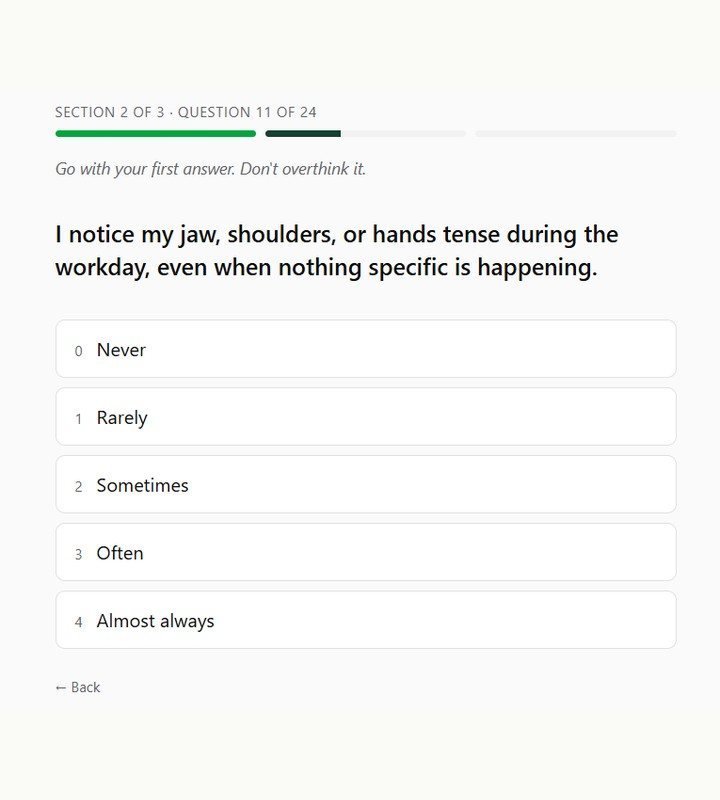
Sleep goes first. The hours stay. The depth doesn't. Falling asleep fine, waking at 3 or 4, mind racing. Or needing a drink to come down.
Jaw and chest. Clenched jaw on waking. Breath sitting high in the chest instead of low in the belly.
Snapping at the person they love most. The nervous system is maxed out, so the smallest demand at home becomes the one that sets it off.
"Productive procrastination". Rearranging the Notion workspace instead of making the call that actually moves the business.
Hearing themselves say "once this round closes, then I'll rest". That sentence, repeated, is the single loudest signal. The thing they're waiting for always arrives. The rest never does.
If one of those is live, it's early. If three or more are live at once, the body has already started the countdown. Catching it there is cheap. Catching it at the floor is expensive.
Startup.talk:What do you mean when you say the founder is the bottleneck?
Knoll:Two meanings sit inside that phrase.
The obvious one. Everything routes through the founder. Decisions, approvals, hiring, customer escalations, the website copy. Nothing ships without them. The team is shaped around waiting for them. That's the operational bottleneck, and most founders can see it when it's pointed out, even if it takes them a while to loosen their grip.
The one I work on is underneath that. The company's ceiling matches the founder's capacity to sit with what they'd rather avoid.
If the founder can't sit with ambiguity, the team gets micromanaged. If they can't take hard feedback, the team quietly stops giving it. If they flinch at money conversations, pricing stays below where it should be. If they need to be liked, the hard hires never get made.
Every unresolved pattern in the founder shows up as a cap on the company. The business grows up to the edge of what the founder can personally bear, and then stalls there. You can't hire your way past it. You can't process your way past it. The founder is the ceiling.
That's what I mean by the founder is the bottleneck. The operational version is the symptom. The pattern-level version is the cause.
“The company's ceiling matches the founder's capacity to sit with what they'd rather avoid.”Christoph Karl Knoll
The hard part
Startup.talk:How many clients and teams have you worked with so far?
Knoll:Over 30 one-to-one clients since launching Lead Yourself First in 2024. Sales reps, account managers, customer support leads, founders, managers and executives, and a few people in transition between all of those.
On the team and audience side, workshops and keynotes have landed at Criteo (both internal and a cross-market online session), Boomi, the Mindful Mentors Club, Barcelona Entrepreneurs and a master class at ESEI Business School. A few hundred people across those sessions combined.
I also created and ran Still Rooms this year, a breathwork event I held over four months. More than 60 people walked through that room with me.
The number I care about more is the one that doesn't fit in a line of copy. It's how many of those humans are now running the See, Interrupt, Rebuild loop on themselves without me in the room. That's where the work actually counts.
Startup.talk:What is a challenging time you had building the practice?
Knoll:Summer 2026. June through August. My attention went almost entirely into building RepFit. Design, product, app store, beta testers, the whole stack.
What I stopped doing was selling. Client outreach dropped. Discovery calls dropped. The 1:1 pipeline that funded the business dropped with them. Cashflow followed on a one-month lag, and by August it was uncomfortable.
The irony wasn't lost on me. I teach founders about the pattern underneath the obvious problem, and I ran straight into one of my own. The default looks like this. Something new and exciting lands, and the founder lets it override everything else. Classic operator move. The business I had built to catch exactly this kind of thing in other people did not catch it in me, because I wasn't looking.
What got me out of it was the same framework I use with clients. Saw the pattern in September. Interrupted it with hard ring-fenced blocks for sales, non-negotiable. Rebuilt the default by treating 1:1 outreach as infrastructure, something that runs whether or not the week is convenient. October was a different month.
The lesson stuck. Even inside a practice about defaults, you don't outgrow them. You just get faster at catching them.

Startup.talk:Who believed in you before there was anything to show? What did they say or do?
Knoll:The first believers weren't the people you'd expect. Two of my best friends, both of whom I'd quietly been helping through their own transitions long before any of this was a business.
Their words stuck. "More people need to speak with you and go through this transition." They said it early, when there was no website, no framework, no proof. They meant it.
The bigger help was less visible. The doors they opened. The names they dropped. The casual recommendation in a meeting I wasn't in. That's the kind of belief that moves a practice forward in the first year, when you don't yet have the social proof to earn introductions on your own.
I think about them often.
What it is all for
Startup.talk:What would make you say Lead Yourself First has succeeded?
Knoll:Success for me isn't a revenue number or a logo wall. Both of those matter for sustainability, and I pay attention to them. They aren't the measure.
I'll say Lead Yourself First has succeeded when three things are true.
One. Prevention has replaced recovery as the default conversation. When HR leaders, founders and sales leaders start treating pattern-level work the way they already treat fitness or sleep. Something you maintain upstream, before anyone breaks down.
Two. The vocabulary has escaped my practice. When a manager says to a report, "that looks like a default pattern, not a performance issue", without quoting me. When "rebuild the default" is something a leadership team says out loud in their own meetings.
Three. Fewer people have the Monday I had in 2012. And fewer people have the bathroom-floor moment I had in 2018. That one is harder to measure, but it's the one that keeps the lights on at my desk.
If some of that is true in ten years, and the practice runs without needing me at every point in it, I'll call it done.
Startup.talk:How should companies support their people while they roll out AI, when humans need to adapt as fast as the systems do?
Knoll:Most AI rollouts spend 95% of the budget on the tech and 5% on the humans. That ratio is wrong. The tool works on day one. The people take six to eighteen months to catch up, and the gap in between is where the rollout quietly fails.
What companies miss is that humans don't resist change. They resist loss. Loss of competence, loss of identity, loss of status, loss of the thing they were good at. When AI lands on a workflow someone has owned for a decade, the body hears a threat even if the memo says "efficiency gain". Until that threat response is addressed, no amount of training lands.
Here is what I'd ask companies to do.
Over-invest in the human layer before the tech lands. Run psychological safety work with the affected teams a quarter before the tool arrives. Give leaders a space to name what they're actually afraid of, which is almost never what they say in a meeting.
Separate adoption from performance evaluation for the first six months. If the stat on someone's screen is "AI usage rate", you've already put them in survival mode and watered down the thing the tool is supposed to do. Let them learn without a scoreboard.
Train pattern-level, not just tool-level. Tool training wears off in a month. Pattern-level work changes how someone shows up to the next tool, and the one after that. Given how fast AI is moving, the second kind of training ages better.
Make the trade-offs visible. If a role is being materially reshaped, say so. Vagueness protects no one. People can adapt to hard news. They can't adapt to a lie or a shrug.
Keep the ratio of automation to humanity. Automate the repetitive stuff. Protect the parts of the work that make people feel useful and in contact with other humans. Those are the parts that keep the business from hollowing out when the efficiency gains show up.
The companies that treat AI rollout as a human change project first, and a tech project second, are the ones whose teams come out of it more capable rather than more anxious. That's the real competitive edge over the next five years.
“Most AI rollouts spend 95% of the budget on the tech and 5% on the humans.”Christoph Karl Knoll
The road ahead
Startup.talk:What are your milestones for the next 12 to 18 months, in clients and revenue?
Knoll:Four milestones over the next 12 to 18 months.
Lead Yourself First coaching. Grow the 1:1 practice from roughly 30 humans total since launch to a sustained active roster of 12 to 15 clients at any given time, with the Mental Fitness System (8-session program) and the premium "Working with Chris" retainer as the main vehicles. That tier is €2,500 a month.
Corporate workshops. Convert the current pipeline (Criteo, IBM, follow-ups from Boomi) into recurring annual contracts rather than one-off sessions. Aiming for three to four anchor accounts delivering workshops quarterly, with "Rise and Fall by Your Defaults" as the entry session.
The Human Layer newsletter. Launch Issue 1 on 30 November. Grow from 1,298 subscribers today to 5,000 by mid-2027, weekly cadence, built for HR and L&D leaders. The newsletter is the top of the workshop funnel.
RepFit. Move from closed beta to Google Play production. First paying cohort of 100 subscribers at €39 a month, then scale from there with founders in year 2 to 5 as the ICP. iOS once offline mode and push notifications are sorted.
Revenue mix stays roughly 60% corporate workshops, 30% 1:1 coaching, 10% RepFit by month 18. The absolute numbers I'd rather not put in a magazine interview, but the mix is the shape I'm building toward.
Startup.talk:Where do you want Lead Yourself First to be in five years?
Knoll:Five years out, a few things I want to be true.
A distributed team. By 2031 the method is being delivered by a small group of trained coaches and workshop facilitators. The See / Interrupt / Rebuild framework runs beyond my own calendar. I stop being the ceiling of my own business, which is the thing I've been teaching everyone else to stop being.
Pattern-level work accepted as a standard L&D capability. Not fringe. Not alternative. On the same line-item as leadership development, sales enablement and manager training. Normalised the way mindfulness was normalised between 2012 and 2020, but with better mechanism underneath.
RepFit at meaningful scale. Tens of thousands of users running behavioural rehearsal between sessions, with real outcome data showing that the people who use it make the shifts stick. A working round of funding behind it, enough for a proper product team.
The Human Layer newsletter as the reference publication for HR and L&D leaders who think pattern-first. Six-figure subscriber base, a working research arm, one annual flagship report that moves how the industry talks about retention and performance.
A new vertical in athletes. Professional and semi-professional athletes applying the same framework to the gap between training and match day, which is where most of their defaults actually show up.
And underneath all of that, the same test I use today. If more people catch themselves at the edge of the pattern instead of at the floor, and the practice runs without me being at the centre of every session, we're where we need to be.
Startup.talk:What are your hopes and fears for a post AGI world?
Knoll:I'll answer this for AI broadly, since whether we actually hit something that deserves the label "AGI" or whether we just end up with increasingly powerful narrow systems that reshape the economy anyway, the human impact looks similar.
My hopes.
That AI handles the work that was never meant for humans in the first place. The repetitive, administrative, context-switching tax that eats most people's week. If that goes, we get back the two things in short supply right now. Time with other humans. And space to do the kind of thinking that moves anything forward.
That the floor rises. A GP in a rural clinic having the same diagnostic support as one in central London. A solo founder in Lisbon getting the operational leverage that used to need a 20-person team. A kid in a village getting a patient tutor that never gets tired of the same question.
That some of the quieter mental health damage of the last decade reverses. Fewer people doing jobs that treat them like a spreadsheet. Fewer people spending their evening on admin that should have been automated three years ago.
My fears.
That the human nervous system can't keep up with the pace of the systems around it. Humans evolved for seasonal change. Weekly deprecation cycles ask the body for something it can't deliver. The default response will be chronic low-grade threat, and the mental health numbers will keep going in the direction they already are.
That companies use the leverage to compress human output rather than human effort. If the gain from AI is "one person can now do what four did", the risk is that the company keeps the four-person workload and cuts the three. We've seen that pattern before in every previous productivity shift. There's no reason to assume this one is kinder.
That meaning erodes. For many people, the thing they were good at was part of who they were. When the thing they were good at becomes a two-second prompt, there's a quiet grief underneath, and almost no vocabulary for it yet.
That the already-anxious become more anxious, and the already-isolated become more isolated. AI is very good at keeping a lonely person company in a way that never requires them to tolerate another person. That's a dependency vector dressed up as convenience.
Both lists are real. The job of my generation of operators is to build and advocate for the versions of this that make humans more capable. The disposable version is the default. We have to make the other one the default instead.
This interview was conducted in writing and has been edited lightly for length and clarity.
About Lead Yourself First
Lead Yourself First, founded by Christoph Karl Knoll in Barcelona, is a mental fitness coaching practice for leaders, founders and high performers, built on neuroscience and the See, Interrupt, Rebuild sequence.
| Attribute | Verified Detail |
|---|---|
| Company | Lead Yourself First |
| Founder(s) | Christoph Karl Knoll |
| Country | Spain |
| Grew up | Wriezen, East Germany |
| Based | Barcelona |
| Launched | 2024 |
| Method | See, Interrupt, Rebuild |
| Official Website | leadyourselffirst.coach |
More Startups in Spotlight
For founders
Building something? Want to share your journey?
Tell us how it started, what nearly broke it and where it is headed. We will turn it into a story like this one.
Share your journeyFor readers
Want to read more human stories behind the startups?
New founder interviews and stories, as they are published.
Follow us on LinkedIn