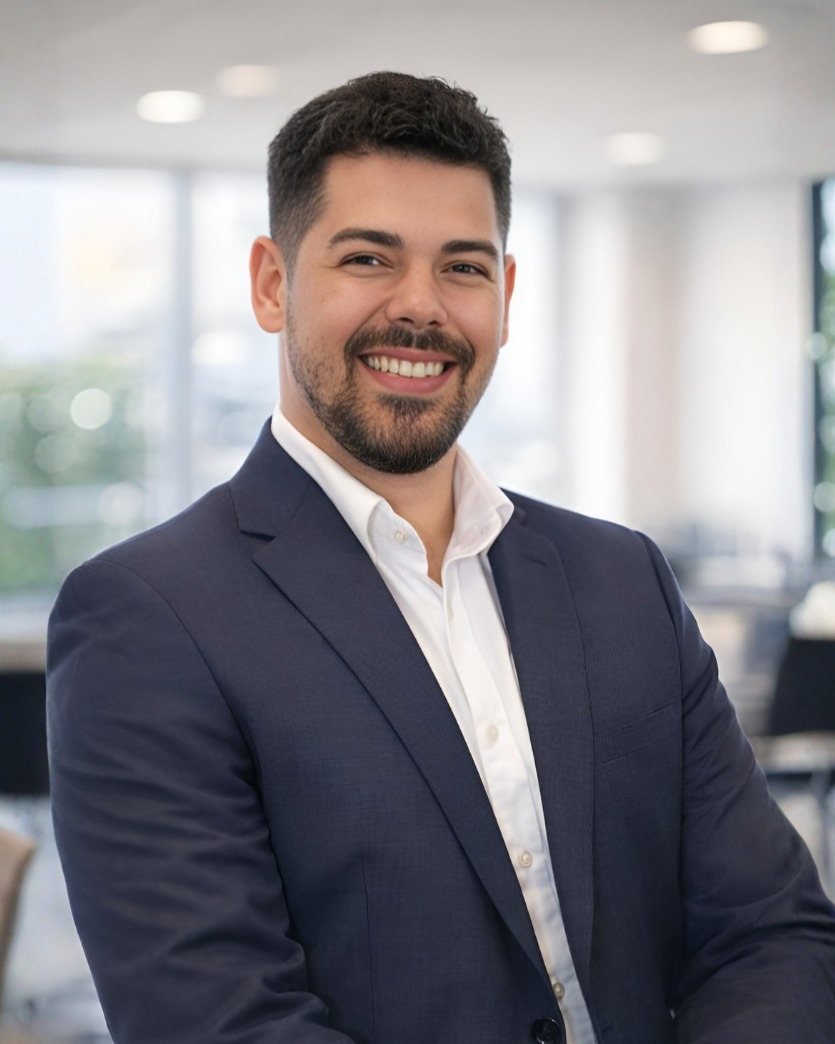
Adrian Duske was born in Hamburg into a family with German and Argentinian roots, spent four and a half years at Google managing more than €50 million in advertising spend, and then built digital marketing businesses. The same problem kept coming back: a business could spend €100 or more to win a potential customer and then lose that customer because nobody answered the phone.
Clickfone began when Adrian and Adrian’s brother, Michael Stitz, could not get an existing AI voice agent to connect reliably to a client’s systems. Michael asked why they did not just build it themselves. Today Clickfone Technologies S.L., based in Barcelona, builds personal AI assistants that answer calls, qualify leads, book appointments and work with CRM and calendar systems, on GDPR-compliant EU hosting. The company is bootstrapped and has 35 paying customers.
Key takeaways
- Clickfone grew out of a webhook that would not work: two brothers who could not connect an existing AI voice agent to a client’s systems decided to build the platform themselves.
- GDPR compliance and EU hosting were designed in before the first product feature, shaped by Michael Stitz’s years at Deutsche Bahn.
- Every assistant introduces itself as AI and says the call is recorded, yet many callers still talk to it as naturally as to a person.
- Anyone can create and deploy an assistant in under a minute, even by voice; the founders tested this with their father, who is over 60.
- With 35 paying customers and about €850 in monthly recurring revenue, Clickfone forecasts about €250,000 in revenue for 2027 and is building distribution through telecom providers and software partners.
Before any of this
Startup.talk:Where did you grow up, and what was childhood like?
Adrian:I was born in Hamburg, Germany, and come from a family with both German and Argentinian roots. Today, I live in Barcelona, which has added another international dimension to my life.
Looking back, I believe that being exposed to different cultures and perspectives has influenced how I approach business, relationships and opportunities.
I have never wanted to limit myself to one market, one country or one way of thinking. That international mindset is also something I want to bring into Clickfone from the very beginning.
Startup.talk:What first got you into building technology, and what did four and a half years at Google teach you that you still use today?
Adrian:My journey into technology started through digital marketing and the realization that technology can fundamentally change how businesses grow and operate.
During my four and a half years at Google, I worked with businesses of different sizes and managed more than €50 million in advertising spend. That experience taught me how to think in terms of scalability, data, experimentation and measurable outcomes.
One of the most important lessons was that technology should never exist just for the sake of technology. It needs to solve a real problem and deliver tangible value.
I also learned that assumptions are not facts. You need to test, measure, learn and continuously improve.
These principles are still at the core of how we build Clickfone today. We don't want to build something simply because it is technically impressive. We want to build something people genuinely need.
Startup.talk:Before Clickfone you built your own digital marketing businesses. What did those years teach you?
Adrian:Building my own digital marketing businesses taught me a completely different side of entrepreneurship compared to working at Google.
Over the years, I helped numerous businesses generate leads, acquire customers and grow their revenue. However, I repeatedly encountered a frustrating problem: we were successfully generating qualified leads, but some of our clients simply failed to follow up with them.
Potential customers would submit an inquiry, request a consultation or express genuine interest in a product or service, yet nobody would call them back.
Businesses were spending thousands of euros on customer acquisition while leaving valuable opportunities untouched. The problem wasn't the marketing. It was what happened after the marketing had done its job.
This made me realize that generating demand is only one part of building a successful business. Having the operational capacity to respond, follow up and convert that demand into revenue is equally important.
I also learned how much time businesses lose through manual processes, fragmented systems and repetitive administrative tasks.
These experiences fundamentally shaped my understanding of automation and eventually became one of the driving forces behind Clickfone.
I didn't want to simply help businesses generate more opportunities anymore. I wanted to build technology that helps them actually capitalize on those opportunities.
The road to Clickfone
Startup.talk:Clickfone started with a simple question: why do businesses still miss important phone calls? Where did that question come from?
Adrian:It came from my background in performance marketing.
For years, I helped businesses generate leads through digital advertising. We optimized campaigns, landing pages, conversion rates and acquisition costs, but there was one part of the customer journey that was often overlooked: what happens when someone actually picks up the phone?
A business could spend €100 or more acquiring a potential customer and then lose that opportunity simply because nobody answered.
That made me question why, in a world where we can automate incredibly complex processes, something as fundamental as answering a phone call was still such a challenge.
But the more we explored the problem, the more we realized that answering the phone was only the beginning.
The real opportunity was to build an intelligent assistant that could understand conversations, make decisions within defined boundaries and actually get things done.
“A business could spend €100 or more acquiring a potential customer and then lose that opportunity simply because nobody answered.”Adrian Duske
Startup.talk:What problem were you seeing that convinced you to build Clickfone?
Adrian:Businesses are overwhelmed by communication and administrative work.
Employees are constantly interrupted by phone calls, appointment requests, customer inquiries and repetitive tasks. At the same time, customers expect immediate responses, regardless of the time of day.
Traditional solutions often require hiring additional employees, outsourcing communication or introducing more software that someone still needs to operate.
We saw an opportunity to change that fundamentally.
Instead of giving businesses another tool they need to manage, we wanted to give them an intelligent assistant that actively works for them.
An assistant that answers calls, qualifies leads, books appointments, accesses business knowledge, connects with existing systems and executes tasks.
The problem is not simply missed calls. It is the enormous amount of human potential being consumed by work that technology can increasingly handle.
Startup.talk:What is it like to build a German-language AI company from Barcelona, and to start it with your brother Michael as CTO?
Adrian:First of all, I wouldn't describe Clickfone as exclusively a German-language AI company. Germany and the DACH region are important markets for us, but we are building an international company from day one. Barcelona provides a fantastic environment for that, with its international community, entrepreneurial spirit and growing technology ecosystem.
The story of how Michael and I started Clickfone is actually quite interesting.
I was trying to deploy an AI voice agent for one of my digital marketing clients. The agent itself worked, but connecting it to external systems and configuring webhooks that actually worked reliably turned out to be unnecessarily complicated and frustrating.
Naturally, I asked my brother Michael for help. Given his technical expertise, I was confident that he would find a solution. We spent considerable time experimenting with different approaches, but even together, we couldn't get everything working the way we wanted.
At some point, Michael simply said, "Why don't we just build it ourselves?"
My answer was, "Perfect. Let's do it."
And here we are.
What started as an attempt to solve a problem for a single customer has evolved into a technology company with a much bigger vision: making intelligent personal AI assistants accessible to everyone.
Building a company with your brother is certainly a unique experience. Of course, we argue, disagree and challenge each other's decisions. We are both passionate about what we do, and we don't always see things the same way. But I believe that is also one of our greatest strengths.
There is an enormous amount of mutual trust between us. I trust Michael's technical abilities, his engineering decisions and his ability to turn ambitious ideas into reality. He trusts my experience in business development, marketing, sales and understanding what customers actually need.
We complement each other incredibly well, and we can be completely honest with one another.
Beyond the business itself, there is something deeply meaningful about building a company together as brothers and pursuing a shared vision.
I genuinely couldn't imagine a better co-founder, business partner or brother to go on this journey with.
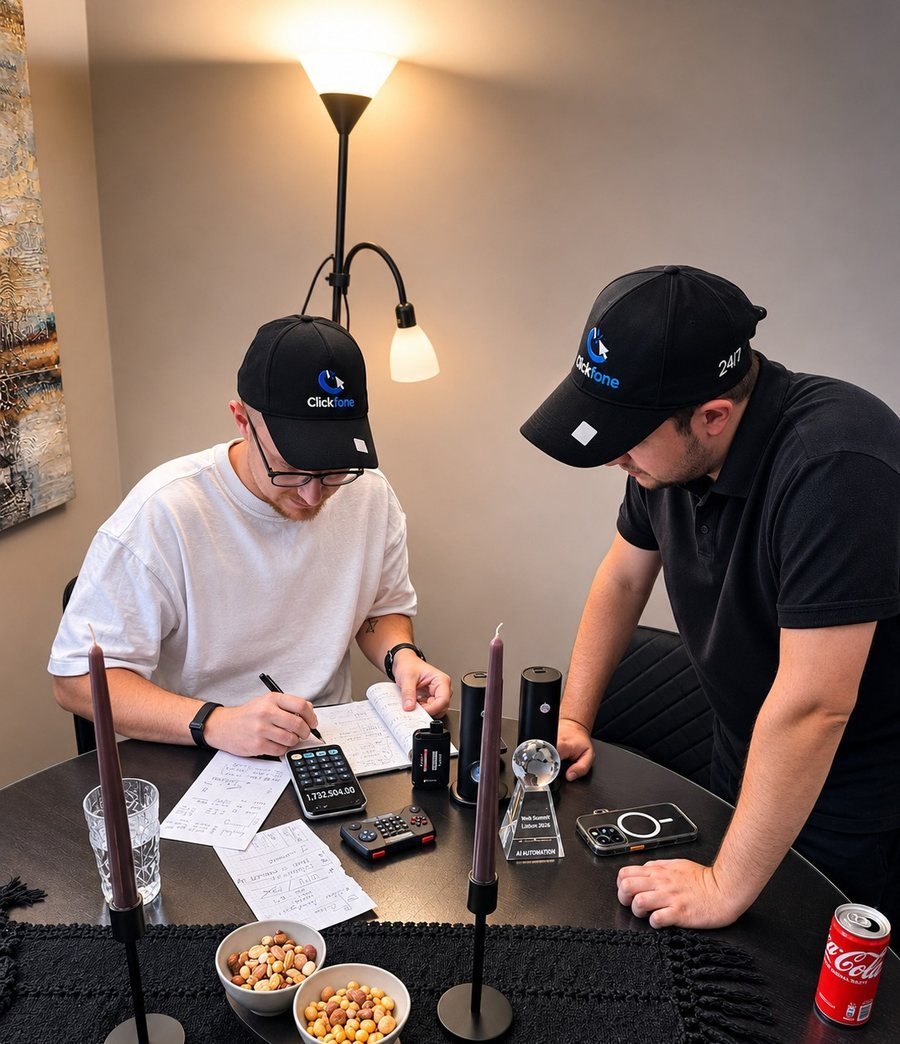
Startup.talk:How has Clickfone grown from answering missed calls to personal AI assistants that execute tasks and connect with the systems people use?
Adrian:Answering phone calls was our entry point into a much bigger opportunity.
Once an AI assistant understands a conversation, the natural next question is: why should it stop there?
Why shouldn't it book the appointment, update the CRM, create a support ticket, qualify the lead or trigger an automated workflow?
That is exactly the direction in which Clickfone has evolved.
Today, our assistants can handle inbound and outbound communication, access company knowledge, schedule appointments and interact with external systems through integrations and automation capabilities.
We are also embracing technologies such as the Model Context Protocol, allowing AI assistants to interact with additional tools and business infrastructure.
Our mobile applications bring these capabilities directly into people's pockets.
The long-term vision is not to build a better answering machine. It is to build a personal AI assistant that understands your business, communicates on your behalf and executes meaningful tasks across the systems you already use.
Voice is our starting point, not our limitation.
The product
Startup.talk:Why the name Clickfone?
Adrian:Clickfone represents the combination of simplicity and communication.
"Click" stands for accessibility, speed and the idea that powerful technology should be available with just a few clicks. "Fone" represents the most natural and universal form of business communication: the human voice.
We wanted a name that was easy to remember, internationally recognizable and not restricted to a particular industry.
Although our vision has expanded far beyond traditional telephony, the name still represents our core philosophy: making complex technology incredibly simple to use.
Startup.talk:How do GDPR compliance and EU hosting shape the way you build Clickfone?
Adrian:Privacy, data protection and security have been fundamental to Clickfone from the very beginning.
Before co-founding Clickfone, my brother Michael worked at Deutsche Bahn, where he gained experience in an environment in which data protection, security and regulatory requirements play a critical role.
When we decided to build Clickfone, one of the very first things Michael emphasized was that our infrastructure needed to be designed around European data protection standards, GDPR compliance and European hosting.
Before we even started developing product features or building the platform itself, we focused on establishing the right technical and architectural foundations.
We didn't want to build a product first and figure out compliance later. We wanted privacy and security to be part of Clickfone's DNA from day one.
AI assistants interact with real people, access business systems and potentially process sensitive information. That comes with an enormous responsibility, especially as these assistants become increasingly capable of executing tasks autonomously.
For us, GDPR and the EU AI Act are not obstacles to innovation. They provide a framework for building technology that businesses and individuals can trust.
We strongly believe that customers should remain in control of their data, their integrations and the permissions they grant to their AI assistants.
As a European technology company, we also want to demonstrate that innovation, scalability, security and strong data protection standards are not mutually exclusive.
The future of AI will not be determined solely by who builds the most powerful technology, but also by who builds technology that people can genuinely trust.
That is why privacy is not a feature at Clickfone. It is the foundation upon which everything else is built.
Startup.talk:What do you deliberately leave out of Clickfone?
Adrian:Unnecessary complexity.
We don't want our customers to become AI engineers, learn complicated programming languages or spend weeks configuring an assistant.
Our vision is to make Clickfone a truly plug-and-play solution. Regardless of which systems or software our customers already use, connecting them to Clickfone should be as simple as plugging a device into a power socket.
Many technology companies deliberately build closed ecosystems because they want to lock customers into their own infrastructure. We fundamentally disagree with that approach.
We don't want to force customers to abandon the tools they already use or become dependent on a single technology provider. Instead, we want Clickfone to become the intelligent layer that connects their existing systems and makes them more powerful.
Accessibility and simplicity are incredibly important to us. In fact, Michael and I even tested Clickfone with our father, who is over 60 years old. We wanted to see whether he could independently create and deploy his own AI agent without needing our technical assistance.
And he could.
For us, that was a meaningful validation of what we are trying to achieve. Advanced artificial intelligence should not be reserved for developers, technology enthusiasts or large enterprises with dedicated IT departments.
We also deliberately avoid building technology that deceives people into believing they are speaking with a human. Transparency is fundamental to our approach.
Ultimately, we want to remove friction rather than introduce another layer of complexity into people's lives.
Our philosophy is simple: the technology behind Clickfone can be incredibly sophisticated, but the experience of using it should never feel that way.
Startup.talk:What is your philosophy on making advanced technology accessible to everyone?
Adrian:I fundamentally believe that technological progress loses part of its value when only a small group of people can benefit from it.
One of the reasons Michael and I tested Clickfone with our father was because we wanted to challenge our own assumptions about simplicity.
Something might feel intuitive to us because we spend every day working with technology. But that doesn't necessarily mean it is intuitive to everyone else.
If someone needs extensive technical knowledge, hours of training or professional assistance just to get started, then I believe there is still work to be done.
Accessibility is not simply about offering a lower price.
It is about removing the barriers that prevent people from using technology in the first place.
Technical complexity, language barriers, complicated interfaces, expensive implementation processes and dependency on specialists.
I want people to be able to explain what they want to achieve in their own language and have technology help them accomplish it.
Regardless of their age, profession, education or technical background.
To me, the ultimate achievement in software development is not building something that only highly skilled people can operate.
It is building something so sophisticated that anyone can use it without ever needing to understand how sophisticated it actually is.
“the technology behind Clickfone can be incredibly sophisticated, but the experience of using it should never feel that way.”Adrian Duske
Startup.talk:What is the one detail in Clickfone you are proudest of?
Adrian:It's difficult to choose just one, but two things make me particularly proud: the natural quality of our AI conversations and the simplicity of our technology.
One of the most fascinating insights we have gained from our existing customers is how naturally people interact with our AI assistants.
We explicitly instruct our assistants to introduce themselves as artificial intelligence and inform callers that the conversation is being recorded. Yet, despite this transparency, many callers become so immersed in the conversation that they seem to forget they are speaking with an AI.
They communicate naturally, ask follow-up questions, express emotions and interact with the assistant just as they would with another human being.
For me, that is an incredible achievement. Not because we want to make people believe they are speaking with a human, but because we have reached a level of conversational quality where interacting with artificial intelligence no longer feels like interacting with a machine.
The quality of our voices, the natural flow of conversations and the overall experience are things I am extremely proud of.
The second achievement is how accessible we have made such sophisticated technology.
Behind Clickfone is an incredibly complex combination of telephony infrastructure, artificial intelligence, speech recognition, voice synthesis, knowledge management, automation and integrations.
Yet someone with virtually no technical knowledge can create and deploy their own AI assistant in less than a minute.
We have even reached a point where users can create and deploy AI assistants simply by using their voice. They can describe what they want, what their assistant should do and how it should behave.
And it actually works.
Think about that for a moment. We are using our voice to create artificial intelligence that can communicate, understand instructions and execute tasks on our behalf.
That is a remarkable technological advancement, and I believe we are only beginning to understand its potential.
For decades, humans have had to learn how to operate software. We are now moving towards a future where software understands what humans want to achieve.
I am incredibly proud of what Michael and our team have accomplished in making this possible.
To me, great technology is not about demonstrating how sophisticated it is. It is about making something incredibly sophisticated feel completely natural, effortless and accessible to everyone.
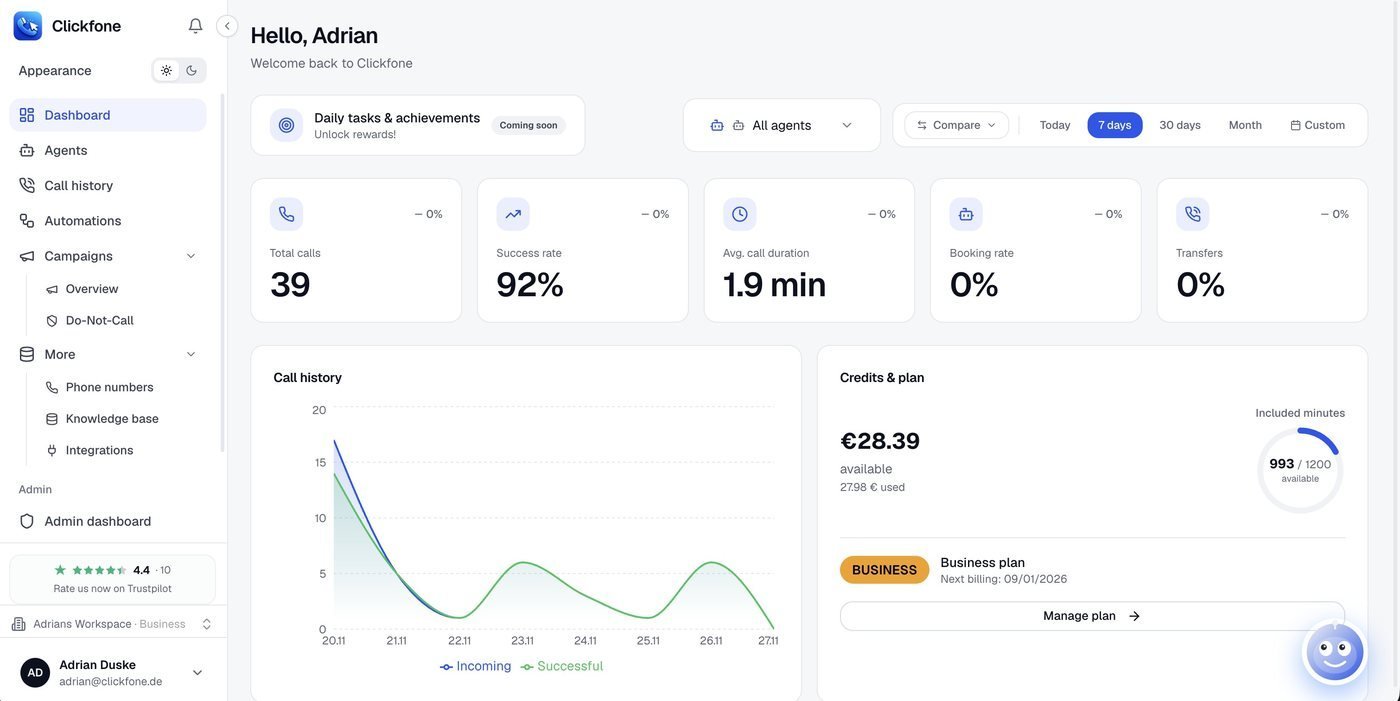
Positioning
Startup.talk:Who is Clickfone for, and what job does it do for them? Describe the person who gets the most value.
Adrian:Clickfone is for anyone who wants to focus on what they do best without constantly being interrupted by communication and administrative tasks.
I recently conducted a case study with one of our customers, which is available on our website. She told me that before using Clickfone, she had to block out time every Tuesday and Thursday just to go through her missed calls and call people back.
She didn't know whether a missed call represented a valuable new business opportunity, someone trying to sell her something, a marketing call or someone looking for an internship.
She was spending valuable time simply trying to find out which conversations were actually worth having.
With Clickfone, her AI assistant can handle those conversations, understand the caller's intentions, qualify potential business opportunities and provide her with the relevant information. Instead of spending time investigating missed calls, she can focus on the opportunities that actually matter.
Another example I experience personally is the hospitality industry.
Whenever I check into a hotel, I notice how frequently receptionists have to interrupt the check-in process because the telephone rings.
As a guest standing directly in front of the receptionist, I suddenly feel like I am no longer the priority. The person calling the hotel receives immediate attention, while I have to wait.
However, this is not the receptionist's fault. They are simply being asked to serve multiple customers simultaneously, which is practically impossible.
With Clickfone, the receptionist can give the guest standing in front of them their full attention, while the AI assistant handles incoming calls, answers questions and manages requests in the background.
And this problem exists across almost every industry.
Think about a hairdresser who has to stop cutting someone's hair because the phone rings.
Think about a restaurant where a waiter cannot serve food because someone is calling to make a reservation.
Think about a real estate agent who is showing a property to a potential buyer but constantly gets interrupted by incoming calls.
Think about an insurance broker who is explaining an insurance policy to a client and suddenly has to interrupt the consultation.
Think about a personal trainer at a fitness studio who is conducting a trial session with a potential new member and cannot answer a call from another person who wants to schedule their own trial session.
I also have a friend who is a lawyer, and we share an office. I regularly see how much concentration his work requires. He deals with complex legal cases, documents and responsibilities that demand his full attention.
Every time the phone rings, he is pulled out of that concentration.
An AI assistant can answer general questions from prospective clients, collect relevant information, schedule appointments and determine whether a request requires his personal attention, without interrupting his work unnecessarily or providing legal advice.
These are just a few examples, but they all share the same fundamental problem: people are constantly being forced to choose between serving their existing customers, acquiring new ones and actually doing their work.
We want to eliminate that compromise.
And that is precisely why we are developing Clickfone as a plug-and-play solution rather than a product designed exclusively for one particular industry.
Whether you are a lawyer, a hotel manager, a hairdresser, a restaurant owner, a real estate agent, an insurance broker or an entrepreneur, you should be able to create an AI assistant that understands your business, connects to your existing systems and supports your individual workflows.
The assistant should adapt to your business, not the other way around.
Ultimately, we are not just helping businesses answer more phone calls. We are helping them protect their time, improve their customer experience, capture more business opportunities and focus on the work that genuinely requires their expertise.
And as we continue to expand our automation and integration capabilities, this value will extend far beyond business communication.
Our long-term vision is that everyone, regardless of their profession, age, technical knowledge or company size, should have access to their own intelligent personal assistant.
Because having someone who supports you, organizes things for you and takes care of repetitive tasks should no longer be a privilege reserved for executives or people who can afford a human personal assistant.
Startup.talk:How do you view your positioning relative to Synthflow, Fonio, Bland AI? Is there another competitor you think of first?
Adrian:Synthflow, Fonio and Bland AI are all interesting companies contributing to the development of the AI voice market.
However, we are approaching the opportunity from a broader perspective.
We don't want Clickfone to be perceived exclusively as an AI receptionist, a voice automation platform or a developer infrastructure provider.
We are building a personal AI assistant ecosystem that combines communication, automation, integrations, knowledge and task execution in one accessible experience.
Our focus is on making advanced AI capabilities available to both non-technical users and organizations with more sophisticated requirements.
We also see traditional telecommunications providers, business communication platforms and emerging personal AI assistants as part of our competitive landscape.
In many cases, our biggest competitor is not another AI company. It is the traditional way businesses have been operating for decades.
We are competing against manual processes, missed opportunities, fragmented software and the assumption that every administrative task requires human involvement.
Startup.talk:What is your core moat that prevents Synthflow, Fonio, Bland AI from replicating your feature set?
Adrian:Individual AI features can be replicated. Anyone claiming otherwise is probably underestimating how quickly this industry moves.
We believe the real moat is created through the combination of infrastructure, integrations, customer experience, distribution and execution speed.
Our approach is to build an ecosystem in which AI assistants become deeply integrated into customers' daily workflows, communication channels and business systems.
As customers connect more tools, configure more workflows and establish their assistants as part of their operations, Clickfone becomes increasingly valuable to them.
Another important component is distribution. We are building relationships with telecommunications providers, software distributors, technology partners and industry-specific solution providers.
Combined with our European approach to privacy, our mobile-first accessibility and our ability to develop and release new capabilities quickly, we believe this can create a meaningful long-term competitive advantage.
Our moat is still being built. At this stage, our biggest advantage is our ability to move quickly, listen to customers and execute on a vision that extends beyond voice automation.
Startup.talk:What are some of the use cases for Clickfone that are not obvious and can add a lot of value to users? List as many as possible.
Adrian:The most exciting use cases emerge when an AI assistant moves beyond answering questions and starts executing tasks, making decisions within defined boundaries and automating entire workflows.
Many people still associate AI voice assistants with answering phone calls. However, once you connect an intelligent assistant to external systems, business applications and automation tools, the possibilities become significantly broader.
Here are some examples of what Clickfone can enable today or through additional integrations and future capabilities:
Transportation and logistics
• Communicating with international truck drivers who do not speak the local language fluently.
• Automatically switching languages to facilitate communication between drivers, warehouses and logistics coordinators.
• Coordinating incoming deliveries and providing drivers with unloading instructions.
• Checking delivery statuses and communicating delays to the relevant parties.
• Scheduling loading and unloading appointments.
• Updating logistics management systems based on telephone conversations.
• Notifying warehouse employees when a delivery arrives.
Airlines and travel
• Providing multilingual customer support around the clock.
• Helping passengers who have missed their flights find alternative connections.
• Checking flight availability and assisting with rebooking through connected reservation systems.
• Answering questions about baggage, cancellations and travel policies.
• Communicating flight disruptions and alternative travel options.
• Handling large volumes of simultaneous customer inquiries during unexpected disruptions.
Healthcare, medical practices and hospitals
• Identifying existing patients through authorized access to connected patient management systems.
• Scheduling, rescheduling and cancelling medical appointments.
• Collecting preliminary information about symptoms and the reason for an appointment.
• Providing relevant administrative information based on a patient's existing records, subject to appropriate authentication and permissions.
• Directing patients to the appropriate department or medical specialist.
• Answering general questions about opening hours, appointment preparation and administrative procedures.
• Escalating potentially urgent situations to qualified medical personnel or directing callers to emergency services.
• Reducing the administrative workload of medical staff so they can focus on patient care.
The objective is not to replace medical professionals or provide independent diagnoses, but to support them by automating administrative communication and workflows.
Finance, invoicing and business administration
• Retrieving invoice information from connected accounting systems.
• Updating invoice details within authorized workflows.
• Creating and sending quotations based on customer requirements.
• Checking payment and order statuses.
• Sending payment reminders.
• Collecting billing information from customers.
• Initiating approved administrative processes without requiring employees to manually navigate multiple applications.
• Automatically forwarding relevant documents and information to the appropriate departments.
Sales and customer acquisition
• Automatically qualifying incoming sales leads before they reach a salesperson.
• Calling back potential customers who have submitted an inquiry through a website.
• Following up with prospects through authorized outbound calls.
• Scheduling sales consultations and product demonstrations.
• Creating and updating CRM records based on conversations.
• Identifying high-value opportunities and notifying the responsible salesperson.
• Preparing and sending personalized offers.
• Re-engaging existing customers and identifying potential upselling opportunities.
• Collecting customer feedback after purchases or appointments.
Hospitality and restaurants
• Managing hotel guest requests around the clock.
• Handling restaurant and hotel reservations.
• Providing multilingual support to international guests.
• Answering questions about hotel facilities, services and local attractions.
• Coordinating housekeeping and maintenance requests.
• Managing reservation changes and cancellations.
• Supporting receptionists during peak hours without compromising the experience of guests who are physically present.
Real estate and insurance
• Qualifying potential property buyers and tenants.
• Scheduling property viewings.
• Answering general questions about available properties.
• Collecting maintenance requests and coordinating service providers.
• Collecting preliminary information for insurance quotations.
• Capturing insurance claim information for human review.
• Scheduling consultations with insurance brokers.
• Updating customer records based on conversations.
Legal and professional services
• Collecting preliminary information from prospective clients.
• Answering frequently asked administrative questions.
• Scheduling initial consultations.
• Identifying the general nature of a legal inquiry and forwarding it to the appropriate specialist.
• Protecting professionals from unnecessary interruptions during work that requires deep concentration.
• Creating structured summaries of client conversations without independently providing regulated professional advice.
Human resources and internal operations
• Coordinating job interviews.
• Pre-qualifying job applicants against predefined criteria.
• Answering general employee questions.
• Supporting internal IT help desks.
• Creating support tickets based on telephone conversations.
• Coordinating communication between employees, suppliers and departments.
• Creating structured handovers and task assignments.
• Automating repetitive internal reporting processes.
Personal AI assistance and mobile accessibility
• Acting as a personal assistant for entrepreneurs, executives and individuals.
• Managing calendars, appointments and daily responsibilities.
• Notifying users directly through the Clickfone mobile app when an important call has been received.
• Allowing business owners to review conversations and call customers back directly from the app.
• Providing relevant context before a user returns a call.
• Prioritizing communication based on urgency and importance.
• Triggering automated workflows across multiple connected applications.
• Allowing users to interact with complex business software simply by speaking.
• Executing authorized tasks on behalf of users without requiring them to be physically present.
What makes all of these use cases particularly exciting is that they are not isolated capabilities. They can be combined into complete, interconnected workflows.
Imagine a potential customer calling a business. The AI assistant understands the inquiry, qualifies the opportunity, checks the company's availability, creates a CRM record, prepares a quotation, sends it to the customer, schedules a follow-up appointment and notifies the business owner through the Clickfone app.
The business owner can then review the conversation and, if necessary, call the customer back directly from their smartphone.
An entire business process that previously required multiple employees, several applications and numerous manual steps can potentially be completed through a single conversation.
That is where we see the real potential of Clickfone.
Our ambition is not simply to automate individual tasks. It is to eliminate entire manual workflows wherever they can be reliably and responsibly automated.
For decades, software has required humans to act as the connecting layer between different systems. We open applications, copy information, transfer data, create documents, send emails and manually trigger the next step in a process.
We believe intelligent AI assistants can increasingly take over that connecting role.
The hard part
Startup.talk:How many people or companies use Clickfone today?
Adrian:As of November 2026, we have 35 paying customers and approximately €850 in monthly recurring revenue.
Considering that we have built Clickfone entirely with our own resources and without external investment, we are very pleased with our initial progress.
What I find particularly valuable at this stage is the diversity of our customers. Every new business brings different requirements, challenges and ideas that help us understand where the technology can create even more value.
We are also moving beyond acquiring customers individually. We have started establishing relationships with telecommunications providers, software distributors and strategic partners who can bring Clickfone to their existing customer networks.
We are still at the beginning of our journey, but we have moved beyond the stage of simply having an idea. We have a working product, paying customers, real customer feedback and a growing commercial pipeline.
The next challenge is scaling what we have built.
Startup.talk:Bootstrapping meant countless sleepless nights. What is a challenging time you had building Clickfone, and how did you get through it?
Adrian:One of the biggest challenges of bootstrapping is that your ambitions are often significantly greater than your available resources.
Michael and I have a very clear vision of what Clickfone can become. The challenge is deciding what to build first when you can already see hundreds of possibilities ahead of you.
We are operating in an industry that moves incredibly fast. New technologies, models and capabilities emerge almost every week. At the same time, you need to maintain a reliable product, support existing customers, develop new features, acquire customers and build a sustainable company.
There are days when I am speaking with potential investors, negotiating partnerships, working on marketing campaigns and discussing product development with Michael, all within a few hours.
Meanwhile, Michael has to balance infrastructure, security, product development, integrations and the technical challenges that come with building an AI platform.
Of course, we have disagreements. Sometimes I want things to happen faster, while Michael needs to ensure that what we build is technically sound, secure and scalable.
Learning to balance those perspectives is part of building a company together.
What helps us get through challenging periods is that we never question each other's commitment to the company. We may disagree about how to get somewhere, but we agree on where we want to go.
We have built Clickfone without external funding, and neither of us is currently paying ourselves a salary from the company. That requires personal sacrifices and a considerable amount of discipline.
But every time we receive positive customer feedback or see something working that seemed impossible just a few months earlier, it reminds us why we are doing this.
Entrepreneurship is not about being motivated every single day. It is about continuing to move forward even on the days when motivation alone is not enough.
Startup.talk:What motivates you to keep building Clickfone when things get difficult?
Adrian:What motivates me is the realization that something Michael and I originally started because of a frustrating technical problem can now genuinely improve other people's lives.
When a customer tells us that Clickfone has saved them hours of work, helped them acquire a new customer or removed a source of daily frustration, that means an enormous amount to me.
It is tangible evidence that the hours we invest are creating something valuable.
But I am also motivated by the people around me.
My wife, my family, Michael, Victor and the people who increasingly believe in what we are building.
When people invest their time, energy, knowledge or financial resources into supporting your vision, you develop a sense of responsibility towards them.
You want to make their trust worthwhile.
There is also a personal challenge involved.
I want to see how far we can take this.
How much can we learn? How much can we build? How many people can we help? How far can two brothers take an idea that started with a simple conversation?
I don't know exactly where this journey will lead us.
But I know that I would rather spend my life finding out than spend it wondering what might have happened if we had never tried.
Startup.talk:How did you win your first paying customers?
Adrian:My background in digital marketing was certainly an advantage, but what helped us most in the beginning was speaking directly with people and understanding their daily challenges.
Instead of approaching businesses with a generic AI sales pitch, we wanted to understand how they operated, where they were losing time and which processes caused unnecessary frustration.
We could then demonstrate how Clickfone could help them in their specific situation.
One of the biggest advantages of our product is that people can experience it immediately. They don't have to imagine what artificial intelligence might be capable of. They can simply call an assistant and have a conversation with it.
That often changes the entire discussion.
People initially approach AI with a certain degree of skepticism. But once they experience a natural conversation and understand that the assistant can actually perform tasks, they start thinking about their own business and identifying opportunities themselves.
I still remember when we acquired our first paying customer. I was at the airport in Istanbul when I received the news.
It wasn't about the amount of money. It was about the realization that someone was willing to pay for something Michael and I had built from scratch.
That first customer represented the transition from an idea we believed in to a product someone else believed was valuable.
No matter how large Clickfone eventually becomes, that first paying customer will always be a special milestone for me.
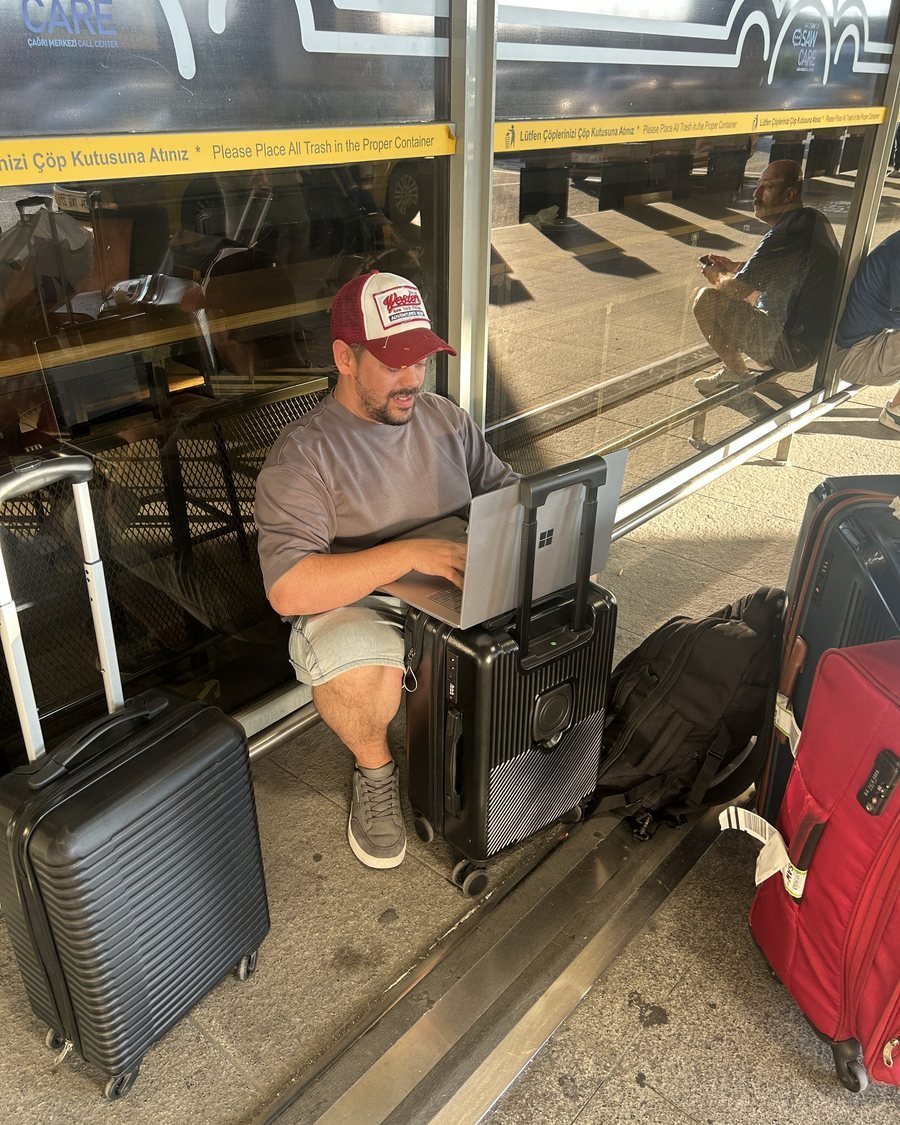
Startup.talk:What happened when you presented Clickfone at Web Summit in Lisbon?
Adrian:Web Summit was an interesting experience because it taught us something about entrepreneurship that has very little to do with technology: you can prepare for almost everything, but you cannot control everything.
We travelled to Lisbon as a team with Michael, our CTO and co-founder, and Eugen, our Head of Sales.
We had prepared our exhibition, our presentation, marketing materials and meetings with potential investors and business partners.
Unfortunately, severe weather disrupted the event on the day we were originally scheduled to exhibit.
Naturally, that was disappointing. As a bootstrapped startup, attending an international event represents a significant investment of time, money and preparation.
But we had two choices. We could spend our time complaining about something outside our control, or we could adapt and make the most of the situation.
We chose the second option.
We continued networking, arranged conversations and established relationships with investors, technology companies and potential strategic partners from different countries.
What I particularly enjoyed was being surrounded by people who were genuinely ambitious about changing industries and challenging established ways of doing things.
It also reinforced my belief that we should think internationally from the very beginning.
Building a company in Barcelona, with German founders and ambitions across multiple markets, should not be seen as a limitation. It is an opportunity.
Web Summit reminded me that sometimes the most valuable opportunities are not the ones you originally planned for.
Startup.talk:Who believed in you before there was anything to show? What did they say or do?
Adrian:Without a doubt, my wife, my brother Michael and my mother. And there is another person who deserves very special recognition: Victor, our first committed investor.
My wife has believed in me from the very beginning and has supported me in more ways than I could ever describe. She has an incredibly pragmatic and structured way of thinking, which is almost the complete opposite of how my mind works.
If you looked at my computer while I was working, you would probably find five or more windows open, over 30 browser tabs and countless ideas competing for my attention. Somehow, I navigate through that chaos. It is how my brain works, and it is often where my creativity and ambition come from.
But sometimes, that chaos becomes overwhelming.
My wife has this incredible ability to create clarity in those moments. When I see a hundred different challenges, opportunities and responsibilities at the same time, she helps me put things into perspective. She gives me direction when I need it most and helps me see the light at the end of the tunnel when I struggle to see it myself.
I genuinely would not be where I am today without her. Behind everything I am building, there is a woman who believes in me, supports me, challenges me and gives me the stability I need to pursue my ambitions.
To my wife, Alev: Thank you for believing in me, even in moments when I struggle to believe in myself. Thank you for bringing clarity into my chaos, for your patience, your love and for supporting me in ways that most people will never see. You are my foundation, my balance and my greatest source of strength. Without you, none of this would be possible. Whatever I achieve in life, you will always be a fundamental part of it. I love you, and I am endlessly grateful to have you by my side.
Michael plays a similarly important role in my professional life. Where I see endless possibilities, he helps me bring structure, technical clarity and feasibility to those ideas. He challenges my thinking and turns ideas that sometimes seem impossible into something tangible.
Both my wife and Michael give me clarity in different but equally important ways.
Without these two people in my life, I don't think I would have had the confidence to say, "Let's go. Let's actually build this."
To my brother Michael: Thank you for being the person who said, "Let's build it ourselves." Thank you for trusting my abilities, challenging my ideas and having the courage to embark on this journey with me. We argue, we disagree, and we probably drive each other crazy sometimes, but there is nobody I would rather build this company with. I have enormous respect for your intelligence, your technical abilities and your dedication. I am incredibly proud to call you my co-founder, but even more proud to call you my brother. Whatever happens on this journey, I am grateful that we get to experience it together.
I am also incredibly grateful for my mother. She has supported me throughout my journey, and I feel incredibly fortunate to have her in my life. Having a family that believes in you, especially during periods of uncertainty, is something I will never take for granted.
To my mother: Thank you for always believing in me, supporting my ambitions and standing behind me throughout my journey. Your love and encouragement mean more to me than I could ever express in words. I am endlessly happy and grateful to have you as my mother. I hope that everything we are building makes you proud, because making you proud means more to me than any financial milestone or professional achievement ever could. I love you, and I will never take your support for granted.
Another person I absolutely want to mention is Victor.
Victor is an incredibly talented young man whom I deeply respect and whose opinion I genuinely value. During the early stages of Clickfone, he provided us with valuable commercial guidance. He helped us understand how to approach sales, how to structure and sell our software licenses, and how to translate our technology into a commercially viable offering.
He gave us perspectives that helped shape our early sales strategy, and his support went far beyond simply offering advice.
What completely surprised me was when he essentially said, "I believe in you and what you are building so much that I am willing to put my own money into your company."
Victor became our first investor to make a financial commitment to Clickfone.
That was an incredibly meaningful moment for me.
I believe he initially wanted to see whether Clickfone was simply another entrepreneurial adventure or whether Michael and I were genuinely committed to building something significant. He wanted to see whether our ambition was matched by our actions and whether we would continue pushing forward when things became difficult.
Over time, he saw our dedication, our progress and our determination to make this company succeed.
Having someone who not only believes in your vision but is willing to commit their own money to it is a completely different level of trust.
I can also genuinely imagine Victor becoming more actively involved in Clickfone in the future, because I believe his conviction goes far beyond the financial opportunity. He believes in the idea, in the company and, most importantly, in us as founders.
To Victor: Thank you from the bottom of my heart for believing in us, for sharing your knowledge, for challenging our commercial thinking and for becoming our first committed investor. Your decision to support us financially was something I never took for granted. I have enormous respect for you, both professionally and personally, and I am incredibly proud to have someone like you supporting our journey. I sincerely hope that we will have the opportunity to build something extraordinary together in the years ahead.
What is particularly beautiful about this entire experience is that we are now beginning to see more and more people recognize the amount of work, dedication and sacrifice that goes into building Clickfone.
People are seeing the hustle, the grind, the long hours and the genuine passion behind what we are doing. They are realizing that this is not a temporary project or a short-lived ambition for us. We are genuinely committed to building something significant.
And increasingly, people want to support us, contribute to our vision and become part of something bigger.
That means an enormous amount to me.
Building a company can sometimes feel like a very lonely journey, even when you are surrounded by people. Having individuals who genuinely believe in you, not because of your revenue, your valuation or your achievements, but because they believe in who you are and what you are capable of, is priceless.
Entrepreneurship is often portrayed as the achievement of an individual founder. But the reality is that behind every founder, there are people whose contributions are rarely visible to the outside world.
My wife gives me stability and clarity. Michael gives our vision a technical foundation. My mother gives me unconditional love and support. Victor has given us commercial guidance and demonstrated his belief in us through a financial commitment.
Each of them has contributed to this journey in their own unique way.
If Clickfone becomes the company we envision, its success will never belong to Michael and me alone. It will also belong to the people who believed in us long before there was anything to celebrate.
I may be the CEO of Clickfone, but I am also a husband, a brother and a son. No professional title will ever be more important to me than those three.
And no matter how successful Clickfone becomes, I will never forget the people who helped me get there.
What building Clickfone taught you
Startup.talk:What are the biggest lessons building Clickfone has taught you so far? Pick the areas where you learned the most, such as customers, pricing and finance, marketing and distribution, product, hiring and team, or fundraising, and for each one tell us what you believed before, what actually happened, and what you do differently now.
Adrian:Building Clickfone has probably been one of the most intense learning experiences of my professional life.
Despite having spent four and a half years at Google and several years building my own businesses, creating a technology company from scratch has challenged me in completely different ways.
Customers
One of the biggest lessons is that you should never assume you fully understand your customers' problems.
Some of our most valuable insights have come from ordinary conversations with business owners. Listening to a customer explain that she had to block out two days every week to review and return missed calls taught me more about the practical value of our technology than any market research report could have.
You need to listen before you build.
Customers don't necessarily care about how sophisticated your technology is. They care about whether it makes their lives easier.
Product development
I am someone who constantly sees new opportunities. When I discover something technically possible, my immediate reaction is usually to ask Michael whether we can implement it.
Michael has taught me that there is a significant difference between making something work and making something work reliably, securely and at scale.
Building a feature is one thing. Making it accessible to someone without technical knowledge is an entirely different challenge.
Our own founding story is a perfect reminder of that. If two people with our respective professional backgrounds struggled to connect an existing AI solution to external systems, how could we expect an ordinary business owner to do it?
That experience continues to influence every product decision we make.
Marketing and distribution
Coming from Google and performance marketing, I naturally understand the importance of customer acquisition.
However, building Clickfone has taught me that distribution is much bigger than advertising.
You can have an extraordinary product, but if nobody knows about it or understands its value, it will remain invisible.
Victor helped us enormously in understanding how to approach software licensing and commercialize our technology. Those conversations opened my eyes to opportunities beyond traditional direct customer acquisition.
Today, I see strategic partnerships, telecommunications providers and software distributors as important components of our growth strategy.
Sometimes, building the right relationship can create more opportunities than spending thousands of euros on advertising.
Pricing and finance
Bootstrapping teaches you discipline very quickly.
Every euro matters. Every decision has consequences. You constantly need to balance what you want to achieve with the resources you actually have available.
At the same time, I don't want financial limitations to restrict our ambition.
We want to make intelligent personal assistants accessible and affordable while building a financially sustainable company.
I have learned that creating value and capturing value are two different things, and a successful company needs to understand both.
Team and leadership
Perhaps the most personal lesson has been understanding that I don't need to have all the answers myself.
I am naturally ambitious, creative and sometimes chaotic. I can see dozens of opportunities simultaneously, but that doesn't mean I should pursue all of them at once.
Michael, my wife and the people around me have helped me understand the importance of structure, prioritization and perspective.
As a CEO, I don't want to be the smartest person in every room. I want to surround myself with people who are better than me in their respective areas.
I want people who challenge me, disagree with me and tell me when I am wrong.
Trusting someone else's expertise is not a weakness in leadership. It is a strength.
Fundraising
Receiving our first financial commitment from Victor was a particularly meaningful experience.
It taught me that investment is not simply a financial transaction. It is an expression of trust.
Someone is putting their own resources behind your vision because they believe you have the determination and ability to turn it into reality.
That creates responsibility.
I don't want to raise money simply because fundraising is considered a milestone in the startup world. I want to work with people who genuinely believe in what we are building and can help us accelerate that journey.
Ultimately, Clickfone has taught me that ambition alone is not enough. You need discipline, humility, resilience, trust and the willingness to continuously learn.
I am still learning every single day, and I hope that never changes.
Startup.talk:What kind of company culture do you want to build at Clickfone?
Adrian:I want to build a company where people feel that they are contributing to something meaningful rather than simply completing tasks.
I value curiosity, honesty, ambition and ownership.
I want people to challenge ideas, including my own.
Michael and I already have that dynamic. We disagree, discuss things openly and challenge each other's perspectives because we both want to achieve the best possible outcome.
I want that spirit to remain part of Clickfone as the company grows.
I don't want employees to feel that their ideas are less valuable because of their job title.
A conversation with a customer support employee could reveal a product opportunity that nobody in management had considered.
A developer might identify a commercial opportunity.
A salesperson might discover a completely new use case.
Great ideas can come from anywhere.
At the same time, I want us to remain ambitious without losing our humanity.
We are building technology that is supposed to give people back their time. It would be contradictory to create a company culture that completely disregards the value of people's time and personal lives.
I want people to work hard because they believe in what they are building, not because they are afraid of disappointing someone.
I want us to celebrate achievements together, learn from failures together and remain honest with one another.
And regardless of how large Clickfone becomes, I want us to remember why we started.
We experienced a problem, believed we could solve it better and decided to do something about it.
That mindset should never disappear.
What it is all for
Startup.talk:What would make you say Clickfone has succeeded?
Adrian:Of course, I want Clickfone to become an internationally successful technology company. I want us to create jobs, generate sustainable revenue and build something that has a meaningful impact on the world.
But if you ask me what success genuinely means to me, my answer is time.
Time is the one resource that none of us can ever recover.
When I look at entrepreneurs, business owners and professionals, I see how much of their lives is consumed by responsibilities that could increasingly be handled by technology.
People spend their evenings answering emails, returning missed calls, organizing appointments, transferring information between systems and completing administrative tasks.
Often, they are doing these things at the expense of spending time with their families, their partners, their children or simply themselves.
And I understand that feeling personally.
Building Clickfone requires an enormous amount of time, energy and dedication. My family experiences that alongside me.
That makes our mission even more meaningful to me.
I would love to reach a point where a business owner can go on holiday with their family without constantly checking their phone or worrying about missed opportunities.
Where a lawyer can concentrate on a complex case without being interrupted every few minutes.
Where a hotel receptionist can give a guest their full attention.
Where someone can finish their working day and actually be finished.
Those moments might seem insignificant individually, but when you multiply them across thousands or millions of people, the impact becomes enormous.
One day, I would love to see a metric on our website showing how many hours Clickfone has given back to humanity.
Not just how many calls we have answered, how many tasks we have completed or how much revenue we have generated.
How much time have we actually given back to people?
Imagine being able to say that Clickfone has returned one million hours to individuals and businesses around the world.
That would make me incredibly proud.
And on a personal level, success would also mean being able to look at the people who believed in us from the beginning and say, "We did it."
My wife, Michael, my mother, Victor and everyone who supported us along the way.
I want their belief in us to have been worthwhile.
Building a successful company would be an incredible achievement. Building a successful company that genuinely improves people's lives would mean even more.
“One day, I would love to see a metric on our website showing how many hours Clickfone has given back to humanity.”Adrian Duske
The road ahead
Startup.talk:What are your milestones for the next 12 to 18 months, in users and revenue?
Adrian:The next 12 to 18 months will be a particularly exciting period for Clickfone because we are transitioning from building the foundations of the company to scaling it internationally.
We have already demonstrated that we can build a functioning product, acquire paying customers and continuously develop the platform with our own resources.
Now we want to accelerate that progress.
Our current internal revenue forecast for 2027 is approximately €250,000. We aim to grow from dozens to hundreds of paying customers while establishing strategic distribution relationships that could eventually give us access to thousands of businesses.
However, our growth strategy is not exclusively based on acquiring individual customers.
We see significant potential in collaborating with telecommunications providers, software distributors, technology companies and established businesses that already serve large customer networks.
These partnerships could fundamentally change the speed at which we can scale and enter new international markets.
We also want to expand our team, particularly in sales, marketing, partner management and product development, while maintaining the speed, flexibility and entrepreneurial mindset that have brought us this far.
But revenue and customer numbers are only part of the picture.
I also want to understand how deeply Clickfone becomes integrated into people's everyday lives.
How frequently are customers using their assistants?
How many tasks are being completed successfully?
How much manual work are we eliminating?
How much time are we giving back?
Are customers discovering new ways to use the technology that we hadn't originally considered?
These are the questions that genuinely excite me.
On the product side, our objective is to continue removing the barriers between people and the technology they use.
I want connecting a new system to Clickfone to become as simple as plugging a device into a power socket. I want creating a personal assistant to become even more intuitive. I want our customers to be able to describe what they need and have the technology take care of the complexity.
We also want to significantly expand our automation capabilities, moving beyond individual task execution towards the automation of entire business workflows.
International expansion will be another important milestone. Artificial intelligence does not stop at national borders, and neither should our ambitions.
Ultimately, the next 12 to 18 months are about building the organization, partnerships and technological infrastructure required to transform Clickfone from an emerging AI startup into an internationally recognized personal AI assistant platform.
We have built the foundations ourselves. Now we want to demonstrate how far we can take them.
Our ambition is global, but our approach remains grounded: deliver genuine value, listen to our customers, execute consistently and build a company that is here to stay.
Startup.talk:What are you looking for in investors and strategic partners?
Adrian:First and foremost, we are looking for people who genuinely believe in what we are building.
Victor is a great example of that.
Before making a financial commitment, he invested his time, shared his knowledge and helped us understand how to approach the commercial side of our technology.
He wanted to understand whether we were genuinely committed to building something significant.
And when he saw that we were, he decided to support us financially.
That kind of relationship means much more to me than simply receiving capital.
Of course, funding is important. It allows us to hire talented people, accelerate development, strengthen our infrastructure and expand internationally.
But I also value experience, strategic thinking, industry knowledge, international networks and people who are willing to challenge us.
We are particularly interested in building relationships with investors and strategic partners who understand artificial intelligence, telecommunications, enterprise software and international distribution.
People who recognize that our opportunity extends beyond answering phone calls.
We are building towards a future in which intelligent assistants become a natural interface between people and technology.
We want partners who understand the long-term significance of that transformation.
At the same time, I want to be very clear about one thing.
We are not building Clickfone because we hope someone will invest in us.
We are building Clickfone because we believe it should exist.
Investment would allow us to move faster, expand our capabilities and reach more people. But our determination to build this company does not depend on receiving permission from anyone else.
Michael and I have already committed ourselves to this journey.
We are looking for people who want to become part of it.
People who want to look back in five or ten years and say that they helped build something that genuinely changed the way people interact with technology.
We are ambitious, we are committed, and we are still at the very beginning.
That is precisely what makes this opportunity so exciting.
Startup.talk:Where do you want Clickfone to be in five years?
Adrian:I want Clickfone to become a globally recognized platform for personal artificial intelligence.
But I also believe that five years from now, the way we interact with technology will look fundamentally different from how it looks today.
Think about how we currently use software.
We open one application to communicate with customers, another to manage appointments, another to create invoices, another to manage projects and another to organize our personal lives.
We are constantly switching between applications, remembering passwords, navigating interfaces and manually connecting information.
Human beings have effectively become the integration layer between different technologies.
I believe that is going to change.
Instead of telling software how to perform a task, we will increasingly tell an intelligent assistant what we want to achieve.
The assistant will understand our objective, identify the necessary systems and execute the relevant actions within the permissions we have granted.
And I don't think this should be limited to business environments.
Imagine having your own personal assistant that understands your preferences, your responsibilities, your schedule and the way you organize your life.
You wake up in the morning, and your assistant can tell you what happened while you were asleep, what requires your attention and what has already been taken care of.
You could simply speak to it.
Ask it to organize your day, coordinate a meeting, contact someone, find information, manage a reservation or execute a complex workflow.
You wouldn't necessarily need to understand which software applications were involved behind the scenes.
You would simply communicate what you wanted to achieve.
What excites me is that we are already seeing the beginnings of this transformation. Today, people can create and deploy an AI assistant through voice input. Something that would have required considerable technical expertise not long ago is becoming accessible through a simple conversation.
Imagine how far that technology could develop over the next five years.
I also want Clickfone to remain independent in its philosophy.
I don't want our customers to be forced into a closed ecosystem. I want them to have the freedom to choose their preferred software, tools and services while using Clickfone as the intelligent layer that connects them.
We want to democratize access to personal assistance.
For decades, having a personal assistant was a privilege associated with executives and wealthy individuals.
Why shouldn't a hairdresser have one?
Why shouldn't a student have one?
Why shouldn't a small business owner, a retired person or someone simply trying to organize their everyday life have access to the same level of assistance?
My ambition is that having your own AI assistant eventually becomes as normal as having a smartphone.
And I want Clickfone to be one of the companies that makes that future possible.
We started because Michael and I couldn't get a webhook to work the way we wanted.
Five years from now, I hope we will look back at that moment and realize that a relatively small technical frustration became the starting point for something much bigger.
Startup.talk:What do you think Europe needs to become a global leader in artificial intelligence?
Adrian:I believe Europe needs more confidence in its own capabilities.
We have exceptional engineers, talented entrepreneurs, world-class research institutions, established industries and an incredibly diverse international market.
Yet when people discuss major technological innovation, the conversation often automatically shifts towards Silicon Valley.
I would like to see that change.
European founders should think internationally from the very beginning.
We should not limit our ambitions to Germany, Spain, France or any other individual market simply because that is where we happen to live.
At the same time, Europe needs to make it easier for ambitious companies to access capital, attract talent and scale across borders.
Building a startup is already difficult enough without unnecessary administrative complexity.
However, I don't believe Europe needs to abandon its values to compete globally.
Privacy, transparency, security and responsible innovation can become significant competitive advantages.
Michael's experience at Deutsche Bahn influenced our approach to building Clickfone around European data protection standards before we even started developing the platform itself.
That is not something I see as a disadvantage.
It is part of our identity.
We also don't necessarily need to compete by building the largest foundational AI models in the world.
There is an enormous opportunity in the application layer, where artificial intelligence becomes genuinely useful to businesses and individuals.
Connecting intelligence to real-world systems, making it accessible and enabling people to accomplish meaningful tasks.
That is where we see our opportunity.
I would love for Clickfone to become one example of what European technology companies can achieve when they combine ambition, engineering excellence, commercial execution and a global mindset.
Great technology can be built anywhere.
We just need to stop believing that it has to come from somewhere else.
“Human beings have effectively become the integration layer between different technologies.”Adrian Duske
Startup.talk:What are your hopes and fears for a post AGI world?
Adrian:I think we are living through one of the most fascinating periods in human history.
We are witnessing technological capabilities emerge that would have sounded like science fiction only a few years ago. And we are still at the beginning of understanding what artificial intelligence could ultimately become.
My biggest hope is that advanced artificial intelligence gives people more freedom.
Freedom to pursue ideas, freedom to learn, freedom to build businesses and freedom to spend their time doing things that genuinely matter to them.
Imagine a world where a person's ability to create something meaningful is no longer restricted by their technical knowledge, financial resources or access to expertise.
Someone with a great idea could potentially build a company without needing an entire department of specialists.
Someone who wants to learn could have access to personalized education.
Someone who struggles with technology could simply communicate what they need through natural language.
That possibility genuinely excites me.
I believe intelligence and access to technology could become significantly more democratized.
However, my biggest fear is that we move in the opposite direction.
That the most powerful artificial intelligence systems become concentrated in the hands of a small number of organizations, creating an unprecedented level of dependency.
We already see how closed ecosystems can limit people's choices. Imagine that happening at a much larger scale, where individuals and businesses become dependent on intelligent systems that they cannot fully understand, control or leave.
That is something we need to take seriously.
It is also why I believe interoperability, privacy, transparency and individual control will become increasingly important.
People should understand when they are interacting with artificial intelligence. They should know what information their assistants can access and what actions those assistants are authorized to perform.
They should remain in control.
Another concern is how society will adapt to the transformation of work.
Artificial intelligence will inevitably change many professions and automate responsibilities that currently require human involvement. We need to ensure that the benefits of that transformation are shared rather than concentrated exclusively among technology companies and their shareholders.
I don't believe the success of artificial intelligence should be measured by how many people we can replace.
It should be measured by how much human potential we can unlock.
Personally, I don't want to live in a future where human beings become irrelevant because machines can perform tasks more efficiently.
I want to live in a future where people have more time to be husbands, wives, parents, brothers, sisters, friends, creators and explorers.
A future where technology supports human relationships rather than replacing them.
Where people have more opportunities to pursue their ambitions without sacrificing everything else that makes life meaningful.
We should build technology that adapts to humanity, not a humanity that is forced to adapt to technology.
That is the future I would like to contribute to through Clickfone.
“We should build technology that adapts to humanity, not a humanity that is forced to adapt to technology.”Adrian Duske
This interview was conducted in writing and has been edited lightly for length and clarity.
About Clickfone
Clickfone, co-founded by Adrian Duske and Michael Stitz and based in Barcelona, builds personal AI assistants that answer calls, book appointments and carry out tasks across the systems a business already uses, on GDPR-compliant EU hosting.
| Attribute | Verified Detail |
|---|---|
| Company | Clickfone |
| Founder(s) | Adrian Duske and Michael Stitz |
| Country | Spain |
| Based in | Barcelona, Spain |
| Before | Google (4.5 years), own digital marketing businesses |
| Before | Deutsche Bahn |
| Official Website | clickfone.de |
| Interview Published | 2026-11-27 |
More Startups in Spotlight
For founders
Building something? Want to share your journey?
Tell us how it started, what nearly broke it and where it is headed. We will turn it into a story like this one.
Share your journeyFor readers
Want to read more human stories behind the startups?
New founder interviews and stories, as they are published.
Follow us on LinkedIn