
Marko Milojkovic grew up in Lapovo, a small town in Serbia, playing basketball and football, and studied management at the Faculty of Economics in Kragujevac. A first job as a purchasing officer at an automotive company meant travelling across Europe to negotiate with suppliers. His first online project, Razmeni, a marketplace where parents exchanged toys, clothes and tools, was built on the no-code tool Bubble after development quotes ranged from 10,000 to 150,000 euros. It closed after a year and a half, but led to a no-code engineering job and then to his own product studio, Eterna Creative.
Test AI Models started inside that studio, first as LLM Bench, which won the Best Use of AI award at the Bubble x Contra AI hackathon. Paste a real prompt, run it on up to 20 AI models side by side, find the cheapest model that passes your own quality rule, and keep watching for changes with alerts. We spoke about why public leaderboards do not help in production, what surprises people when they see cost across models, and why independence is the product.
Key takeaways
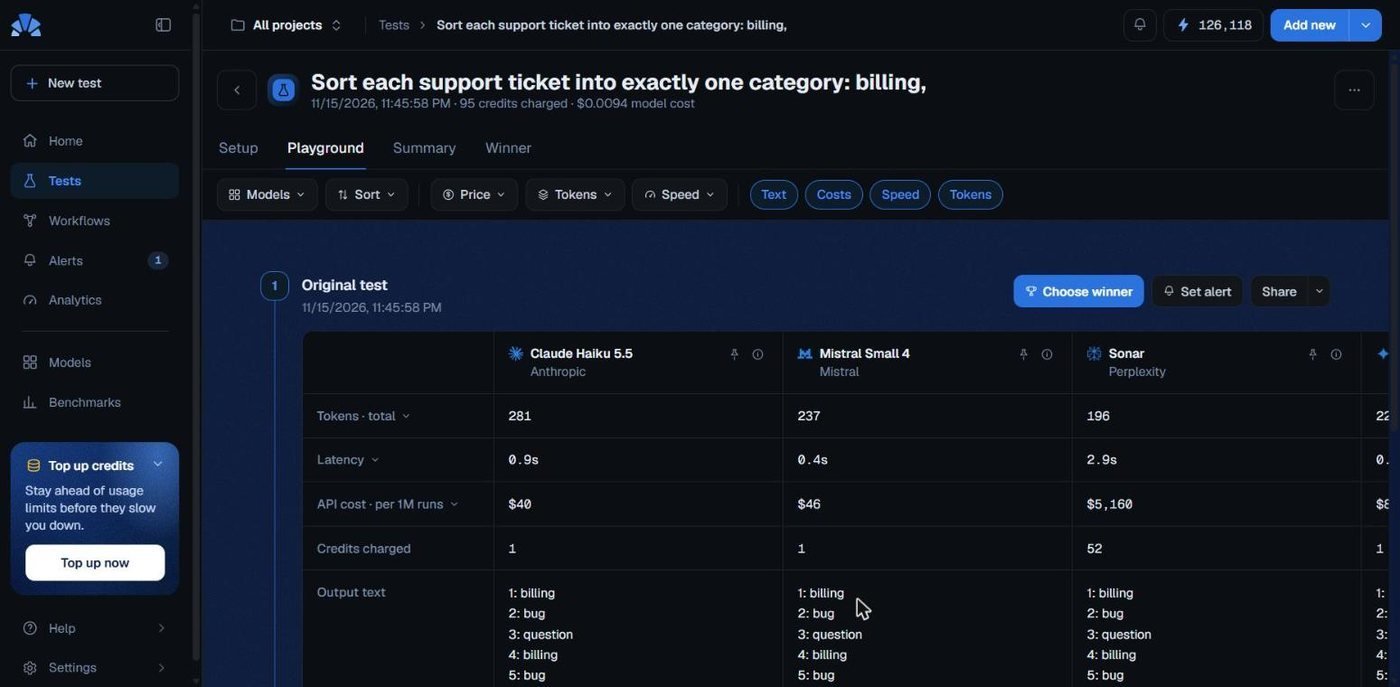
- Test AI Models runs a team's own prompt on up to 20 models at once and compares cost, speed and quality against a pass rule the user writes, including a cost-at-one-million-runs figure that makes price gaps visible.
- Alerts re-run a saved test daily, weekly or monthly to check that the chosen model is still the best pick. Warning when a cheaper model appears is the next feature.
- After surveys and interviews, Milojkovic narrowed the product to teams with high API bills and to software studios building AI products for clients, rather than serving everyone.
- More than 150 engineers use the platform. The 12-month targets are 2,500 registered accounts, 150 paying accounts and $5,000 in monthly recurring revenue, plus a public API and an MCP server.
Before any of this
Startup.talk:Where did you grow up, and what was childhood like?
Milojkovic:I grew up in a small town in Serbia called Lapovo. It was a fun childhood with a lot of outdoor activities with friends and socializing - we were never bored. I played and trained basketball and football as most kids do in my country. I finished high school in the same place as an economic technician, then the Faculty of Economics in Kragujevac, on the Management course. That is the city where I spent five amazing college years and that I am now returning to after ten years. What goes around comes around.
Startup.talk:What first got you into building things?
Milojkovic:As soon as I got my first 'corporate' job, I knew this was not for me long-term but I got into good culture company in automotive, and I used that time to learn as much as I could from great leaders. My first online project was a marketplace for parents called Razmeni (exchange) - where parents could exchange excess children toys, clothes and tools. I had no IT background and I was starting whole project with a friend, so we were looking for someone to build it for us, and we got amazed at quotes - from 150k EUR for MVP down to 10k EUR at minimum but still that was too much for us. Then somehow in online search I found out about no-code tool Bubble and I realized I could build it on my own, so I spent each free hour in the next year to build the full platform and learn all the things about what building software is really like. After a year and a half that project was live - in the end we closed it but it was an amazing learning experience that got me into my first no-code engineering job after that for 6 months, and after that I started my own studio called Eterna Creative. A lot of fortunate and unfortunate things happened that led me to this. I never thought I would be doing software engineering...
Startup.talk:What was your first job, and what did it teach you?
Milojkovic:My first job after college was in a commercial role: purchasing officer at an automotive company. I had amazing leaders and we traveled across Europe to meet all the suppliers, negotiate and meet so many amazing people. This job taught me about the high standards of doing business in automotive, how to make partnerships and deals and how to manage team. I also read a lot of business and psychology books while there and I really got the most out of that role. It was not good money but good culture and good learning, which put me on the right growth path in the next three companies before I started my own studio. Where we are now, with AI engineering and the products we have the privilege of building, is just amazing when I look back. It was a lot of hard work, but I believe that luck follows hard work and good intentions.
The road to Test AI Models
Startup.talk:What made you start Test AI Models?
Milojkovic:With the expansion of AI, a lot of the products we were building in my studio Eterna Creative started asking for some AI features, like AI estimates, scope generations, image gen etc, but it was always a struggle to test 3 or more models, to implement them and then to just pick one and delete the rest. But there was no solution for testing models before implementation. So I decided to build it for myself for just a couple of models, and then people loved it so we decided to go all in with the product.
Startup.talk:What did client work at Eterna Creative teach you about choosing LLMs for real products?
Milojkovic:It taught me that usually cheaper models can do good enough job for most of the LLM tasks, so there was no reason to pay premium models in such cases. Differences were really huge, up to 80x more expensive. From then on - for each client task that had an LLM I used Test AI Models and always found better, faster and cheaper models, that gave my product studio an edge over the competition. We are very versed in AI as we built a lot of AI products, and building Test AI Models taught us a lot more about best practices in AI engineering so we are applying all of that in our client work also.
Startup.talk:What was it like to win the Best Use of AI award at the Bubble x Contra hackathon with LLM Bench?
Milojkovic:It was surreal really, I had never won an award like that, and I had been a Bubbler for five years at that time, so it felt like the pinnacle of my career so far - starting with no engineering background to building products for clients to winning the Best Use of AI award by Bubble and Contra for my own product that I imagined and brought to life - it's really amazing feeling and something that still drives me. I'm super thankful to the team for seeing potential in our product.
Startup.talk:Why did you pivot from serving everyone to teams with high API usage?
Milojkovic:First version of Test AI Models (LLM Bench) was aimed at developers, researchers, marketing teams and the general public, but following lean principles we started to run some surveys and interviews and we realized that we needed to find a first sub-niche that would make the most use of our product: first adopters. We realized it is the teams for whom we save the most money, the ones with the highest monthly LLM invoices. We researched and found out that AI agent / agentic teams that have products with many LLM steps fit this well and also software service companies that build many of these products for their clients.
The product
Startup.talk:Why the name Test AI Models?
Milojkovic:We wanted to have functional name that is easy to remember and that 'speaks its truth' from the first hearing. It's not sexy but it works, and positioning is really important for us. We are very strategic and precise about everything we do so there was quite a bit of research into it, and also one factor was finding available domains, as a lot of first ideas were taken just to be resold but not really used (what a business model that is, right...).
Startup.talk:Why test models on a team's own prompt instead of relying on public leaderboards?
Milojkovic:Industry benchmarks are good for keeping the model providers in check, making headlines and informing the general public, but they have little practical use in production. Models and providers vary so much, that for one prompt different models will make totally different responses based on how that model was trained, and there is a lot of parameters and settings that go into setting the ideal prompt and choosing a model. In our products we had to make sure that we always find the best models for our clients and for that we had to integrate real LLMs and run real API calls to compare the results and have REAL DATA on THAT PROMPT.
Startup.talk:How do users define the rule a model has to pass?
Milojkovic:So far it's fully manual, which means the user has to write what GOOD QUALITY means to them, no matter how short or long that description is. We had different ideas on how to build this feature, but we realized that each user has its own 'taste-of-quality' so we decided to leave it fully open. But we do plan to improve this feature with 2 things: to have an AI helper generate first version of quality rule, and to add more quality checks not just one (formatting, style, missed answers, etc.). These features we are working on next and will be live soon.
Startup.talk:What surprises people most when they see cost-per-inference across 20 models?
Milojkovic:First thing that surprises them is the cost difference. On one prompt it's not a big deal as one API prompt expense is never too high, usually in 2-3 decimals, but we added one cool modification to this metric - cost at 1mil runs, where we multiply each result by 1 million and then it is much easier to compare models. For example for one case we had one cheap model cost 20 USD for 1mil runs and one flagship model was 1,800 USD... The shock is usually the first reaction.
Startup.talk:How do alerts help teams when a model changes or a cheaper one appears?
Milojkovic:Model change is what we are tracking now, so when a user sets up an alert - we just track how much it changes each week in terms of same parameters and checks. The idea here is that once you have a production prompt that works for you and you found model that is best for you, you want to make sure that each week your chosen model is still the best. Alerts can run daily, weekly or monthly based on the need.
Next feature we are working on is 'cheaper one appears' part of your question - where before each run we will inform user that new models are added on the platform that they can add to the alert - and also some ideas we have about automating all this for the user completely but that is the third step now.
Startup.talk:What do you deliberately leave out of Test AI Models?
Milojkovic:We don't want to go into what evaluation platforms are doing - we don't want to be the infrastructure for the products as that category is already well filled, and the same goes for AI gateway products. At least not very soon. Positioning and being the best at what you do is something we learned early on is very important for successful products.
Positioning
Startup.talk:Who is Test AI Models for, and what job does it do for them? Describe the person who gets the most value.
Milojkovic:Test AI Models platform is for high-API usage AI teams: successful AI products that have 1k+ or 10k+ USD monthly AI provider bills, and also software companies and freelancers that build AI products for others. Our product is used in 2 situations: model selection in building phases and cost optimization phases once product grows.
Startup.talk:How do you view your positioning relative to OpenRouter, Artificial Analysis, LMArena, Promptfoo, Braintrust and in-house evaluation scripts? Is there another competitor you think of first?
Milojkovic:These are all very good products for what they are doing, but they are not direct competitors but adjacent ones. Braintrust is closest to what we do in a way but they are a kind of sub part of AI infrastructure evals, and they have a bit different take. In-house evaluation scripts are also cool for big teams and legit solution, we are trying to build our product to be so good and useful that building and maintaining in house scripts doesn't make too much sense when such solution as ours exists.
Our strengths are:
Your own prompt and your own pass rule, not a public benchmark and not “the models agree”
Cost at equal quality: cost per answer, the quality check, a savings figure in dollars
Any model, cheap ones included: 9 providers and 50+ models available, up to 20 models a test, one bill, no keys
It keeps watching: smart alerts re-run the test and warn when the pick gets dearer, slower or changes its answer
No coding: the evaluation an engineering team builds in Braintrust, for a founder or a no-code builder, with us in the browser, no SDK, no API keys, no setup
Startup.talk:What is your core moat in AI model evaluation?
Milojkovic:We run REAL API calls on user prompt, have complete ENGINE for testing with smart parameters, we MONITOR models for changes and we publish REAL benchmarks from the actual AI teams winner decisions. We are the only real AI model intelligence platform that allows AI teams to make decisions on DATA - data is our moat.
Startup.talk:Why won’t the model providers build this themselves?
Milojkovic:Well a comparison run by one of the companies being compared will not be trusted by engineers. We take no money from any provider, and that neutrality is the product. The best-known open-source testing tool, Promptfoo, now belongs to OpenAI, which makes an independent option more valuable, not less.
“data is our moat.”Marko Milojkovic
Startup.talk:What are some of the use cases for Test AI Models that are not obvious and can add a lot of value to users? List as many as possible.
Milojkovic:One use case we were not considering is AEO research: one company uses it to see weekly how its clients’ brands get mentioned in various prompts and how much that drifts from week to week.
Pricing your own AI feature is another: founders run their real prompt to get the true cost per call before they set their own price and margin.
Big teams need a backup model: teams find a model from a second provider that passes the same check, so an outage or price rise doesn’t stop their product.
Catching silent model changes is really important today. Here a smart alert re-runs the test on a schedule and warns when the chosen model’s answer, speed or price changes (which happens!).
Testing smaller languages is interesting for companies serving markets like Serbia, Hungary or Poland: check which cheap models still answer well in the local language, which English benchmarks never show.
Fixing the prompt before paying for a bigger model is one more small feature we offer: a tidied-up prompt often lets a much cheaper model pass, so the saving comes from the prompt as well, not only from the provider.
Startup.talk:What is the one detail in Test AI Models you are proudest of?
Milojkovic:The data. We built our platform from the start to be data-driven and to allow teams to make best decisions, which is the best groundwork for any further expansion or route we want to take.
Launch
Startup.talk:What did you learn from your launch?
Milojkovic:This launch was very cool, it put us on the map even though we didn't have huge success there. We learned that we need to warm up people a lot, and to build a following first, which is not something we were great at from the start I have to say. Product Hunt is great platform, it is getting saturated now, but with a smart strategy, something we plan for our relaunch, it will make a bigger boom.
Startup.talk:Which feedback from the launch surprised you?
Milojkovic:We did a launch webinar on LinkedIn that was happening on Product Hunt launch day, we called it AI Models Battle, and it got amazing interest - 600+ people signed up on it and we got 60+ users just from that event. Definitely something we will utilize in coming weeks.
The hard part
Startup.talk:How many people use Test AI Models today?
Milojkovic:We have more than 150 engineers on our platform, though we had a pause over summer where we were rebuilding the platform in a custom framework to let us grow enough to make our vision real. We are now continuing our growth plans, and we are looking for guidance on that with our partners and friends, to find the best marketing mix that can win.
Startup.talk:What is a challenging time you had building Test AI Models?
Milojkovic:Well when we started we were building on a no-code platform, and it was quite hard to make it all work as we had to orchestrate all providers and calls, to take care of limits, schedules, parallel work etc, which is much better now in a custom framework (not easier, just with fewer engineering limits).
Startup.talk:Who believed in you before there was anything to show? What did they say or do?
Milojkovic:Our biggest push was definitely Bubble and Contra at the AI hackathon - this gave us huge push to continue building and it came just weeks after we started to work on this idea. Family was a great support too, and we also had early discussions with some angel investors and they all pushed us in a good direction to chase this idea.
Startup.talk:How do you balance building Test AI Models in public with running a client product studio?
Milojkovic:For the team in the studio, Test AI Models is just one of the projects we are building and maintaining, so it's standard work for the team, but for me it's much bigger work for sure as it's not just engineering which we do for clients, but it's also strategy, sales, marketing and all the things around it. It's very fun times, with overtime for me but this is what I really love to do and I see huge potential.
What it is all for
Startup.talk:What would make you say Test AI Models has succeeded?
Milojkovic:Well it's hard to speak about some numbers in terms of goals, but we do want to get into biggest AI product teams and become a go-to product for choosing AI models. We take it one milestone at a time, and next one is 50 new AI teams in the next 90 days who actively use our solution. I think the most important success for me will be establishing real connection and feedback system with our users, this will help us grow the right way.
Startup.talk:Will AI model choice become a commodity, or will it matter more as models multiply?
Milojkovic:I think it will only matter more in time - we are provider agnostic, which means no providers have influence into results, and by staying that way we only stay true to our idea. Big model companies are eating a lot of software horizontally and vertically nowadays, but none of the model companies can do what we do without bias - so this is our advantage. I don't see a future where AI models are used less, only more, much more. The future I see is one where each AI team uses Test AI Models to stay on the edge and build the best products for the world.
“none of the model companies can do what we do without bias”Marko Milojkovic
The road ahead
Startup.talk:What are your milestones for the next 12 months, in users and revenue?
Milojkovic:In one year from today we are targeting 2,500 registered accounts, 500 of them running tests every month, and 150 paying accounts bringing $5,000 in MRR. On the product side, we ship a public API and an MCP server so tests run from code and from AI agents, launch the Team plan.
Startup.talk:Where do you want Test AI Models to be in five years?
Milojkovic:I want it to stay an independent place where companies decide which AI model runs each step of their product, and keep that choice right. Teams will test a new model on their own prompts the day it ships, switch with evidence and confidence, and send live traffic to the cheapest model that passes their bar. Because we will never take money from any model provider, our results can be trusted like an independent audit. Underneath sits a growing dataset of real cost, speed and quality per task, which shows the market what each model is actually good for - and keeps model providers in check.
Startup.talk:What are your hopes and fears for a post AGI world?
Milojkovic:It's a complex topic, all of us in AI are helping this come sooner than later, but I do believe in humanity's ability to win this battle and to keep AGI on our side long-term. Practically, my hope is that intelligence becomes as cheap and ordinary as electricity, so a team of three can build what used to take three hundred, and medicine, science and education speed up for everyone. My fear is that this power ends up with two or three companies that set the price of thinking, change their models without telling anyone, and leave no independent way to check the answers. The more we depend on AI, the more we need neutral tools that test it and keep the choice open. That is part of why we build Test AI Models, and it is our mission to build a better world.
“my hope is that intelligence becomes as cheap and ordinary as electricity”Marko Milojkovic
This interview was conducted in writing and has been edited lightly for length and clarity.
About Test AI Models
Test AI Models is a no-code platform for testing AI models, founded by Marko Milojkovic in Serbia. Paste a real prompt, run it on up to 20 models side by side, find the cheapest model that passes your own quality rule, and monitor for changes with alerts. testaimodels.com
| Attribute | Verified Detail |
|---|---|
| Company | Test AI Models |
| Founder(s) | Marko Milojkovic |
| Country | Serbia |
| Grew up | Lapovo, Serbia |
| Studied | Management, Faculty of Economics, Kragujevac |
| Before | Purchasing officer in automotive; Razmeni marketplace |
| Also runs | Eterna Creative, a product studio |
| Official Website | testaimodels.com |
More founder interviews
 VoCalm
 Jotted
 Skillbox
 Legal Arena
For founders
Building something? Want to share your journey?
Tell us how it started, what nearly broke it and where it is headed. We will turn it into a story like this one.
Share your journeyFor readers
Want to read more human stories behind the startups?
New founder interviews and stories, as they are published.
Follow us on LinkedIn