
Skillbox is built by two cofounders, Adenekan Wonderful and Shedrack Akintayo. Adenekan learned to build for the web in a free community class in Lagos, where a teacher told the room that what they were learning had made Google the company it was. He worked out 1% of that and decided that was all he needed. He walked into more than 30 companies asking to intern, and the day after he finished school he started at Switch.ng.
Years later, as an engineer in London on a UK Global Talent visa, he found himself copying AI coding skills around and restaging his setups by hand. Together with Shedrack, who brings deep experience in cloud, DevOps, security and documentation, he built Skillbox, one library for those skills that follows their sources, checks every version and syncs the right set to every tool. It launched on 11 November 2026. We spoke about the update that started it, why a security check has to be tied to the exact version, and why good architecture still takes experience.
Key takeaways
- Skillbox keeps AI coding skills in one library, follows their GitHub or GitLab sources, shows the diff when something changes, and delivers the right set to Claude Code, Cursor, Codex and each machine.
- Every version is checked. Skillbox Trust decides whether a version can sync, and Cisco Skill Scanner adds a second, independent set of findings. A pass is not a guarantee, so people still decide what runs.
- Trim shortens noisy test and build output before the agent reads it, and keeps the full log on the machine.
- About 50 people installed the desktop app in the first two or three hours after launch. Today it has a few hundred users and about 3,000 synced skills.
Before any of this
Startup.talk:Where did you grow up, and what first got you into programming?
Adenekan Wonderful:I grew up in Lagos, Nigeria. It was an amazing place to grow up, though my family was not wealthy. From early on I was looking for something that could set me apart from the other kids, and programming became that. I started around 16 or 17. Being able to sit at a computer and see something I had written actually change what was on the screen blew my mind. I did not know much yet, so I just kept at it, over and over.
Startup.talk:How did you learn to build for the web, and what did those early years teach you?
Adenekan Wonderful:I learned web development at a free community class near where I lived. People in the area ran those classes to give kids another path, and I was lucky enough to get into one. It changed my life.
The moment that stayed with me was when my teacher said that what we were learning that day was what had made Google the huge company it was. I sat there and worked out 1% of that, and thought, I just need 1%. That was one of my biggest drivers. If people could make that kind of money from tech, I was going to double down and learn.
“I sat there and worked out 1% of that, and thought, I just need 1%.”Adenekan Wonderful
Startup.talk:What was your first job as a developer?
Adenekan Wonderful:It was not a formal developer job at first. In Lagos, a lot of people finish school and then spend a year at home waiting for college admission. My brother had done that, and I wanted to do something different. I walked into more than 30 companies around my school, asking to intern, with only some HTML and CSS to show. Around the 26th or 27th company, the CEO liked what I had already made and asked me to start the next day. So the day after I finished school, I started as an intern at Switch.ng. I did not spend that year at home.
Startup.talk:You are a mentor on ADPList. What do you tell people who ask how to become a senior engineer?
Adenekan Wonderful:I tell them that seniority is less about years in the chair and more about how you think. A senior engineer can step back, look at a problem from a wider angle, and explain it clearly. A lot of that comes from having made many mistakes, and from knowing what is worth trying and what is not. I see that pattern over and over.
From frontend engineer to maker
Startup.talk:You moved to London on a UK Global Talent visa. What was that path like?
Adenekan Wonderful:It was a unique experience: fairly smooth, but taxing. I had been lucky enough to work on many projects and with many people back home, and that was a lot of what I showed the UK government. The hard part was going back through years of work and remembering the impact I had actually made. That was also one of the first times I really learned to document what I was doing as I went.
Startup.talk:You have shipped Piggment, Scoutbar, Pause.do and now Skillbox. What do those products have in common?
Adenekan Wonderful:They all started as a problem I had myself. I try to solve it, and if the solution works exceptionally well for me, I look at whether it is a common problem for other people. Only then do I try to turn it into a product. I am my first customer.
I also have a high bar for the applications I use and pay for, and I hold myself to that same bar on everything I ship. That is a big part of why I like building products: I am building for myself first, and I will not put my name on something I would not want to use.
“I am my first customer.”Adenekan Wonderful
Startup.talk:What did you learn from the ones that did not take off?
Adenekan Wonderful:The ones that did not take off taught me not to get so obsessed with making something perfect before launch that I never put it in front of people. It is easy to build a polished solution in private and miss the window. You want something refined enough to stand up, but not so over-finished that customers never get the chance to shape it. They are the ones who help you find product-market fit as you go.
Startup.talk:Who did you build Skillbox with?
Adenekan Wonderful:Shedrack Akintayo is my cofounder, and he was one of the most important people in getting Skillbox to where it is. He brings a huge amount of experience in documentation, security, cloud and DevOps. I come more from the product side. Together it has been a combo from heaven. He helped shape the product itself, not just the infrastructure around it.
Startup.talk:What has it been like building Skillbox with a cofounder?
Adenekan Wonderful:It has been a combo from heaven, genuinely. I come from the product side. Shedrack comes from cloud, DevOps, security and documentation, and he has an insane amount of experience in those areas. He was one of the people who actually helped shape Skillbox, not just support it. We have also been using the product ourselves every day, and that shared daily-driver habit has been a useful test: if the two of us cannot live without it, we have something worth passing on.

Skillbox
Startup.talk:Where did the idea for Skillbox come from?
Adenekan Wonderful:It came from trying to keep skills in sync myself. I was copying them around and restaging setups, and it was messy. I wanted the skills I trusted on my machine to stay current without me having to chase every change by hand.
Startup.talk:Why the name Skillbox?
Adenekan Wonderful:The idea is in the name. Your skills are keyed in a box, and the box is your machine. I also did not want to spend so long on the name that it became another reason not to launch. So Skillbox it was.
Startup.talk:Your skills were scattered across repos, project folders and tools. What was the moment you decided to fix it?
Adenekan Wonderful:The moment that really frustrated me was when a well-known developer left a comment on Matt Pocock’s grilling skill, complaining about the em dashes. Matt updated the skill, and I had to go and pull the new version myself. I remember thinking, why is this not just coming upstream automatically, especially if I have auto-updates on, from developers I already trust? That was the frustration that pushed me to build Skillbox.
Startup.talk:Why scan every version of a skill for prompt injection?
Adenekan Wonderful:A skill is not just a prompt. It can include instructions, scripts, dependencies and bundled files, and any of those can tell an agent to fetch secrets, run remote code, or ignore your rules. Copying a skill into Cursor or Claude Code is easy. Knowing what this exact version contains, and stopping a bad one from reaching every machine, is not.
That is why we check each version, not the skill’s name. The result is bound to the content hash. A later update is a new check. Allowing one flagged version does not approve the next one. An incoming version stays separate from the copy already on your machines until you decide what happens.
We look for prompt injection, data exfiltration, secrets, obfuscated code, remote execution, destructive commands, and known vulnerabilities on pinned dependencies. A passing check is not a guarantee that a skill is harmless. You still decide what may run.
“Copying a skill into Cursor or Claude Code is easy. Knowing what this exact version contains, and stopping a bad one from reaching every machine, is not.”Adenekan Wonderful
Startup.talk:How do Skillbox Trust and Cisco Skill Scanner work together?
Adenekan Wonderful:Skillbox Trust is our required check: static rules and known-vulnerability lookup on pinned dependencies, and it is what actually holds delivery. A version that is waiting, needs review, is blocked, or could not be fully inspected stays in the library. It does not sync until Trust can decide.
Cisco Skill Scanner sits beside that as a second, independent set of eyes. It looks for prompt injection, exfiltration, command injection, secrets and obfuscation, and labels findings in STRIDE and OWASP terms. It runs isolated and offline. Cisco findings can still surface issues after Trust has passed, but they cannot grant delivery or override a Trust block.
So we built the gate ourselves, and we use Cisco as extra evidence, not as a substitute. A Trust pass is not a sign that Cisco found nothing, and a clean scan is not a guarantee of safety.
Startup.talk:What does Trim do, and why did you add it to a skill library?
Adenekan Wonderful:Agents often run tests, builds, installs, Git and search commands that print thousands of lines they never use. That output still fills the context window, sessions compact sooner, and work gets lost.
Trim shortens noisy command output before the agent reads it. The command still runs. The full output stays on your machine, and the agent can read it back if it needs to. Errors always come through. If Trim cannot tell whether an output is safe to shorten, it leaves that output in full. All of that work happens on the device. Prompts, code, transcripts, command output and file paths never leave it. Skillbox only receives numeric totals and setup status, so we can show usage without seeing the work itself.
We added it because a skill library that delivers instructions is only half the problem. If those skills then fill the session with noise, you have not really helped. Trim is how we keep the agent’s context useful. It is part of the Individual plan, from £6.99 a month, and getting it into more teams is a big part of what we want to do next.
Startup.talk:Why a free plan plus a paid tier from £6.99 a month?
Adenekan Wonderful:We wanted the core of Skillbox — one library, sync across your tools and machines, source tracking, and Skillbox Trust — to be free, with no card required, for as long as you like. Security is not an add-on on any plan. The free plan covers up to three devices and 100 followed sources.
Individual is £6.99 a month after a seven-day trial, and adds Trim, Skillbox AI and Try in chat, with no device or source limits. Team is £12.99 per active member per month, and adds shared workspaces, team standards, workspace usage and a weekly report for admins. The idea is simple: free to sync, and you pay for what saves you money.
The product
Startup.talk:Who is Skillbox for, and what job does it do for them? Describe the user who gets the most value.
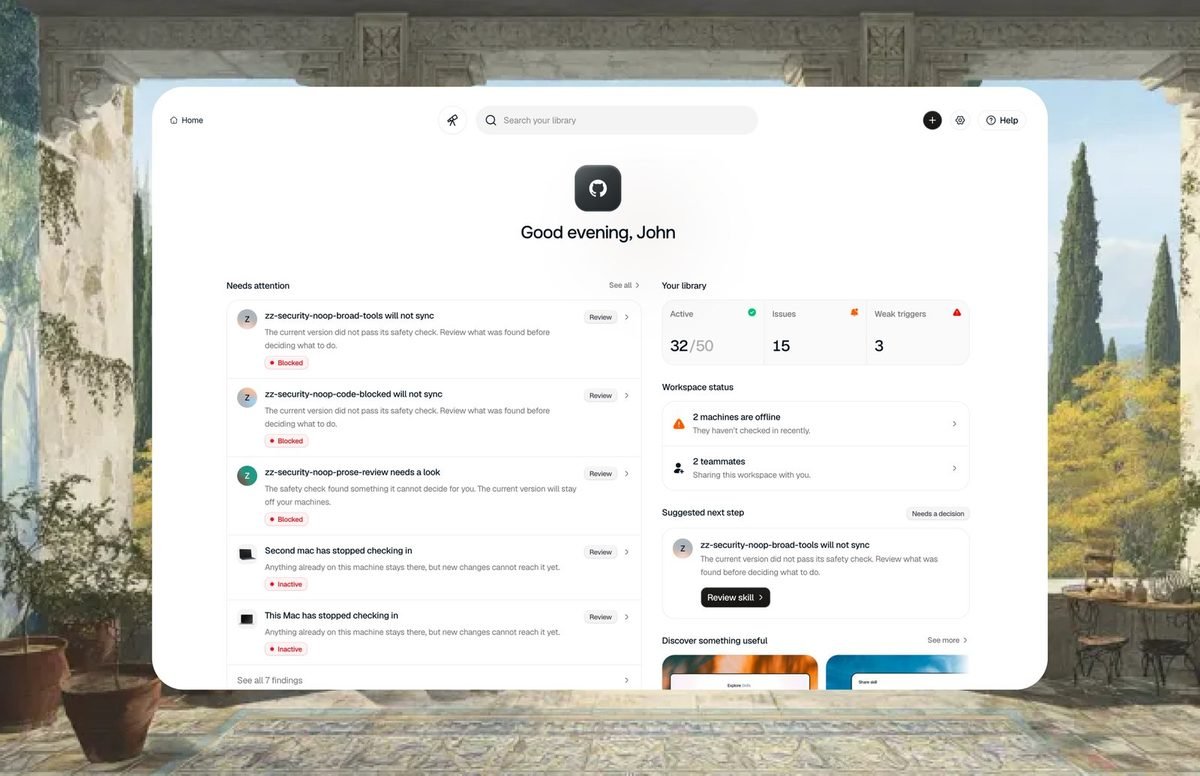
Adenekan Wonderful:Skillbox is for people who already use AI coding agents — Claude Code, Cursor, Codex and others — and whose skills have ended up scattered. One came from GitHub. Another lives in a project folder. Three more are installed in Cursor but missing from Claude Code. A teammate has the version everyone else should be using, and eventually nobody is sure what they have, which copy is current, or why one agent behaves differently from another.
The job is to give those skills a single library: import them from your computer, GitHub or GitLab, or pick one carefully from Explore; follow the source; review diffs when something changes; scan each version; and deliver a smaller active set to the tools and projects where it belongs.
The person who gets the most value is someone who cares which version is actually running, wants the same setup on every machine and tool, and wants a teammate’s good skill to have a proper home rather than being passed around in chat. Teams that want shared standards across a workspace, without forcing an automatic install on every person, get a lot from it too.
Startup.talk:How do you view your positioning relative to skills.sh, rulesync and Anthropic's own skills? Is there another competitor you think of first?
Adenekan Wonderful:skills.sh, rulesync and Anthropic’s own skills are all part of this landscape. Anthropic defined a lot of the skill format that tools now follow. Directories and rule-sync tools help you find or copy skills. We are trying to be the library you actually live in: one place to keep skills, follow their GitHub or GitLab sources, review diffs when something changes, scan each version, and deliver the right set to the right project and machine.
The competitor I think of first, though, is Tessl. We looked at them early on. They are building what they call a software factory: an agent-enablement layer for building, testing and distributing skills, with a strong focus on evals — measuring whether a skill actually changes what an agent does. That is important work. For the problem we were trying to solve, the everyday job of keeping a personal or team library in sync, reviewing incoming changes, and deciding what reaches your machines, that was not the UX we needed. So Tessl is still the name that comes to mind first when I think about the space, even though we are pointed at a slightly different job.
Startup.talk:What is your core moat that prevents Anthropic or anyone else from replicating your feature set?
Adenekan Wonderful:I would not claim that a feature list is impossible to copy. Anthropic and others could ship pieces of this. What is hard to reproduce quickly is the combination we had to get right: following a source without silently overwriting the version you already use, binding a security check to a content hash so an approval does not follow the skill’s name, pinning one person to a known version while streaming an update to someone else, and doing that across teams with proper access control.
Under the hood we designed it so many clients can share the same version tags, which is how we think about running this at a much larger scale — hundreds of thousands of skills, not just a few thousand. The other half is the feel of the product: the polish, the onboarding, the way updates and reviews work, so people actually trust it as a daily driver. Shedrack’s background in security, cloud and DevOps was a big part of getting that architecture right. After a point you cannot prompt your way through those details. You need experience to make them work.
Startup.talk:What are some of the use cases for Skillbox that are not obvious and can add a lot of value to users? List as many as possible.
Adenekan Wonderful:- Capture a session that went well and turn the approach into a reusable skill, with the names, paths and private details from that conversation left out. It lands in your library and stays private until you publish it, and it is there the next time you work.
- Follow a GitHub or GitLab source and review the exact diff before an update reaches your machines, instead of pulling the new version by hand.
- Pin one teammate to a known-good version while someone else receives updates automatically.
- Give each project its own active set of skills, so a frontend repo does not load the same setup as a release repo, then keep that set consistent across the machines you work on.
- Pause unused installs and get a nudge when two skills look like they overlap, without deleting them from the library.
- Preview a skill in an isolated chat before you rely on it.
- Require a skill as a team standard so a project’s conventions stay in place, while sharing still does not auto-install for everyone.
- Keep executables off machines until someone opts in, even if the rest of the skill looks fine. An exception on one version does not cover the next update.
- Use Trim so test and build output stops eating the agent’s context, with the full log still on the machine.
- For teams outside engineering: we are already hearing from companies that want the same shared-skill idea for sales and marketing, not only for developers.
- Browse Explore, inspect a public skill’s instructions and files, and add it deliberately, rather than installing from a README in a hurry.
Startup.talk:How well can anyone trust a skill from a public repository today?
Adenekan Wonderful:Not very well, on its own. A public repository can change, and a skill can include scripts and instructions that are easy to miss. Anyone can publish something that looks useful.
Skillbox helps by checking each version, showing you the files and the diffs, and holding delivery when Trust needs a decision. Cisco’s scanner adds another set of findings. None of that is a guarantee. A pass means we did not find a known threat pattern in that version, not that the skill is harmless. You should still read what you are about to run, especially if it came from a source you do not already trust. Trust developers you do trust, review updates from everyone else, and do not let an exception on one version silently cover the next.
Startup.talk:What is the one detail in Skillbox you are proudest of?
Adenekan Wonderful:Two things, and I care about both.
The first is the polish: the onboarding, the type, the colour, the way the app feels to use. I care about the micro-animations, the stagger when you open a dropdown, the timing that just feels right. Most people would never measure it, but they feel it.
The second is the architecture itself: how we handle security attestation, tagging, syncing skills across teams, and access control. These are small, unglamorous details. After a point you cannot prompt your way to them. You need experience to make them work.
Launch
Startup.talk:Skillbox launched on 11 November. What happened in the first hours?
Adenekan Wonderful:The first hours were amazing. We had a huge amount of support, almost immediately. Shortly after we went live we were sitting at number six or seven. People from the Product Hunt community were reaching out to me and to Shedrack to say they loved what we had built. That kind of organic response means a lot.
Startup.talk:Which feedback from the launch surprised you?
Adenekan Wonderful:I assumed that because Skillbox is a desktop app, there would be a real barrier to actually using it. I thought people would visit the site, click around, and leave. Within two or three hours we had about 50 installs, and people were signing up and syncing their skills. I had not expected that. I was so happy. It was the first clear sign that we had built something that made sense to people other than us.
Startup.talk:How did you prepare for the launch?
Adenekan Wonderful:Shedrack and I launched it together. I had also been through Product Hunt before: a previous product of mine landed at number seven, so I had a sense of how the site works and I was not overly anxious about it. I still prepared carefully. I did not want to be overconfident. We used the same approach I had used to launch earlier products.
Startup.talk:Skillbox is a desktop app. What did you learn about launching one?
Adenekan Wonderful:I went in expecting the install step to be a real barrier. I thought people would browse the site and leave. What surprised me was how quickly people signed up, installed it, and started syncing skills — about 50 installs in the first two or three hours. If the product solves a problem people already have on their machines, a desktop app is not the obstacle I feared it would be. The harder work is still making the first hour feel polished enough that they trust it.
The hard part
Startup.talk:How many people use Skillbox today?
Adenekan Wonderful:We are at a few hundred users, and about 3,000 synced skills. That is a lot when you think about what each skill represents, and it is still a size where we can actually hear from people. Users have emailed me about bugs, and we fixed them quickly. I love that. The architecture is built so we can manage skills at a much larger scale, but I would rather have honest numbers and real feedback than a figure we cannot learn from.
Startup.talk:What was the hardest stretch of building Skillbox?
Adenekan Wonderful:The hard stretch was figuring out the architecture that would actually work: the middle ground between getting the UX right and not giving people too much to deal with. We wanted something powerful enough for teams, versioning and security, without making everyday use feel heavy. Finding that balance took time.
Startup.talk:Who believed in what you were building before there was anything to show? What did they say or do?
Adenekan Wonderful:Shedrack believed in it early, and he did more than cheer from the side. He came in with the cloud, security, DevOps and documentation experience I did not have, and he helped shape the product. For my part I was already living with the problem, so I was my own first believer. And once we launched, the people who installed it in those first hours, and the users who take the time to email us when something is wrong, have meant a great deal.
What it is all for
Startup.talk:What would make you say Skillbox has succeeded?
Adenekan Wonderful:For me and for Shedrack, Skillbox has already become a daily driver. We have been using it every day for weeks, and it is a strange, good feeling to realise we have built something we ourselves cannot live without. Success is passing that same behaviour to the next 10,000 developers: people actually using it every day, and actively syncing their skills. That is the number I would look at.
Startup.talk:If agents write and share their own skills, who should review them?
Adenekan Wonderful:A human should. If an agent writes a skill, the person or team who is going to run it needs to review it before it reaches their machines, the same way they would review a skill from a public repo.
In Skillbox, a captured skill lands in your library and stays private until you publish it. We help pull the reusable method apart from the names, paths and private details that belonged only to that session, and we still check the version. Trust can hold delivery, and executables still need an explicit opt-in. None of that replaces a person reading the instructions and the files. A passing check is not a sign-off. The more agents write and share their own skills, the more important that human review step becomes, especially inside a team.
The road ahead
Startup.talk:What are your milestones for the next 12 months, in users and revenue?
Adenekan Wonderful:We want to start monetising Trim and get Skillbox into the hands of more teams. We already have interest from companies in San Francisco, including some YC companies, that want team-wide skills across sales, marketing and engineering. That is the next stretch: go from a daily driver for individuals to a library teams can actually run on.
Startup.talk:And for the next 24 months?
Adenekan Wonderful:In the next 24 months we want to sign more logos. Same direction, more teams actually running Skillbox as part of how they work.
Startup.talk:Where do you want Skillbox to be in five years?
Adenekan Wonderful:I want Skillbox to become a layer for how agents authenticate and communicate, not only a library for skills. You would install it in your organisation, connect something like Linear, and everyone who should have access would have it. Skills, MCPs, and context management sitting together as the knowledge and permission layer for agents.
Startup.talk:What are your hopes and fears for a post AGI world?
Adenekan Wonderful:I do not really have fears about a post-AGI world. Knowledge is power, and if we already have knowledge in our pockets, I genuinely do not see what we should be afraid of. I think it makes us faster as humans. Everything in life is a bit scary, and everything carries risk, but that does not stop us living every day. The risks are still there. We just live our lives.
“Knowledge is power, and if we already have knowledge in our pockets, I genuinely do not see what we should be afraid of.”Adenekan Wonderful
This interview was conducted in writing and has been edited lightly for length and clarity.
About Skillbox
Skillbox is one library for AI coding skills, synced across Claude Code, Cursor, Codex and your machines. It follows GitHub and GitLab sources, shows diffs, checks every version with Skillbox Trust and Cisco Skill Scanner, and includes Trim to keep agent context clean. Free to start; Individual from £6.99 a month. skillbox.so
For founders
Building something? Want to share your journey?
Tell us how it started, what nearly broke it and where it is headed. We will turn it into a story like this one.
Share your journeyFor readers
Want to read more human stories behind the startups?
New founder interviews and stories, as they are published.
Follow us on LinkedIn