
Priyank Upadhyay grew up in Asansol, West Bengal, and studied engineering at Asansol Engineering College. Upadhyay led mobile apps and backend at Yellow.ai, built Kubernetes multi-cluster infrastructure at Avesha, spent years in the CNCF and Docker open-source communities, coined the term Site Reliability Intelligence and hosts The Root Cause Podcast.
RubixKube is a Site Reliability Intelligence platform: invisible software that sits inside production, builds a memory of how the infrastructure works and what broke before, finds the root cause of each incident with evidence, and fixes as much as the team has let it earn. Its companion Kepler is a desktop agent for the person on call. We spoke about why memory is the real gap, how trust is earned from Observe to Auto, and why Upadhyay does not call it an AI SRE.
Key takeaways
- Upadhyay argues the disease in operations is amnesia: when the people who hold the map of a system leave, the next incident starts from scratch, so RubixKube stores how the infrastructure works and what fixed it before.
- RubixKube works in three modes, Observe, Assist and Auto, and deleting, scaling to zero and replacing what people wrote never run on their own in any mode.
- Every claim in a root-cause report points at something a tool returned, code checks each citation, and when evidence is thin the report says likely, not confirmed.
- In one three-week run in October 2026 on a customer's environment, RubixKube handled 856 incidents and folded 476 alerts into 165 investigations.
- Kepler ran a 136-day closed beta with 220+ engineers and goes live for everyone on 20 November 2026; RubixKube is bootstrapped.
Before any of this
Startup.talk:Where did you grow up, and what was childhood like?
Upadhyay:Asansol, a town in West Bengal. I grew up there and studied engineering there. I was a curious child who loved breaking things to see how they worked and putting them back together differently. Artist by heart, engineer by habit. By school I was already building websites for local businesses, around 2010 and 2011, long before anyone called that a career. The other thing that started early was community: tech meetups, people building things, people starting things. I have never really stopped doing either.
Startup.talk:What first got you into building things?
Upadhyay:Tinkering, and then someone paying for it. I was building websites for shops and businesses in Asansol while still at school, in 2010 and 2011. Nobody taught me. I broke things until they worked. The same pattern came back in 2019 when I left a steady job and freelanced for nine months in Pune: web apps, mobile apps, websites, graphics work, whatever someone needed. I learned Flutter and the MEAN stack by shipping with them, which is the only way I have ever learned anything. That is where I found out I like zero to one. The ambiguity, the pressure, the responsibility. Some of the best engineers I have met started exactly like that, building something they were not qualified to build yet.
Startup.talk:What was your first job, and what did it teach you?
Upadhyay:Persistent Systems in Pune, 2017, on the IBM Security team writing security adapters and middleware. Unglamorous, and it taught me the thing I still repeat: a system is only as safe as what it trusts. Every door the attackers came through this October was a token someone forgot or a vendor with more access than it needed. I learned to read that at my first job. It also taught me I wanted to be closer to the whole system than to one adapter inside it. Yellow.ai and Avesha came after, and that is where I learned what production actually costs the people who run it.
The road to RubixKube
Startup.talk:What made you start RubixKube?
Upadhyay:Google invented the site reliability engineer in 2003 with a specific split: thirty percent on incidents, thirty on automation, forty on new capability. The industry adopted the title and never adopted the split. At Yellow.ai, at Avesha, and across years in the CNCF and Docker communities talking to engineers at NVIDIA, Google and Oracle, I kept hearing the same number: ninety percent firefighting. The automation bucket never got funded. There was always a more urgent fire.
What stayed with me was the amnesia. Every team has a few people who hold the whole system in their heads. When they leave, the map leaves with them, and the next incident starts from scratch. Then AI arrived that could read systems the way those people do and not forget what it saw last month. The cloud changed where infrastructure runs. This changes who understands it. I think it is the biggest shift in operations since the cloud, and I wanted to build the thing it needs.
“I wanted to build the thing it needs.”Priyank Upadhyay
Startup.talk:What did you see on-call teams struggle with that convinced you an AI SRE was needed?
Upadhyay:Look at what an on-call engineer has open. Datadog and Grafana serve the infrastructure. PagerDuty serves the organisation. Confluence stores what the company believed when somebody wrote it down. The incident platform serves the postmortem. All useful. None of them is hers. Every tool in operations was bought by the company, for the company, and the person holding the pager sits inside that purchase as a cost, not a customer. The operator is the last unserved user in engineering.
So the part that matters, between the alert and the fix, runs on the folded sheet of paper in her pocket: which node was flaky last quarter, which alert is noise, who answers after midnight. When the incident closes, the org gets a postmortem. She gets nothing, and the next one starts from her memory again. Once I saw that clearly, an AI SRE stopped being a nice idea and became the obvious missing layer.
Startup.talk:How did RubixKube grow from an idea into something running in production at real teams?
Upadhyay:I described it to the CTO of a leading AI company and he said: how can I log in? That was the first design partnership. We put the prototype in their staging, and in one of the first engagements it found a hidden cloud cost problem in five minutes that would normally have taken days of engineering. The migration was planned and done over a weekend. That told me the thesis was right. Everything since has been earning the right to be in production.
We earn it by building every capability as an agent first, proving it on real incidents in a harness, and only then moving the proven parts into code. We run it on our own production every day. In October 2026 we ran three weeks on a customer's clusters: 856 incidents, 476 alerts folded into 165 investigations, RCAs written with the evidence attached before anyone opened the page. That is the difference between a demo and software people leave switched on.
Startup.talk:What is it like to build RubixKube as a small team?
Upadhyay:I hire on three things, in this order: a learning mindset, ownership, and wanting to start your own company someday. The third one sounds like a risk until you have run an early-stage team. People who think like founders do not need a culture document to take ownership. I got that from Yellow.ai, where the culture said out loud that the corporate ladder is not the only direction.
In practice: a very small team across time zones, Imran running everything that is not code so that I can build, and for a long while a standup at 11pm Bangalore time because that was when everyone overlapped. Small means we build the general thing, not the thing the last customer tripped on. We don't build dashboards, we don't copy features, and nothing ships that we would not run on ourselves. Building infrastructure that does not forget, and hiring people who will one day leave to build their own thing, is the same idea. The knowledge should outlive the person.
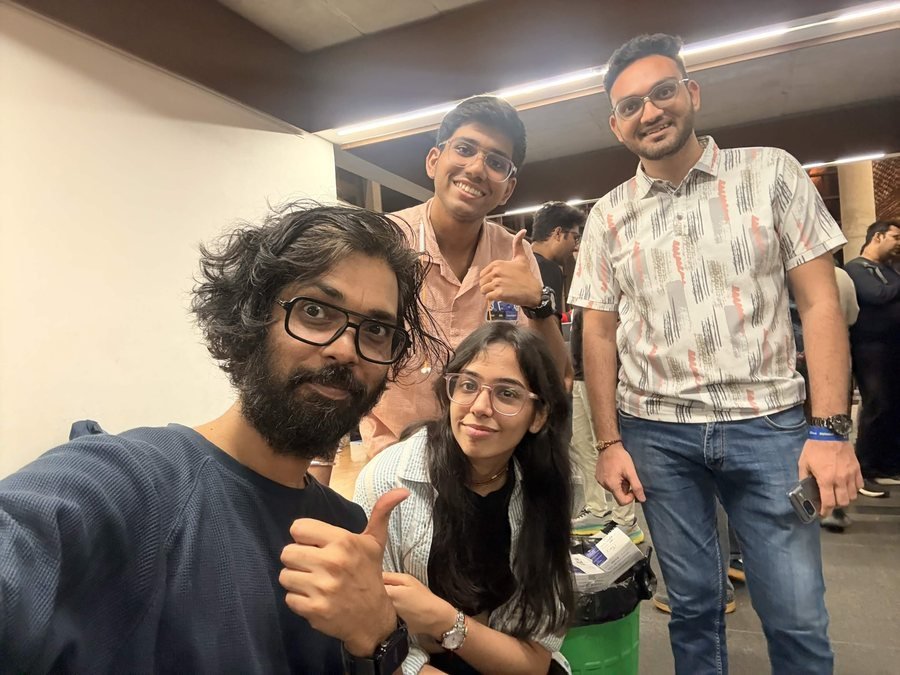
The product
Startup.talk:Why the name RubixKube?
Upadhyay:Rubik's cube and Kube, for Kubernetes, which is where we started. A scrambled cube looks like chaos until you know the moves. Then every face lines up and you wonder how it ever looked hard. That is exactly what an incident feels like before and after you understand it. Rubix, our agent, got his name the same way. A small cube with a big job. Yes, he has a mascot, and yes, people have built puzzles to find him when he goes missing.
Startup.talk:How does RubixKube decide that it has found the true root cause of an incident?
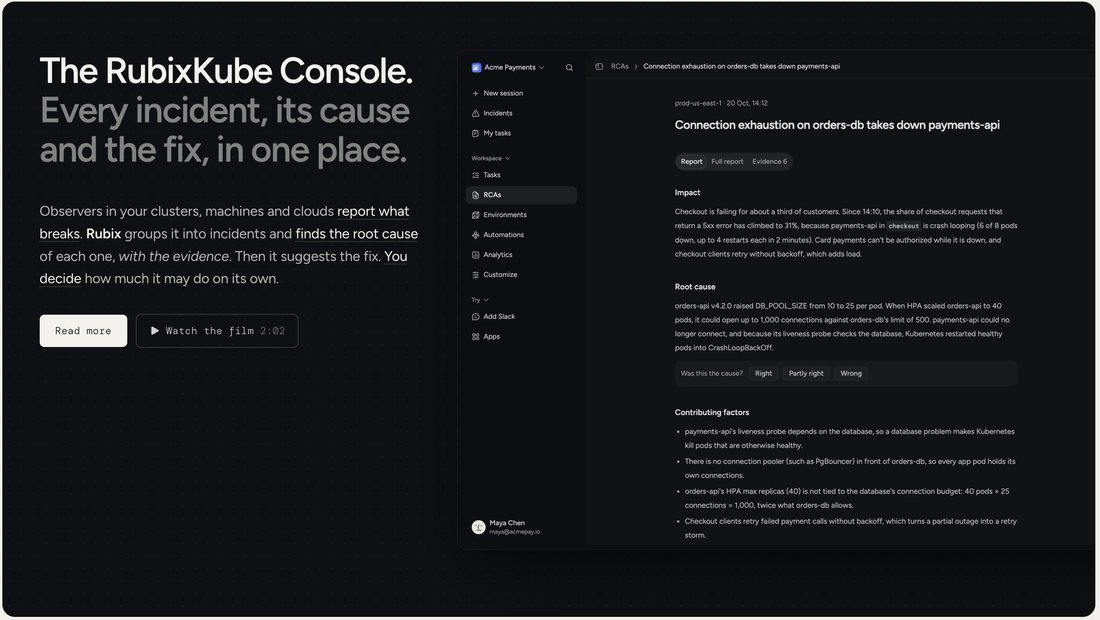
Upadhyay:It doesn't decide. Evidence does, and code checks the evidence. Every claim in an RCA points at something a tool actually returned, and we check every citation against the real output before the report exists. The verdict and the confidence are computed from that, not asserted by the model. The model writes the story. It does not grade its own homework.
The second half is memory. A root cause that is consistent with the last eighteen months of this system's history is worth more than one that is consistent with tonight's logs. Most tools meet your infrastructure for the first time at every incident. We don't, and that is most of the difference between a plausible cause and the true one. When the evidence is thin the report says likely, not confirmed. I would rather ship an honest probably than a confident guess, because engineers check.
“It does not grade its own homework.”Priyank Upadhyay
Startup.talk:How much should the system be allowed to fix on its own?
Upadhyay:As much as it has earned. Nobody gives software authority over production on day one, and nobody should. RubixKube starts in Observe: it watches and explains. Then Assist: it proposes, you confirm. Then Auto, for the tasks a team has watched it get right enough times: scale this down, restart that. Delete, scale to zero, and anything that replaces what people wrote never run on their own in any mode, and the system cannot loosen its own limits.
People ask how much the AI should be allowed to fix. The question I care about is how fast a team can safely get from Observe to Auto, because the destination is not a better pager. It is infrastructure that understands itself and fixes itself. Trust earned through a track record is the only road there. Automation that cannot explain itself is noise at speed.
Startup.talk:Why did you make RubixKube remember what worked in past incidents?
Upadhyay:Because the amnesia is the actual disease. Alerts, dashboards and AIOps all treat the symptom, too many signals. The disease is that every incident begins with a team that knows less about its own infrastructure than it did last quarter, because the person who knew left, or the postmortem sits in a document nobody reads.
So everything RubixKube sees goes into the Memory Engine: how the infrastructure works, what changed, what broke before, what fixed it. Who owns this service, what was it doing last week, if it goes down tonight what else goes with it. Teams can teach it too. In one PoC a single skill that only said where the logs live took the same incident from 23% to 80% confidence on the root cause. Nothing about the model changed. It knew where to look. That is all a senior engineer is: not smarter, better informed. Memory gives that to everyone, and memory does not resign.
Startup.talk:Who gets the most value from RubixKube: platform teams, SREs or startups without an ops team?
Upadhyay:Two kinds of people, and we built one product for each.
The platform team at a company with more services than people who understand it gets RubixKube: invisible software that watches production when nobody is there, builds the memory, and comes to you with the cause and the action. Plug it in, ten minutes on a standard Kubernetes setup, forget it exists.
The individual operator gets Kepler: a tool that is personal, local, wide and careful. It lives on her machine, carries her memory, works across every repo, cluster and dashboard she touches, and never widens its own fence. Developers got an entire industry built around one person. Operators got nothing until now. RubixKube watches when nobody is present. Kepler sits with the engineer. Those are the two ends of an incident.
Startup.talk:What do you deliberately leave out of RubixKube?
Upadhyay:Dashboards. A dashboard is a question, and the world has enough questions. RubixKube is invisible software on purpose: you should not have to use it. It comes to you.
Multi-tenancy, in Kepler. One operator, one machine, never a team seat. A SaaS would have been easier to sell, but the moment a tool reports to the organisation it stops being the operator's. Nothing leaves the machine unless she sends it.
The LLM, from the observer. It is a small Go agent, about 46 MB on a nine-node cluster, that reads and reports what changed. Your production context should not leave your boundary to get intelligence from it.
And the phrase AI SRE. On purpose. More on that below.
Positioning
Startup.talk:Who is RubixKube for, and what job does it do for them? Describe the person who gets the most value.
Upadhyay:The engineer who owns reliability without owning the services. Platform, SRE, DevOps, or the backend lead who got reliability by default. The job: when something breaks, know what broke, why, what it will take down with it, and what fixed it last time, before they open a single tab. When nothing is wrong, stay out of the way.
We rebuilt the console around two questions: what needs me, and what can I do about it. If a screen does not answer one of those, it should not exist.
Startup.talk:How do you view your positioning relative to PagerDuty, Datadog, incident.io, Rootly and other AI SRE tools? Is there another competitor you think of first?
Upadhyay:PagerDuty and incident.io own the page and the process. Datadog owns the signals. They are good at what they do and we plug into all of them. None of them hold the understanding, and understanding is where the time goes. Google's split gave thirty percent of an SRE's time to incidents. The industry runs at ninety. That gap is our market.
The question I get more often is why not Cursor or Claude Code with an MCP to Datadog. Because that is shaving with a chainsaw. A developer edits an inert world: the files hold still and git remembers everything. An operator acts on a living system that changes while you look at it and forgets the moment the incident ends. Wiring an IDE agent to your telemetry does not fix that. It still starts from zero when you prompt it, it has no memory of the Kafka lag that took you down three months ago, and it is built to complete the task, so it will restart the pod on the node that is partitioned. Keep creation tools in the editor. Production needs its own harness: always watching, remembering, and fenced.
And I don't call it AI SRE. That label presupposes the technology should behave like an SRE, same workflow, same ceiling. I call it Site Reliability Intelligence: infrastructure that understands itself. When a larger player adds AI SRE as a feature, it starts from zero. When we are in year two at a customer, we have context nobody can acquire from outside.
Startup.talk:What is your core moat in AI-driven incident response?
Upadhyay:Accumulated trust, and the memory it is built on. A Memory Engine that has watched one company's infrastructure for eighteen months knows that company in a way nothing bolted on later can. Every incident makes the next one shorter, and what is learned is checked against evidence, not remembered as text.
Models are rented, and they get better for everyone at the same time. What the system has learned about your infrastructure is yours, and it compounds. Trust follows the same curve: every correct recommendation widens what a team lets it do. You cannot ship that in a release, and a bigger company cannot buy it. They can only start from zero.
Startup.talk:What are some of the use cases for RubixKube that are not obvious and can add a lot of value to users? List as many as possible.
Upadhyay:Catching production impact while the code is still editable. We built a Cursor and Claude Code plugin that connects to live infrastructure context, so an engineer can ask from the IDE what this change will break, before the push. The same memory that diagnoses failures after the fact, applied at the point where it is cheapest to fix.
Cost. One of our first engagements found a hidden cloud cost issue in five minutes that would have taken days. Health and spend are the same question asked twice, and most monitoring only asks the first one.
Migrations. I asked Kepler to move our own CI/CD to GitOps, a job I had put off for months. It ran a war room of sub-agents, built the repo, the secrets, the image pipeline and the auto-updates, checked each step, and pinged me on WhatsApp for approvals. Under five hours. I had dinner.
Also: key rotation, where nobody rotates because nobody knows what will break, so it maps every use first. The CVE morning question, does this affect us, answered from clusters and lockfiles instead of let me check. Onboarding from the graph instead of from the one person who knows. Blast radius: if this goes down tonight, what goes with it. Postmortems that write themselves and, more important, get read next time, by the system if not by people.
Startup.talk:What is the one detail in RubixKube you are proudest of?
Upadhyay:A list of words. Before we drew a single screen of the new console we wrote down the word we use and the words we stopped using. Environment, not cluster. Incident, not insight. Organization, not tenant. Rubix for the agent, not RubixKube. Each of the old words was a small lie about what the product is, and every one cost the reader a little attention on every screen. Nobody will mention it in a review. It is the thing I am proudest of.
Close second: red only appears when something is actually wrong. When everything shouts, nothing is heard.
Launch
Startup.talk:What did you learn from your public launch?
Upadhyay:That Product Hunt is a room full of individuals, and RubixKube is a tool an organisation buys. People liked the idea. Very few of them could go and install an observer on their company's production cluster that afternoon. A new category needs education and a push, and a launch day gives you neither.
The lesson turned into a product. If the individual operator could not bring RubixKube to work, we would build something they could put on their own machine, with their own keys, and no one to ask. That is where Kepler came from.
Startup.talk:Which feedback from the launch surprised you?
Upadhyay:How personal the response was. We had positioned RubixKube for teams and platforms, and the comments came from individuals: the person on call, the one who carries the map. They did not ask what it would do for their company. They asked what it would do for them, tonight. We had been building for the organisation and the operator was the one answering. That is the gap Kepler fills.
The hard part
Startup.talk:How many people use RubixKube today?
Upadhyay:Kepler ran a closed cohort for 136 days: 220+ engineers on real systems, 600+ downloads, 118 in our Discord. At Hack Day Pune, 165 operators sent 3,095 requests through it in a day. They used it to chase crashing pods, read heap dumps and rotate keys. Kepler goes live for everyone on 20 November 2026 at rubixkube.ai/kepler.
RubixKube, the platform, runs on several startups' and enterprises' production environments every day. In one three-week run on a customer's environment in October 2026 it handled 856 incidents, folded 476 alerts into 165 investigations, and wrote the RCA with evidence before anyone opened the page.
Startup.talk:What is a challenging time you had building RubixKube?
Upadhyay:Building a category before it has a name. When you say AI SRE, buyers have a checkbox for it. When you say Site Reliability Intelligence, you spend the first twenty minutes of every meeting explaining why the checkbox is too small. I chose that on purpose, and it cost us time with people who only wanted the checkbox.
The other one was people. AI, Kubernetes and real production experience in the same person is one of the hardest searches in Indian engineering. We ran standups at 11pm Bangalore for months to hold a team across four countries together. The answer in both cases turned out to be the same: hire for learning and ownership rather than the checklist, and let the product do the convincing. One CTO saying how can I log in is worth more than any pitch I have given.
Startup.talk:Who believed in you before there was anything to show? What did they say or do?
Upadhyay:Before there was a product there were conversations, and the people I had worked with before carried me through them. Prasad Dorbala, who was CPO at Avesha, has been a guide and mentor from the start and sat through the earliest brainstorming with us. Eric Peterson, VP of Engineering at Avesha, gave me the direction and the access to move forward. Kishore, CTO at Yellow.ai and my old boss, heard the idea and said: how can I log in? That became the first design partnership.
The category did not exist yet, so the first months were prototyping and talking to people to find out what they were actually looking for. The very first of those conversations was with Brian Byun from Khosla Ventures. Years in the CNCF and Docker communities meant I could get to the right people: Randy Bias, John Capobianco, Kaushik Thirthappa, and many more, several of whom later sat down with me on our podcast, The Root Cause. By January 2026 we knew what people wanted, and that is when we launched.
With Kepler we went further and built it live with the people who would use it: a beta cohort that shaped it for 136 days before anyone else could download it.
Startup.talk:How do you earn the trust of engineers before they let an AI touch production?
Upadhyay:You don't ask for it. You start in observation mode and let the recommendations be right. Engineers check. They check three RCAs, find them right, and delegate the small, well-understood things. Then bigger things. The autonomous loop expands through track record, never through a settings page. Every claim has evidence, every action has a trail, nothing destructive runs on its own, and the system cannot grant itself permission.
And when the evidence is thin, the report says so. An engineer forgives probably a hundred times. They never forgive one confident wrong answer they acted on.
What it is all for
Startup.talk:What would make you say RubixKube has succeeded?
Upadhyay:When an engineering team spends its time the way Google meant in 2003. Thirty percent on incidents, not ninety. When a senior engineer resigning is the loss of a person and not the loss of the map. When the infrastructure knows what is happening, why it is failing and how to fix it, and most incidents never reach a human at all. Revenue follows that. It does not lead it.
Startup.talk:What will on-call look like when AI handles most incidents end to end?
Upadhyay:The pager becomes rare and the work becomes senior. Known failures are handled by checks and remedies that came out of past investigations, and plain code runs those without a model. People review decisions, teach the system, and finally get to the forty percent that was always meant for new capability. The few who used to carry the whole map get their evenings back, and their knowledge stops being a single point of failure.
I don't believe in the agent running alone, and I don't believe in humans opening five tabs forever. The shape is two ends of an incident: something that watches when nobody is there, and something that sits with the engineer when someone is. Infrastructure that heals itself, with you deciding how far.
The road ahead
Startup.talk:Where do you want RubixKube to be in five years?
Upadhyay:Self-healing infrastructure as the default expectation, the way version control is. The layer that knows what is happening, why, and what to do about it, running under most production systems. What is learned travels between customers without any data moving, so a new customer starts protected by every incident every earlier one had. And Site Reliability Intelligence as the name of the category, because by then AI SRE will sound like a feature, which is what it is.
Startup.talk:What are your hopes and fears for a post AGI world?
Upadhyay:The goal does not change. If something else comes, AGI or whatever follows LLMs, the infrastructure should still know what is happening, why it is failing, how to fix it, and fix itself. We built it so the model is replaceable and the memory is not. That is the hope: the model gets better for free, and everything learned about your systems compounds on top of it. A self-healing infrastructure is the future I am building for, and a better model only gets us there sooner.
The fear is where the memory lives. AI for infrastructure needs logs, configs, credentials and topology. A world where every company has to send its production reality to three data centres to get any intelligence from it is not one I want to be on call for. So the model comes to the data, asks before it touches anything, and the boundary stays yours.
This interview was conducted in writing and has been edited lightly for length and clarity.
About RubixKube
RubixKube is a Site Reliability Intelligence platform. Invisible software that sits inside production, builds a memory of how the infrastructure works and what broke before, finds the root cause of every incident with evidence, and fixes as much as the team has let it earn. Kepler is its desktop agent for the people on call. rubixkube.ai
| Attribute | Verified Detail |
|---|---|
| Company | RubixKube |
| Founder(s) | Priyank Upadhyay |
| Country | India |
| Grew up | Asansol, West Bengal, India |
| Background | Yellow.ai (mobile and backend lead), Avesha (Kubernetes multi-cluster), CNCF and Docker communities |
| Also | Host of The Root Cause Podcast |
| Funding | Bootstrapped |
| Official Website | rubixkube.ai |
More founder interviews
 ATS Engine
 Dailies.games
 OkTreat
 BuenEd
For founders
Building something? Want to share your journey?
Tell us how it started, what nearly broke it and where it is headed. We will turn it into a story like this one.
Share your journeyFor readers
Want to read more human stories behind the startups?
New founder interviews and stories, as they are published.
Follow us on LinkedIn