
Snigdha Tantipudi grew up in India, later experienced the American education system through Acellus Academy, and started out as a web developer at FSH Works & Services before founding BuenEd Private Limited. Tantipudi works across product, engineering, strategy and community, and writes much of BuenEd's code personally.
BuenEd is a free AI-powered platform for the whole university journey: students explore more than 80,000 universities in 150+ countries, get personalised guidance from the STyra AI assistant, and use an essay helper, resume builder and currency converter, with no paid placements and a student ambassador programme. We spoke about how a fragmented search became a product, why recommendations are never for sale, and what Tantipudi wants BuenEd to look like in five years.
Key takeaways
- Tantipudi saw university search as fragmented: dozens of websites for rankings, requirements, essays and scholarships, so BuenEd grew from a search engine into a guidance ecosystem.
- The structured database covers 80,000+ institutions across 150+ countries, and Tantipudi treats it as an evolving foundation rather than a finished directory.
- BuenEd keeps the core platform free and refuses paid placements, because a recommendation should exist for suitability and not because an institution paid for visibility.
- The platform has passed 500 registered users; the targets are 10,000+ users and $25,000 in annual revenue within 12 months, and 50,000+ users and $100,000 within 24 months.
- A student can pick a university, major and year and take a 40-question, 60-minute assessment of the academic expectations they would face.
Before any of this
Startup.talk:Where did you grow up, and what was childhood like?
Tantipudi:I grew up in India, where my early experiences shaped much of how I look at education, opportunities, and personal growth. Later, I had the opportunity to experience the American education system as well, which gave me a different perspective on how students approach higher education.
Moving between different educational environments made me increasingly aware that opportunities exist across the world, but accessing the right information is not always easy.
I've always been curious about technology, possibilities, and how things work. I think that curiosity eventually became a significant part of my entrepreneurial journey.
Startup.talk:What first got you into building things?
Tantipudi:My interest in building things came from curiosity and the desire to turn ideas into something tangible.
I was particularly fascinated by technology because it allows one person to create something that can potentially reach thousands or even millions of people.
Programming gave me the ability to move beyond simply imagining solutions. I could identify a problem, learn the tools required, write the code, and actually build something people could use.
Over time, I became more interested in developing complete products rather than just experimenting with individual pieces of technology. That combination of curiosity, independence, and problem-solving eventually led me towards entrepreneurship.
Startup.talk:What was your first job, and what did it teach you?
Tantipudi:My first professional role was as a Web Developer at FSH Works & Services, where I worked on AVIV.
The experience gave me an opportunity to apply my technical knowledge in a professional environment and understand what it means to develop something beyond personal projects.
It taught me the importance of translating requirements into working solutions, approaching problems systematically, and understanding that writing code is only one part of delivering a product.
It also helped me appreciate the difference between building something independently and working within a professional development environment.
That experience, combined with building my own products, has helped shape the way I approach software development and entrepreneurship.
The road to BuenEd
Startup.talk:What made you start BuenEd?
Tantipudi:BuenEd started with a problem I felt was much bigger than it initially appeared: choosing the right university and navigating the admissions process should not be so complicated.
Students often have to visit dozens of websites, compare universities manually, research eligibility requirements, understand different application systems, prepare essays, and figure out which opportunities are actually suitable for them.
Much of this information is scattered across different platforms, and the process can become especially difficult for international students.
I wanted to build something that brought these different pieces together.
The original idea was to make university discovery easier, but as I explored the problem further, I realized that students needed more than a search engine. They needed guidance throughout their higher-education journey.
That is how BuenEd evolved into an AI-powered global education ecosystem.
My goal was not simply to help students find a university, but to help them make more informed decisions about their future.
Startup.talk:What did you see about the university search that made it feel so overwhelming for students?
Tantipudi:The biggest problem I noticed was fragmentation.
There is plenty of information available online, but it is spread across university websites, ranking platforms, admissions portals, scholarship databases, forums, and private consultancy services.
Students are expected to collect all this information, understand it, verify it, and then determine which options are relevant to their individual circumstances.
There is also a significant difference between finding a university and finding the right university.
A student might discover a highly ranked institution but still have no idea whether their academic profile, intended major, budget, or long-term goals make it a suitable choice.
International students face additional challenges because requirements, deadlines, tuition structures, currencies, and education systems vary between countries.
I felt there was an opportunity to make this process more centralized, personalized, and understandable.
Startup.talk:What is it like to found an education company as a young entrepreneur and developer?
Tantipudi:It is exciting, challenging, and occasionally overwhelming, but I wouldn't trade the experience.
Being a young founder means that you sometimes have to establish credibility before people fully understand what you are capable of.
You are learning business strategy, product development, technology, marketing, and operations simultaneously, often without an established team or substantial resources behind you.
As a developer, I have the advantage of being able to translate ideas into actual products. I don't have to wait for an entirely separate technical team to begin experimenting with an idea. I can build, test, identify problems, and improve the product myself.
At the same time, I've learned that technical ability alone doesn't build a successful company. Understanding people, making difficult decisions, and knowing which problems are worth solving are equally important.
I also think being young gives me a different perspective. I'm close to the generation experiencing these educational challenges, and I want to build something that genuinely reflects what students need rather than what companies assume they need.
Startup.talk:How did you build a database of 80,000+ universities across 150+ countries?
Tantipudi:One of the biggest technical undertakings behind BuenEd was building a university discovery system that could operate at a genuinely global scale.
We developed a structured university database covering more than 80,000 institutions across 150+ countries.
The process involved gathering university information, organizing records into a consistent structure, and developing a database that could support searching, filtering, and discovery across different countries and education systems.
An important part of this work was making the information usable rather than simply collecting a large number of university names. The data needed to be organized in a way that could support the actual student experience.
We approached the database as part of the larger product architecture because the quality of university discovery depends heavily on the quality and organization of the underlying information.
There is still room to expand and improve the depth, verification, and coverage of individual university records. I see the database as a continuously evolving foundation rather than a finished static directory.
The product
Startup.talk:Why the name BuenEd?
Tantipudi:BuenEd is a combination of two ideas: "Buen," meaning "good" in Spanish, and "Ed," representing education.
Together, the name represents "Good Education."
I wanted a name that was short, recognizable, and connected to the purpose of the platform without restricting it to one country, one education system, or one particular service.
For me, BuenEd represents the idea that access to quality educational opportunities should be easier, more transparent, and more accessible.
It is more than a brand name. It reflects the purpose behind what we are building.
Startup.talk:How does Styra AI personalise guidance for each student?
Tantipudi:STyra AI is designed to make the experience feel less like navigating a database and more like receiving personalized educational guidance.
Every student has a different academic background, intended major, preferred destination, ambitions, and circumstances. A generic recommendation cannot account for all these differences.
STyra is part of BuenEd's effort to make guidance more contextual. The platform uses relevant student information and educational goals to make its assistance more meaningful.
Instead of treating every student identically, the vision is to provide guidance that reflects where a student is academically and what they are trying to achieve.
I see STyra as an important part of the broader ecosystem because university discovery should not end with a list of search results. Students should be able to understand their options and receive help navigating the next steps.
Ultimately, the goal is to make personalized educational guidance accessible to students who might not otherwise have access to an individual admissions counsellor.
Startup.talk:Why keep BuenEd free with no paid placements, and how will it sustain itself?
Tantipudi:I believe students should be able to discover educational opportunities based on suitability, not on which institution has paid the most to appear in front of them.
University decisions can influence someone's finances, career, and future for years. I don't want the recommendations students receive to be distorted by sponsored rankings or paid placements.
Keeping the core platform free is also important to our accessibility mission. Students should not have to pay simply to discover universities or understand their options.
For sustainability, I see opportunities in value-added services, institutional partnerships, and other business models that can support the platform without compromising the integrity of its recommendations.
The distinction I want to maintain is that monetization should complement the student experience, never dictate it.
Building trust is more important than generating short-term revenue through placements.
“monetization should complement the student experience, never dictate it”Snigdha Tantipudi
Startup.talk:How do the essay helper and resume builder fit into the application journey?
Tantipudi:Finding a university is only one part of the admissions process.
Once students identify institutions they are interested in, they need to prepare application materials that communicate their experiences, abilities, and ambitions.
The Essay Helper and Resume Builder address two important parts of that journey.
The Essay Helper is intended to support students as they develop and improve application essays, helping them organize their thoughts and communicate their experiences more effectively.
The Resume Builder helps students create structured, professional resumes that present their academic backgrounds, achievements, extracurricular activities, and relevant experiences.
Together, these features extend BuenEd beyond discovery. We want students to have access to tools that help them move from researching opportunities to preparing for them.
Startup.talk:What role do student ambassadors play in BuenEd's growth?
Tantipudi:I see student ambassadors as an important part of building a global student community around BuenEd.
Students understand other students in a way that traditional marketing sometimes cannot. They know the questions people ask, the difficulties they encounter, and the kind of resources that would genuinely help them.
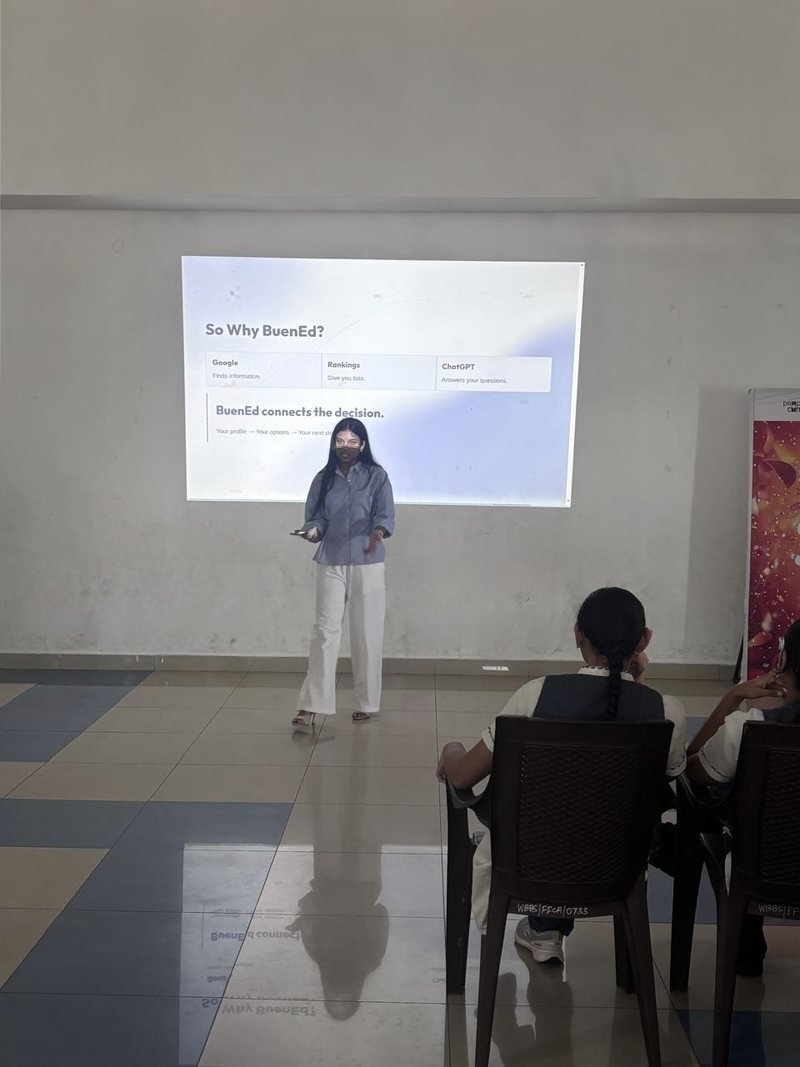
Our Global Student Ambassador Program is designed to bring students from different educational backgrounds and countries into the BuenEd ecosystem.
Ambassadors help introduce the platform to their communities, share useful resources, create awareness, and communicate student perspectives.
I don't want the program to be limited to referrals or promotional activities. I want it to become a two-way relationship where ambassadors also contribute ideas and help us understand the needs of students in different regions.
Startup.talk:What do you deliberately leave out of BuenEd?
Tantipudi:One thing I deliberately prioritize is relevance and trust.
BuenEd is not intended to become another general-purpose AI chatbot or a platform that overwhelms students with unrelated information.
Its purpose is specifically connected to higher education, university discovery, academic opportunities, and career-related preparation.
I also don't want to build a platform where universities can simply pay to influence what students see as their best options.
We need to be careful about how recommendations are presented, how information is communicated, and how much students should rely on AI-generated guidance.
I would rather have a focused platform that solves educational problems properly than one that tries to do everything without doing anything particularly well.
Positioning
Startup.talk:Who is BuenEd for, and what job does it do for them? Describe the person who gets the most value.
Tantipudi:BuenEd is designed for students worldwide who are exploring higher-education opportunities and need a more organized way to navigate their decisions.
Our ideal user is a student who has ambitions but may not know where to begin.
They might be considering studying abroad, comparing universities in different countries, researching a particular major, or trying to understand how their academic profile aligns with available opportunities.
It is also valuable for students who already know where they want to study but need help preparing their applications.
Beyond individual students, I see potential value for school counsellors, educational institutions, and organizations that support students through the admissions process.
Essentially, BuenEd is for anyone who believes that finding the right educational opportunity should be easier, more transparent, and less dependent on how much money they can spend on private guidance.
Startup.talk:How do you view your positioning relative to Leverage Edu, Yocket, Common App, Niche, College Board BigFuture and private admissions consultants? Is there another competitor you think of first?
Tantipudi:I think these platforms address different parts of the higher-education journey, and it is important not to treat them as identical competitors.
Platforms such as Leverage Edu and Yocket provide education counselling and study-abroad-related services. Common App focuses on application submissions to participating institutions. Niche and College Board BigFuture help students discover and evaluate educational opportunities. Private admissions consultants provide individualized support, often at a considerable cost.
BuenEd approaches the problem from a different direction.
We are building a centralized, AI-powered ecosystem that combines global university discovery with personalized guidance and practical application tools.
I don't believe the future of education guidance should require students to jump between multiple platforms to complete one journey.
Our ambition is to make the experience more integrated and accessible, while keeping the core platform free and avoiding paid university placements.
I view the broader category of fragmented education discovery and guidance as the problem we are competing against, rather than assuming that one individual platform is our only competitor.
Startup.talk:What is your core moat in AI university guidance?
Tantipudi:I believe our long-term differentiation will come from the combination of data, product integration, accessibility, and the experience we build around the student.
A university database by itself is not a moat. An AI assistant by itself is not a moat either.
The opportunity lies in connecting these components into a system that understands the student's goals and helps them navigate multiple stages of the educational journey.
Our global university coverage provides an important foundation. The integration of discovery, guidance, essay assistance, resume creation, and other educational resources creates a more complete experience.
Another important differentiator is our positioning around accessibility. We want students to have access to useful guidance without requiring expensive private counselling or relying on paid university placements.
Over time, the quality of our recommendations, the depth of our information, user trust, and our understanding of student needs can become increasingly important competitive advantages.
“A university database by itself is not a moat.”Snigdha Tantipudi
Startup.talk:What are some of the use cases for BuenEd that are not obvious and can add a lot of value to users? List as many as possible.
Tantipudi:I think BuenEd has applications beyond simply helping students search for universities. For example, students can use it to compare universities across different countries, discover institutions offering specific majors, explore alternative educational pathways, and understand how their academic backgrounds align with different university opportunities. It can also help students prepare application essays and professional resumes, organize their university research, and explore international education opportunities without having to navigate dozens of separate websites.
Another important use case is its potential to support school counsellors and educational organizations. Counsellors can use BuenEd's University Finder to streamline university research, explore options for multiple students, and spend less time gathering information manually. We also see opportunities in helping students understand international education costs through currency conversion and discover institutions beyond the globally recognized universities they might initially consider.
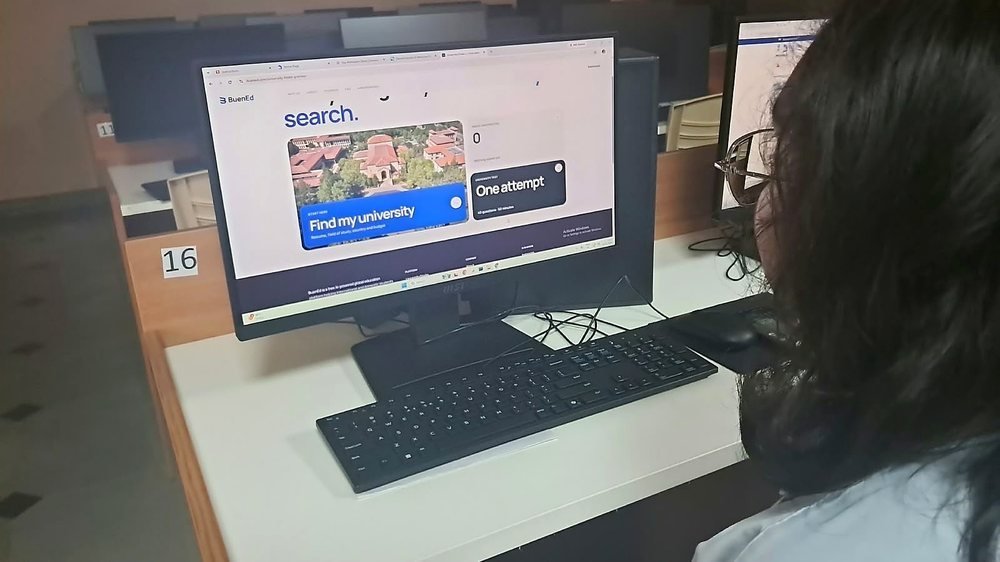
One feature I'm particularly excited about is our university-specific academic analysis assessment. Students can select a university, major, and year of study and take a 40-question assessment within 60 minutes. The purpose is to give them an opportunity to explore the academic expectations associated with their chosen university and understand how prepared they might be for that environment. Ultimately, I want BuenEd to become useful throughout a student's educational journey, not just at the moment they are choosing a university.
Startup.talk:What is the one detail in BuenEd you are proudest of?
Tantipudi:I'm particularly proud that BuenEd was built with the ambition of serving students globally rather than solving a problem for just one education system.
Building a platform that brings together 80,000+ universities across 150+ countries and connects that discovery experience with AI-powered guidance and application tools has been a substantial undertaking.
But beyond the technical achievement, what matters most to me is the idea behind it: a student should not need access to expensive resources or an extensive network of counsellors just to understand their educational options.
I'm proud that we have taken that idea and turned it into an actual product that students can access.
Launch
Startup.talk:What did you learn from launching on Product Hunt?
Tantipudi:Launching on Product Hunt taught me that building something and communicating its value are two very different challenges.
You can spend months developing a product and understanding its technical details, but a new user needs to understand its purpose almost immediately.
The experience reinforced the importance of clear positioning, a simple onboarding experience, and demonstrating the problem a product solves rather than simply listing its features.
It also showed me the value of putting a product in front of a wider audience. Feedback from people who have never been involved in its development can reveal things that you might overlook when you are too close to the product.
For me, the launch was an important opportunity to introduce BuenEd beyond its initial audience and learn how people respond to the idea.
Startup.talk:Which feedback from the launch surprised you?
Tantipudi:The Product Hunt launch gave me an opportunity to see BuenEd through the eyes of people who were encountering the platform for the first time.
One of the most valuable aspects of that experience was recognizing that the way founders understand their products can be quite different from how new users perceive them.
It reinforced the importance of making the platform's purpose immediately understandable and ensuring that the experience is intuitive for someone who has never used it before.
I think external feedback is particularly valuable because it helps identify gaps that internal development teams can sometimes overlook.
The hard part
Startup.talk:How many people use BuenEd today?
Tantipudi:BuenEd has crossed 500 registered users, with approximately 2,000 website traffic visits.
For an early-stage platform, I think it is important to look beyond registrations. Returning users and actual engagement give us another perspective on whether people find enough value to come back.
We are still in the early stages of growth, and I see these numbers as a starting point rather than the measure of what BuenEd can eventually become.
Our priority is to keep improving the product, understand how students use its features, and build something that creates lasting value.
Startup.talk:What is a challenging time you had building BuenEd?
Tantipudi:One of the biggest challenges has been building a relatively complex technology product with limited resources.
As a founder who is also deeply involved in development, I have had to balance product architecture, backend development, frontend experiences, integrations, debugging, deployment, and the business side of the company.
There have been technical issues that required significant troubleshooting, features that took longer than expected, and decisions about what to prioritize when there were more ideas than available resources.
Another challenge has been deciding how to turn a broad vision into something that can be launched and improved incrementally.
I have learned that progress does not always mean adding more features. Sometimes it means going back, fixing the foundations, and making sure the existing experience works reliably.
Those experiences have taught me patience and the importance of building sustainably rather than rushing simply to say something has launched.
Startup.talk:Who believed in you before there was anything to show? What did they say or do?
Tantipudi:My parents were the first people who believed in me and supported me when I decided to pursue this idea.
Starting a company at a young age is not necessarily the conventional path, and building something from scratch comes with uncertainty.
Their support gave me the confidence to explore the idea, spend time developing it, and continue working towards something that initially existed only as a concept.
Having people who believe in you before there are users, recognition, or tangible results makes a significant difference.
I'm particularly grateful that my parents supported my decision to take this path and gave me the opportunity to turn an idea into something real.
Startup.talk:How do you earn the trust of students and parents making such a big decision?
Tantipudi:Trust is particularly important in education because the decisions students make can have long-term consequences.
I think the first step is transparency. Students should understand that AI recommendations are guidance, not guarantees of admission or substitutes for official university information.
We also need to be careful about how information is presented and encourage students to verify important requirements, deadlines, fees, and eligibility criteria directly with institutions.
Our decision to keep the core platform free and avoid paid university placements is also connected to this principle. We don't want students questioning whether a recommendation exists because it is genuinely relevant or because someone paid for visibility.
Ultimately, trust cannot be established through marketing alone. It has to be earned through consistency, useful products, responsible communication, and an experience that puts the student's interests first.
What it is all for
Startup.talk:What would make you say BuenEd has succeeded?
Tantipudi:I would consider BuenEd successful when a student can approach the platform with uncertainty about their educational future and leave with a much clearer understanding of their opportunities and next steps.
I don't want success to be measured only by the number of users, countries, or universities in our database.
I want to know whether we have genuinely reduced the difficulty of navigating higher education, whether students from different financial backgrounds can access meaningful guidance, and whether our platform has become a trusted resource.
Commercial sustainability matters because a company needs to survive and grow to continue serving people. But I would never want growth to come at the expense of the original purpose.
If BuenEd eventually becomes a platform that students around the world instinctively turn to when thinking about their educational future, I would consider that a meaningful achievement.
Startup.talk:What will choosing a university look like when every student has an AI counsellor?
Tantipudi:I think university selection will become significantly more personalized.
Instead of students spending hours searching through unrelated websites and trying to understand which information applies to them, AI systems will be able to help organize their options around their academic interests, goals, preferences, and individual circumstances.
An AI counsellor could help students explore institutions, compare different destinations, understand application requirements, prepare materials, and identify questions they should ask before making a decision.
However, I don't think the role of AI should be to make these decisions on behalf of students. Choosing a university is a deeply personal decision, and human judgment will remain important.
I see the future as a combination of AI-powered accessibility and human decision-making. Every student should have access to a level of educational guidance that was previously available mainly to those who could afford it.
The road ahead
Startup.talk:What are your milestones for the next 12 months, in users and revenue?
Tantipudi:Over the next 12 months, my target is to reach 10,000+ registered users and generate $25,000 in annual revenue. Beyond these numbers, I want to strengthen BuenEd's position as a global higher-education platform by improving the quality and depth of our university information, making STyra AI more capable, expanding our international student community, and developing stronger institutional partnerships. I also want to explore sustainable monetization opportunities that allow us to grow without compromising the accessibility of the core platform or introducing paid university placements. My focus is on building a product that can grow consistently while maintaining the trust of its users.
Startup.talk:And for the next 24 months?
Tantipudi:Over the next 24 months, my target is to reach 50,000+ registered users and generate $100,000 in annual revenue. By this stage, I want BuenEd to have evolved beyond its initial product offering into a more established global higher-education technology platform. I envision stronger international adoption, deeper institutional relationships, a more sophisticated AI guidance experience, and a comprehensive set of tools supporting students throughout their educational journeys. I also want to establish a sustainable business model and a stronger operational foundation that allows the company to scale beyond its initial team and resources. Ultimately, I want these two years to establish the foundation for BuenEd's long-term global expansion.
Startup.talk:Where do you want BuenEd to be in five years?
Tantipudi:In five years, I want BuenEd to be recognized as a global education technology company rather than simply a university discovery platform.
I envision a world where students can use BuenEd as a starting point for their entire higher-education journey, from exploring possibilities and selecting institutions to preparing applications and navigating their academic future.
I want our technology to become increasingly intelligent, our university coverage to become more comprehensive, and our institutional network to extend across more countries.
I also want BuenEd to be financially sustainable and capable of operating at a much larger scale.
Ultimately, I want to build something that has a lasting impact on how people access education. The ambition is not just to build a successful startup, but to create infrastructure that makes global educational opportunities easier to understand and access.
Startup.talk:What are your hopes and fears for a post AGI world?
Tantipudi:My biggest hope is that advanced AI makes opportunities more accessible rather than concentrating them in the hands of a small number of people.
Education is one of the areas where I believe this could have an extraordinary impact.
Imagine a student in a small town having access to the same quality of personalized educational guidance as someone attending an expensive international school. That is the kind of future I would like to see.
At the same time, I think there are important concerns. If AI systems become increasingly influential in decisions about education, careers, and opportunities, we need to think carefully about accuracy, transparency, bias, privacy, and accountability.
I also worry about a future where people become overly dependent on AI without developing their own ability to think critically and make decisions.
I don't believe the goal of AGI should simply be to automate everything. It should be to expand what people can achieve.
As someone building with AI, I find that future incredibly exciting, but I also believe founders have a responsibility to think about the consequences of the technologies they create.
This interview was conducted in writing and has been edited lightly for length and clarity.
About BuenEd
BuenEd is a free AI-powered platform for the university journey, built by Snigdha Tantipudi in India. Students explore 80,000+ universities in 150+ countries, get guidance from the STyra AI assistant, and use an essay helper, resume builder and currency converter. There are no paid placements. buened.com
| Attribute | Verified Detail |
|---|---|
| Company | BuenEd |
| Founder(s) | Snigdha Tantipudi |
| Country | India |
| Grew up | India |
| Background | Web developer; founder of BuenEd Private Limited |
| Product | University Finder, STyra AI, Essay Helper, Resume Builder |
| Users | 500+ registered |
| Official Website | buened.com |
More founder interviews
 Test AI Models
 Appulse Index
 Rewisp
 VoCalm
For founders
Building something? Want to share your journey?
Tell us how it started, what nearly broke it and where it is headed. We will turn it into a story like this one.
Share your journeyFor readers
Want to read more human stories behind the startups?
New founder interviews and stories, as they are published.
Follow us on LinkedIn