
Mountaga Diallo was born in Guinea-Conakry, grew up loving math and solving problems, and arrived in France at 15, where Diallo finished a commerce baccalaureate and worked at Carrefour Market Drive. Page2Doc began as a personal itch: copying a webpage into a document broke fonts, dragged in backgrounds and meant hopping between ChatGPT, Google Translate, Excel and Word.
Page2Doc is a Chrome extension and web app that turns any webpage into a clean PDF, Word, Excel, CSV or JSON file, and can summarize, translate and extract tables without leaving the page. There is also an API for developers. Bootstrapped, Page2Doc says it has more than 700 users on the Chrome Web Store and around a hundred paying users, and Diallo is aiming for €10,000 in monthly revenue by December 2026, a goal rather than a result.
Key takeaways
- Diallo argues a webpage is not a document: converting it well means stripping navigation and ads while keeping headings, tables and structure, and shaping the output for PDF, Word or Excel.
- The competitor Diallo watches most closely is the browser itself, with its print button and built-in AI assistants, so a plain export button is not enough.
- Diallo does not call the conversion algorithm a moat; the bet is reliable extraction across messy sites, AI processing and an API that makes Page2Doc infrastructure for other products and AI agents.
- Page2Doc reports more than 700 Chrome Web Store users and around a hundred paying users, and the first Product Hunt launch was, in Diallo's words, a reality check.
- Over the next 12 to 18 months the focus is a sustainable SaaS business, with a target of €10,000 monthly revenue by December 2026.
Before any of this
Startup.talk:Where did you grow up, and what was childhood like?
Diallo:I was born in Guinea-Conakry, in West Africa, and grew up loving math and solving problems. At 15 I arrived in France and started high school in commerce, graduating with a baccalaureate in commerce.
Startup.talk:What first got you into building things?
Diallo:I was on my laptop trying to convert a file and edit it, but the process was too slow. I had to copy and paste every time, and when you copy and paste you sometimes get a mismatch of fonts, or you even copy the background and paste it into your document. So I wondered: what if I built a tool where I insert a link and it turns the page directly into a document? That is how Page2Doc started.
Startup.talk:What was your first job, and what did it teach you?
Diallo:I worked as a work-study employee at Carrefour Market Drive. It taught me about speed, customer satisfaction and respect for colleagues and teammates.
The road to Page2Doc
Startup.talk:What made you start Page2Doc?
Diallo:Page2Doc started as a personal project to turn web content faster into clean, usable documents, because of my own pain handling web content and getting it into an editable document.
Startup.talk:What was the moment you got fed up with saving webpages as messy files?
Diallo:It wasn't necessarily one dramatic moment. It was the accumulation of small frustrations.
Imagine finding an interesting webpage and wanting to do something useful with it.
You open ChatGPT to summarize it. Then Google Translate to translate it. Then Excel because you need a table. Then Word or Google Docs because you want to edit the content.
Suddenly, you're switching between a dozen tabs, copying and pasting information and trying to preserve formatting.
I remember thinking: why should I have to leave the webpage and use five different tools just to work with information that is already in front of me?
That question became an important part of the Page2Doc vision.
Startup.talk:How did Page2Doc grow from a webpage-to-PDF converter into an AI tool for tables, summaries and structured data?
Diallo:The evolution came from understanding that converting a webpage is not necessarily the end goal.
A PDF is useful when you want to preserve information. A Word document is useful when you want to edit it. An Excel file is useful when you want to analyze data.
But what happens when you want to understand the information?
That is where AI changes the equation.
We started thinking beyond file formats and toward information workflows.
Page2Doc gradually expanded to include capabilities such as:
AI-powered summaries.
Translation of webpage content.
Table extraction and structured data.
Keyword extraction.
Content analysis.
Metadata extraction.
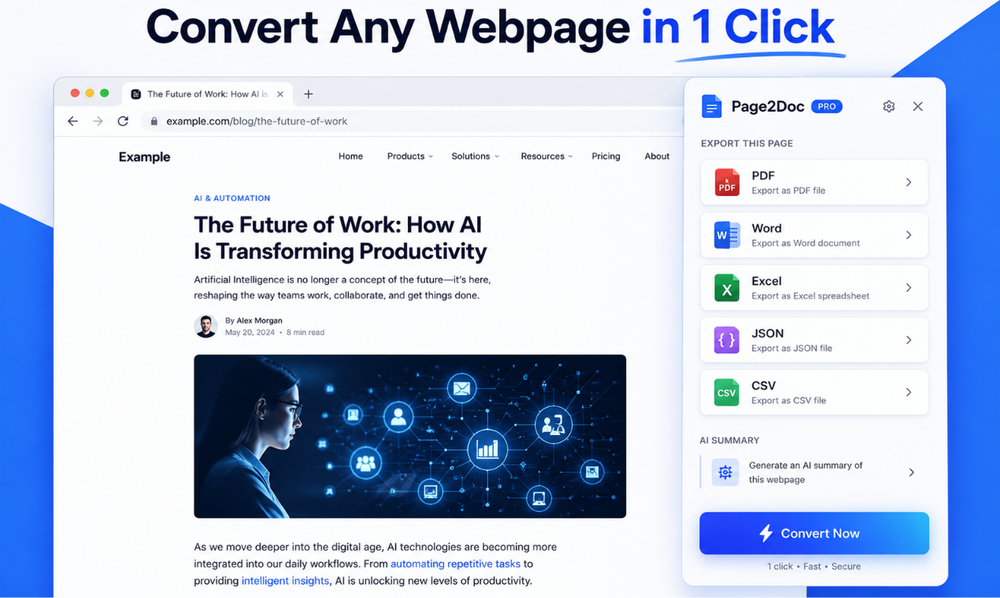
Multiple export formats, including PDF, Word, Excel, JSON and CSV.
The fundamental idea is that users shouldn't have to manually reconstruct information every time they want to reuse it.
We want to reduce the distance between discovering information and doing something meaningful with it.
Startup.talk:What is it like to build Page2Doc as a small team?
Diallo:Building a product with limited resources forces you to be extremely intentional.
You cannot afford to build everything. Every feature, technical decision and marketing experiment has an opportunity cost.
One of the biggest challenges is balancing three things: building a reliable product, understanding what customers actually need and making sure people discover that the product exists.
There is also a very personal side to it. When you're building a small product, you experience everything directly: the bugs, the customer feedback, the infrastructure decisions, the marketing experiments and the uncertainty.
But there is an advantage too. You can move quickly, make decisions without unnecessary complexity and stay close to the product.
I see being a small team as an opportunity to remain focused rather than a limitation.
The product
Startup.talk:Why the name Page2Doc?
Diallo:The name describes the original promise very directly.
Take a webpage — a Page — and turn it into a Document — a Doc.
The name was suggested by the Replit AI agent, and I kept it because the .com domain was available.
Startup.talk:How do you turn a cluttered webpage into a clean document?
Diallo:The challenge is that a webpage is not a document. It is a collection of different elements: text, navigation, advertisements, images, menus, interactive components, tables and sometimes dynamically loaded content.
Simply printing a webpage doesn't necessarily produce a useful document.
The approach is to identify and extract the meaningful content while minimizing irrelevant elements.
Depending on the page, this involves handling content structure, removing unnecessary clutter, preserving headings and formatting, processing images and managing tables.
Then we need to make sure the result is appropriate for the selected export format.
A PDF should preserve the reading experience. A Word document should remain editable. An Excel export should make structured information usable.
The difficult part isn't generating a file. It's generating a file that someone actually wants to use.
“The difficult part isn't generating a file. It's generating a file that someone actually wants to use.”Mountaga Diallo
Startup.talk:Why add AI summaries, translation and table extraction to a converter?
Diallo:Because converting information and understanding information are increasingly connected.
People don't always want a copy of an entire webpage. Sometimes they want the important points, sometimes they need the content in another language, and sometimes they only need the data contained in a table.
AI makes it possible to offer these capabilities within the same workflow.
Instead of treating conversion, translation, summarization and extraction as separate products, we can bring them together.
I think the bigger opportunity is to make information portable between different workflows.
Startup.talk:Who uses the Page2Doc API, and what do they build with it?
Diallo:The API is designed for developers and businesses that want to integrate webpage-to-document capabilities into their own products and workflows.
For example, a SaaS company might want to let users export online content as PDFs. A research platform might need to capture webpages for documentation. An automation platform might need to transform web content into structured information.
There are also opportunities in data processing, reporting, document management and AI-powered applications.
The interesting thing about an API is that it allows Page2Doc to become infrastructure rather than just a standalone application.
Startup.talk:Why start as a Chrome extension?
Diallo:Because Chrome is the most used browser, and starting there lets me reach more people who have the same problem.
Startup.talk:What do you deliberately leave out of Page2Doc?
Diallo:We try to avoid building features simply because they are technically possible or fashionable.
Page2Doc should not become another overloaded application where users need to understand dozens of settings before accomplishing something simple.
We want to remain focused on the transformation and use of web information.
That means prioritizing features that improve capture quality, document usability, structured extraction and AI-assisted workflows.
We also don't want to build a general-purpose chatbot that happens to have an export button.
Positioning
Startup.talk:Who is Page2Doc for, and what job does it do for them? Describe the person who gets the most value.
Diallo:Page2Doc is for people who work with information every day.
That includes researchers, students, consultants, journalists, analysts, professionals, entrepreneurs and teams that regularly collect information from the web.
But I think the person who gets the most value is someone who doesn't just browse the internet — they need to do something with what they find.
For example, imagine a consultant researching a market. They might visit 30 websites, collect statistics, compare pricing information, save reports and prepare a presentation.
Or imagine a researcher who needs to preserve online sources, translate articles and extract information into structured datasets.
These people don't simply need another way to download a webpage. They need a way to turn online information into usable work.
That's the customer we're building for.
Startup.talk:How do you view your positioning relative to Print Friendly, Save as PDF extensions, Browse AI, Bardeen and ChatGPT's own browsing? Is there another competitor you think of first?
Diallo:I see these products as solving different parts of the broader information workflow.
Print Friendly and traditional PDF extensions focus primarily on making webpages printable or easier to save.
Browse AI and Bardeen are more focused on automation, data extraction and repetitive browser workflows.
ChatGPT's browsing capabilities help people understand and interact with online information.
There is some overlap, but I don't think all these products are direct substitutes.
Page2Doc sits at the intersection of webpage capture, document conversion, structured extraction and AI-powered information processing.
Our focus is on what happens after someone discovers information online: how to preserve it, transform it, structure it and reuse it.
The competitor I pay particular attention to is the browser's native functionality itself. Users already have a print button, a download option and increasingly powerful AI assistants.
That means we cannot simply offer another export button. We have to deliver a substantially better outcome.
Startup.talk:What is your core moat in web-to-document conversion?
Diallo:I don't think a conversion algorithm alone is an unbeatable moat.
The technology can be replicated, and the market will continue to evolve.
Our opportunity is to build a combination of capabilities that becomes increasingly difficult to reproduce well.
That includes:
Reliable extraction across different website structures.
Consistent formatting across document formats.
Handling complex pages, tables and dynamic content.
Intelligent transformation using AI.
A developer-friendly API.
A simple user experience that connects all these capabilities.
Over time, we want to develop a deeper understanding of how different types of web content should be extracted and transformed.
The long-term advantage isn't just converting a webpage. It's building the infrastructure that makes web information useful across different applications.
“The long-term advantage isn't just converting a webpage. It's building the infrastructure that makes web information useful across different applications.”Mountaga Diallo
Startup.talk:What are some of the use cases for Page2Doc that are not obvious and can add a lot of value to users? List as many as possible.
Diallo:I think this is one of the most exciting aspects of Page2Doc because the applications extend far beyond saving articles.
Here are some examples:
Researchers: archive research papers and online sources.
Students: convert educational resources into study documents.
Journalists: preserve online articles and source material.
Lawyers: archive public legal information and regulatory pages.
Consultants: build market research reports from multiple websites.
I would add another interesting category: AI agents.
As agents browse the web on behalf of users, they need to transform what they find into structured information that other systems can consume.
That could become a significant opportunity for Page2Doc.
Startup.talk:What is the one detail in Page2Doc you are proudest of?
Diallo:I'm particularly proud of the ambition to make the experience feel simple despite the technical complexity underneath.
A user shouldn't need to understand HTML, DOM structures, rendering engines, document generation or AI pipelines.
They should be able to open a webpage, choose what they want to do and receive something useful.
Behind that simplicity are many engineering challenges: different website structures, formatting inconsistencies, tables, images, export quality and processing limitations.
I find it rewarding when complicated technology becomes something that feels effortless to the person using it.
Launch
Startup.talk:What did you learn from launching on Product Hunt?
Diallo:My first Product Hunt launch was a reality check.
We had a product, an idea and enthusiasm, but the launch didn't generate the traction we had hoped for.
It taught me that building something useful and getting people to discover it are two entirely different challenges.
A launch isn't a substitute for distribution.
You need a clear positioning, an audience that understands the problem, a compelling demonstration and a reason for people to care.
We also learned that launching too early without a sufficiently developed product and acquisition strategy can limit the impact.
Six months later, we approached the second launch differently. By then, Page2Doc had evolved considerably, with improved functionality, AI capabilities, paying customers and a more developed business model.
The biggest lesson was that a launch is not the finish line. It's one moment in a much longer process of building a business.
Startup.talk:Which feedback from the launch surprised you?
Diallo:One of the most interesting things was realizing that people don't necessarily think about the problem in terms of file conversion.
They think about the outcome they want.
Some want a clean PDF. Others want to extract tables, summarize information or make online content easier to work with.
That reinforced an important insight: the value isn't necessarily the file itself. It's what the user can accomplish with the information afterward.
It also made us think more seriously about how to communicate Page2Doc's broader capabilities without making the product sound unnecessarily complicated.
The hard part
Startup.talk:How many people use Page2Doc today?
Diallo:More than 700 users on the Chrome Web Store, and around a hundred paying users.
But I see that as the beginning, not the destination.
Startup.talk:What is a challenging time you had building Page2Doc?
Diallo:One of the hardest parts has been making the product reliable across the diversity of the web.
Websites are not designed to be converted into clean documents. Every website has its own structure, rendering behavior, styles and content.
A conversion that works perfectly on one website can fail on another.
Then there is the complexity of supporting multiple output formats. A PDF, a Word document and an Excel spreadsheet have completely different requirements.
We also faced technical challenges around AI processing, infrastructure costs, performance and maintaining a product that can grow without becoming unnecessarily expensive.
Another difficult part is prioritization. As a founder, you constantly see opportunities to improve the product, but you have limited time and resources.
I've learned that progress isn't about building everything. It's about identifying the problems that matter most and solving them properly.
Startup.talk:Who believed in you before there was anything to show? What did they say or do?
Diallo:I think entrepreneurship can be quite lonely, particularly during the early stages when you have an idea but very little external validation.
My godfather Pierre helped me, and I was selected for Round 1 of the Spring Fighters program at Station F. And my first customer, from the west coast of the USA (I cannot say his name for privacy reasons, as he did not allow it), made me feel I should continue. Thanks to him, I kept going.
Startup.talk:How do you deal with websites that are hard to capture cleanly?
Diallo:We approach this as an engineering problem rather than assuming that every website can be processed in exactly the same way.
Different pages require different extraction strategies.
A simple article is relatively straightforward. A complex e-commerce page, a dynamically rendered application or a website with unusual layouts can be considerably more difficult.
The goal is to identify the meaningful content and preserve as much useful structure as possible.
That involves working with page structure, rendering behavior, content extraction and format-specific processing.
We also need to recognize limitations. Some websites have authentication requirements, access restrictions or technical protections that cannot simply be bypassed.
Ultimately, reliability is a continuous process. The web changes constantly, and our extraction capabilities need to evolve with it.
What it is all for
Startup.talk:What would make you say Page2Doc has succeeded?
Diallo:Success would mean that Page2Doc becomes a product people genuinely depend on.
Not something they use once, forget about and replace with another tool, but something that becomes part of how they work with information every day.
I'd like to see three things.
First, users who genuinely save time and accomplish more because of Page2Doc.
Second, a sustainable business with recurring revenue, a loyal customer base and a product that can grow internationally.
Third, a technology platform that other developers and businesses can build upon through our API.
Ultimately, I'd be proud if Page2Doc became one of those products where people say: I used to spend 20 minutes doing this manually. Now I do it in seconds.
That would be meaningful success.
Startup.talk:What will saving and using information from the web look like when AI agents browse for us?
Diallo:I think we're moving toward a fundamental change in how people interact with information.
Today, humans browse websites, read articles, copy information, download documents and manually move data between applications.
In the future, AI agents will increasingly perform those activities on our behalf.
Imagine asking an agent to research 50 competitors, extract their pricing, compare their products, translate their documentation and prepare a structured report.
The agent won't simply need to read webpages. It will need to preserve, understand, transform and transfer information between systems.
This creates an interesting opportunity for Page2Doc.
I see a future where our technology could help power the information-processing layer between the web and AI applications.
The browser becomes the discovery interface, AI becomes the reasoning layer, and structured documents and data become the output.
I don't think documents will disappear in an AI-driven world. Their role will evolve.
They will increasingly become structured, machine-readable and connected to automated workflows.
“The browser becomes the discovery interface, AI becomes the reasoning layer, and structured documents and data become the output.”Mountaga Diallo
The road ahead
Startup.talk:What are your milestones for the next 12 to 18 months?
Diallo:Over the next 12 to 18 months, my priority is to move Page2Doc from an early-stage product toward a sustainable SaaS business.
I want to focus on four areas.
Product: Improve conversion reliability, AI processing quality, document formatting and the developer API.
Distribution: Build predictable acquisition channels through SEO, content marketing, communities, partnerships and targeted outreach.
Monetization: Improve conversion from free users to paid subscriptions.
Retention: Understand which features generate recurring value and make those workflows significantly better.
In terms of ambition, my target is to reach €10,000 in monthly revenue by December 2026.
I see that as an ambitious business milestone, not something I would claim is already achieved.
Beyond revenue, I want to build a product with measurable organic acquisition, recurring usage and a growing international customer base.
Startup.talk:And where do you want Page2Doc to be in five years?
Diallo:In five years, I would like Page2Doc to have evolved from a browser extension into a complete information-processing platform.
The original problem was simple: saving a webpage shouldn't be frustrating.
But the bigger problem is much more interesting: the internet produces an enormous amount of information, and we still don't have sufficiently seamless ways to turn that information into useful knowledge and structured workflows.
I envision Page2Doc serving individuals, businesses and AI agents through several interfaces:
A browser extension for instant capture.
A web application for document processing.
An API for developers and businesses.
AI-powered workflows for extraction, analysis and transformation.
Infrastructure that helps agents work with information found on the web.
I don't want to build just another productivity application.
I want to build infrastructure that makes the information on the internet more accessible and useful.
Startup.talk:What are your hopes and fears for a post AGI world?
Diallo:I think AGI could become one of the most transformative developments in human history.
My hope is that it makes knowledge, education, scientific research and economic opportunities more accessible.
A world where someone with a good idea and limited resources can build something meaningful is incredibly exciting to me.
I also think AI could remove a lot of repetitive work and give people more time to focus on creativity, judgment, relationships and meaningful projects.
But I have concerns too.
One is the concentration of power. If access to the most capable AI systems is controlled by a very small number of organizations, the benefits may not be distributed equally.
Another is the impact on employment and economic identity. Technology can create enormous wealth while simultaneously making certain skills and professions less valuable.
There are also questions about trust, misinformation, privacy, autonomy and how much decision-making we should delegate to intelligent systems.
I don't think we should approach AGI with either blind optimism or pure fear.
We need to think seriously about how to distribute its benefits and preserve human agency.
As a founder, I find this particularly relevant. I want to build technology that gives people more capabilities, not simply replaces their ability to think and act.
Ultimately, I hope the post-AGI world is one where technology expands what ordinary people can achieve.
And I hope we remember that progress should be measured not only by how intelligent our machines become, but also by how much better human lives become.
This interview was conducted in writing and has been edited lightly for length and clarity.
About Page2Doc
Page2Doc is a Chrome extension, web app and API that converts any webpage into a clean PDF, Word, Excel, CSV or JSON file, with AI summaries, translation and table extraction, built by Mountaga Diallo.
| Attribute | Verified Detail |
|---|---|
| Company | Page2Doc |
| Founder(s) | Mountaga Diallo |
| Country | USA |
| Born | Guinea-Conakry |
| Moved to | France at 15 |
| Background | Commerce baccalaureate; Carrefour Market Drive |
| Funding | Bootstrapped |
| Other product | koopon.app |
More founder interviews
 TrackSub
 VoCalm
 digiQueue
 Rewisp
For founders
Building something? Want to share your journey?
Tell us how it started, what nearly broke it and where it is headed. We will turn it into a story like this one.
Share your journeyFor readers
Want to read more human stories behind the startups?
New founder interviews and stories, as they are published.
Follow us on LinkedIn