
AJ Bubb spent about 15 years at Accenture and Amazon, working on emerging technology and then on products at scale, before a question from a daughter in late 2022 sent Bubb looking for something to call their own: "Have you actually built anything?" In 2024 Bubb started the Facing Disruption podcast, and the recorded conversations opened doors that sales meetings never had.
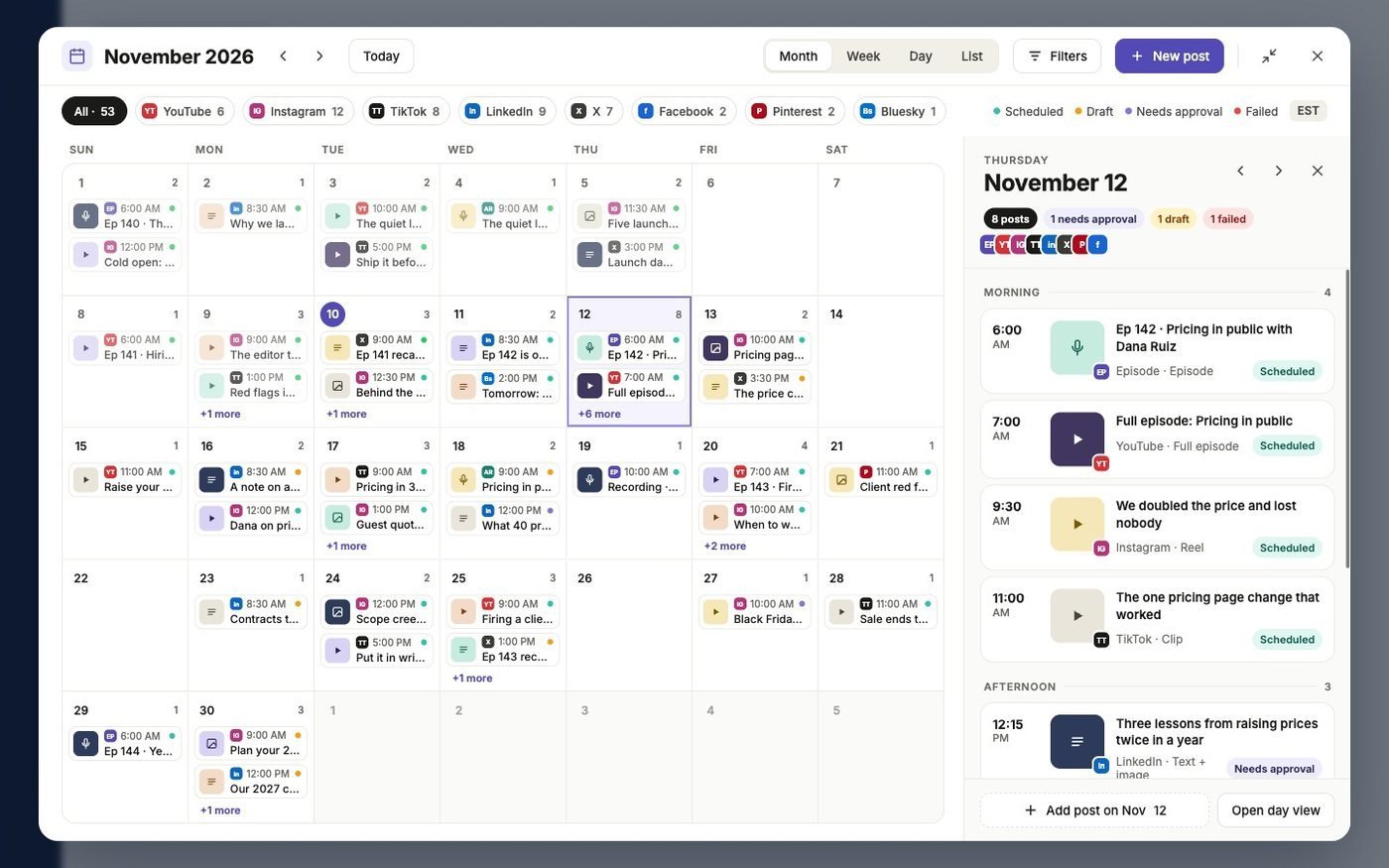
Convia turns each episode into a campaign for podcast and video hosts, with posts for every platform, a publishing schedule, a share page for guests, one comment inbox and analytics across 11 platforms. Bubb says the platform now holds 126 shows, and the company has $250k in funding.
Key takeaways
- Bubb built Convia because the work after the recording, guests, scheduling, publishing and measuring, kept stalling the visibility that Facing Disruption had created.
- The core idea is that an episode is not content but access: every guest has their own audience, and most shows promote an episode once and let that access expire.
- Convia starts from the conversation rather than a prompt, so posts come from what was actually said, and nothing is published without the host's approval.
- Bubb is clear about the lane: Convia does not host podcasts, send email or edit video, and works with tools like Descript as the operations layer between production and distribution.
- The surprise from the early launch period was how strongly hosts responded to the guest and operations side more than to the AI, because hosts do not want more content, they want their week back.
Before any of this
Startup.talk:What first got you into building things?
Bubb:Cars, honestly. About twenty years ago I was deep in the Volkswagen scene, and VW had its ignition system locked down tight. So a group of us did what enthusiasts always do: we tried to engineer our way around it to get more power. We started putting high-output MSD racing coils, built for American muscle cars, into small European engines. They blew up. We ordered more. Those blew up too. Eventually someone at MSD noticed a strange order pattern, picked up the phone and asked us what on earth we were doing, and that call turned into a working relationship. I learned two things in that garage that I still build on: you learn fastest by building and breaking things, and the best companies stay close enough to their customers to notice the signal nobody planned for.
The road to Convia
Startup.talk:What made you start Convia?
Bubb:Late 2022, my daughter asked me what I actually do for a living. I was halfway through the usual answer about innovation and AI when she asked, "Have you actually built anything?" After twenty years of helping Amazon, Accenture and dozens of other organizations build their products, I couldn't point to something that was mine. That question stuck with me.
In 2024 I started Facing Disruption, and something unexpected happened: executives and founders who would never take a sales meeting said yes to a recorded conversation. Every one of my best opportunities started tracing back to the show. That's when it clicked for me. Content doesn't create reach. It creates access. But the access only lasts as long as you stay visible, and visibility dies the moment you get busy doing the work it brought you.
The bottleneck was everything after the recording: guests, scheduling, publishing to every platform, and knowing what worked. I'd been through Notion, Airtable, Buffer, Planable and my own n8n workflows, and none of them held context across episodes. So I built the platform I needed. Once other hosts saw it, it was clear the need was much bigger than my show.
Startup.talk:When did you realize you wanted to help other people get heard?
Bubb:At 24, in 2008, I gave a last-minute talk to a standing-room-only crowd of more than 200 people about how fear had held me back. I was terrified. Afterward people lined up to share their own stories, some of them in tears, and I was invited to give the talk again. What I learned that day was that willingness was the credential. Saying something true out loud that other people were carrying privately gave me more authority than any expertise could.
I've been publishing on and off ever since: my first article in 2005, a blog in 2011, video in 2015. Every time I was visible, opportunities found me, from being named a top IT pro in Philadelphia to 40 Under 40 to eventually Amazon. And every time, the work that visibility brought me ended the publishing, because I was busy delivering. Publish, get found, get busy, go quiet, start over. That pattern isn't a discipline problem; it's a capacity problem. The people who most deserve an audience are the least able to keep one, because they're busy serving the audience they already earned. Convia is my answer to that. I build the way it gets said.
Startup.talk:What did hosting Facing Disruption teach you about how much value a single episode loses after it airs?
Bubb:That an episode is not content, it's access. Every conversation is a relationship with someone who has their own audience and network, and the episode is the proof that relationship exists. Most shows promote an episode once and move on, the guest never gets anything that makes sharing easy, and the access quietly expires. The ideas stay valuable for months. The promotion just stops.
“an episode is not content, it's access”AJ Bubb
Startup.talk:How did 15 years at Amazon and Accenture shape the way you built Convia?
Bubb:At Accenture I worked on emerging technology and innovation, and much of it was alongside AWS. I moved to AWS because I'd come to believe something simple: products scale and human capital doesn't. Consulting taught me to spot patterns across industries, from mining to education to entertainment, and AWS taught me how product companies build for scale. Convia is both: a consultant's understanding of a messy workflow, turned into a product that does the work instead of advising on it.
Startup.talk:What is it like to build Convia while still being a host yourself?
Bubb:It's the biggest advantage we have. Facing Disruption has more than 400 videos and about 48,000 YouTube subscribers, and every feature runs on our own shows before anyone else touches it. We also treated Convia as a case study in what AI-accelerated product development can do: how far a very small team can get when AI is part of how you build. That's a big part of how Convia went from an idea to a platform publishing to 11 networks so quickly.
The product
Startup.talk:Why the name Convia?
Bubb:Truthfully, I went through dozens of names to try and find something available. Con-Via came from Conversations Via, as in, we distribute your content via every platform possible.
Startup.talk:How does Convia keep posts sounding like the host rather than like AI?
Bubb:Convia doesn't start from a prompt; it starts from the conversation. Every episode is transcribed and tagged, so the platform knows what was actually said, by whom, and how it connects to everything else the host has talked about. Posts are built from the host's real points and the guest's real words, and nothing is published without the host's approval. AI does the heavy lifting; the host stays the author.
Startup.talk:Why plan content as campaigns rather than one-off posts?
Bubb:Because one post is a coin flip and a campaign is a strategy. A good conversation has several angles worth sharing, for different audiences on different platforms, over weeks rather than a day. A campaign also brings the guest in, so the episode reaches their network too. That's what turns one recording into lasting reach.
“one post is a coin flip and a campaign is a strategy”AJ Bubb
Startup.talk:How do you measure whether a recording turned into real authority?
Bubb:We track performance across every platform Convia publishes to, in one place, so hosts can see which ideas, guests and formats actually move their audience. The bigger signal is what happens afterward: guests resharing, new conversations, inbound invitations. Authority shows up as momentum, not as a single viral post.
Startup.talk:Which kinds of shows and experts get the most out of Convia?
Bubb:Interview shows where every guest brings their own audience, hosts who use their show for business development, and the agencies and producers who run several shows at once. The more guests and platforms you manage, the more Convia gives you back.
Startup.talk:What do you deliberately leave out of Convia?
Bubb:We're very clear about our lane. We don't host your podcast or replace your RSS feed. We don't send email; we draft newsletters for the tool you already use. We don't edit video or make clips; we integrate with tools like Descript. And we don't replace agencies; we make them faster. Convia is the operations layer between production and distribution.
Positioning
Startup.talk:Who is Convia for, and what job does it do for them? Describe the person who gets the most value.
Bubb:Hosts who already know what they're building, whether that's a business, a personal brand or a network, and who are losing hours to the operations around each episode. And the agencies and producers who do that work for multiple clients. The person who gets the most out of it has a great show and a growing guest list, and is tired of spreadsheets and copy-paste.
Startup.talk:How do you view your positioning relative to Descript, Opus Clip, Castmagic, Riverside and social schedulers like Buffer? Is there another competitor you think of first?
Bubb:Riverside, Descript and Opus Clip help you record, edit and clip, and we start where they stop. Descript is an integration partner, not a competitor. Schedulers like Buffer publish what you hand them, but they don't know what's in your episode, who your guest is, or what you said three months ago. Convia is the layer that understands the conversation, plans the campaign, involves the guest, publishes across 11 platforms and measures the results.
Startup.talk:What is your core moat in content repurposing for hosts?
Bubb:Two things. First, Convia understands a host's whole library, not just the latest episode, so ideas can be resurfaced and connected over time. Second, the guest network: every guest is a distribution channel, and Convia is built to activate it. Underneath both is the hard infrastructure work. We hold approved integrations with YouTube, TikTok, Meta and LinkedIn's Community Management API, and that takes real time and trust to earn.
Startup.talk:What are some of the use cases for Convia that are not obvious and can add a lot of value to users? List as many as possible.
Bubb:Guest share pages, where every guest gets their episode, ready-made posts and the release schedule in one place. Business development: using the show to build warm relationships with people you want to work with. Resurfacing older episodes when a topic comes back into the news. Agencies running every client show from one login. One comment inbox across all platforms. Running Convia entirely from your own AI assistant through our MCP server. And non-podcast sources, like turning a blog post or document into a campaign.
Startup.talk:What is the one detail in Convia you are proudest of?
Bubb:The guest experience. Guests are the most under-used asset in podcasting, and Convia gives each one a page with their episode and posts they can share in one click. It treats guests like partners, which is how I've always thought about the people who come on my show.
Launch
Startup.talk:What did you learn from launching Convia?
Bubb:That a launch is a moment, not a strategy. The traction we've seen has come from direct relationships: hosts, producers and partners who saw Convia work on real shows.
Startup.talk:Which feedback from the launch surprised you?
Bubb:How strongly people responded to the guest and operations side, much more than to the AI. Hosts don't want more content; they want their week back.
“Hosts don't want more content; they want their week back”AJ Bubb
The hard part
Startup.talk:How many people use Convia today?
Bubb:We have 126 shows on the platform: a mix of podcast hosts, producers, agencies, and companies all growing through long form, authentic human content.
Startup.talk:What is a challenging time you had building Convia?
Bubb:Zero to one is hard every time, and AI makes it faster, not easier. We built a lot very quickly, and at one point I had to step back and ask whether we were building what hosts needed or just what we could build. Narrowing our focus and spending more time with hosts and partners was the turning point.
Startup.talk:How do you stand out when every podcast tool now adds AI clips and show notes?
Bubb:By not competing on clips. Clips and show notes are becoming commodities. What isn't a commodity is the operations around a real conversation: the guest relationship, the campaign plan, the publishing and the measurement. That's where hosts lose their time, and that's the problem we own.
What it is all for
Startup.talk:What would make you say Convia has succeeded?
Bubb:My personal mission predates Convia by almost twenty years: help people with real expertise get it out of their heads and into the world, so it's useful to someone other than them. Convia is the current way I do that. I'll call it a success when Convia is the default layer between a conversation and its distribution, and when an agency describes its own service using our language in a room we're not in. That's the moment a product becomes a category.
Startup.talk:What will expertise and authority look like when anyone can generate content at scale?
Bubb:The value moves to what can't be generated: real conversations with real people. Right now attention rewards volume and a willingness to perform, not whether you actually know anything, and AI has made that worse by driving the cost of plausible content to nearly zero. I want the opposite: a world where the people worth listening to are the people who get heard. Being good at the work should be enough. You shouldn't also have to be good at broadcasting.
The road ahead
Startup.talk:Where do you want Convia to be in five years?
Bubb:The de facto layer between conversation and distribution, reaching thousands of experts through the agencies and producers who serve them, from booking the guest to measuring the impact.
This interview was conducted in writing and has been edited lightly for length and clarity.
About Convia
Convia is a content operations platform built by AJ Bubb in the USA for podcast and video hosts, turning each episode into a campaign with posts, a schedule, a guest share page and analytics across 11 platforms.
| Attribute | Verified Detail |
|---|---|
| Company | Convia |
| Founder(s) | AJ Bubb |
| Country | USA |
| Previously | About 15 years at Accenture and Amazon |
| Also hosts | Facing Disruption, 400+ videos |
| Started | Facing Disruption in 2024, Convia after |
| Funding | $250k |
| On the platform | 126 shows |
More Startups in Spotlight
For founders
Building something? Want to share your journey?
Tell us how it started, what nearly broke it and where it is headed. We will turn it into a story like this one.
Share your journeyFor readers
Want to read more human stories behind the startups?
New founder interviews and stories, as they are published.
Follow us on LinkedIn