
Navdeep Singh grew up in Roorkee, India, and began his career writing software for astronomers at the National Optical Astronomy Observatory in Tucson, where he worked on ANTARES, a system that filters the night sky's alert stream for rare events such as supernovae. He later worked at Audible, Amazon and Meta before building AwardHack, which he runs alone.
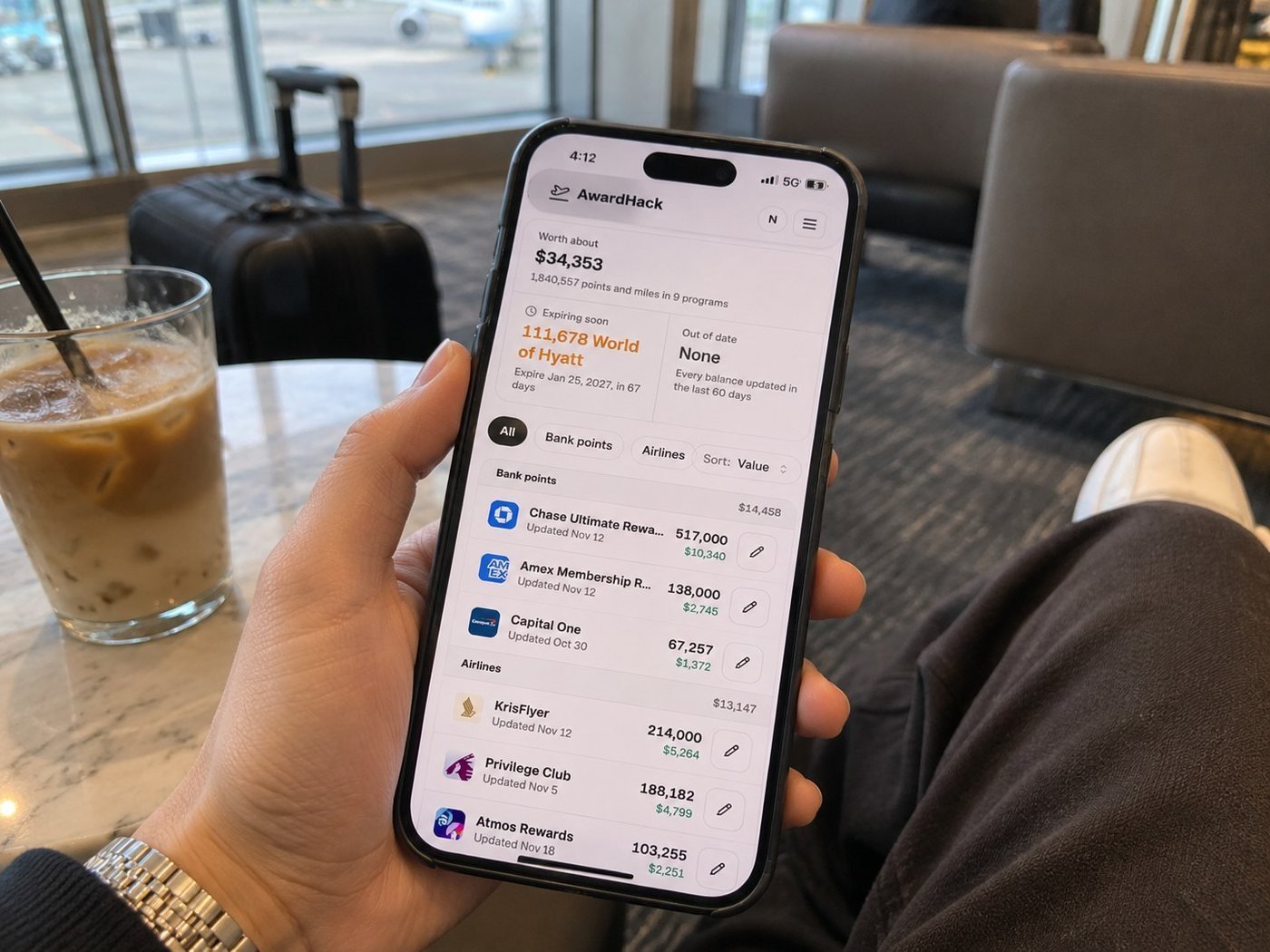
AwardHack is a privacy-first command center for credit card points, miles and travel perks. It never asks for bank logins or loyalty passwords. Users pick their cards once, and it shows what an award flight costs across 30+ programs, which card to get next and which credits are about to expire. Singh says more than a million people visit each month, over 12,000 have signed up and more than 500 pay.
Key takeaways
- Singh built AwardHack after finding the same business class seat bookable through a partner program for nearly half the miles, information that was scattered across blogs, award charts and forum threads.
- The product never links to bank accounts. Users choose from 250+ cards and AwardHack fills in credits, earn rates and fee dates, partly because account linking does not work in most countries.
- Every number shows its working, a habit Singh brought from building software for astronomers who check your math. Each data set carries its sources and the date it was last verified.
- Singh runs the company alone. His hardest moment was a Google sign-in key mismatch that cut daily sign-ups from about 200 to about 50 for four days before he noticed.
- The Nordics came first after expanding beyond the USA, through a partnership with AwardFares; India, Australia and Indonesia are next.
Before any of this
Startup.talk:Where did you grow up, and what was childhood like?
Singh:I grew up in Roorkee, a city in northern India. I had a pretty relaxed childhood, and my family always encouraged me to think beyond the usual day-to-day and dream big. I've been curious about computers and technology for as long as I can remember. I started by taking things apart, then writing little programs to automate boring tasks, like sorting my music library. Eventually, I built a simple website for a family friend's business, and seeing someone actually use something I'd created to save time was the moment I got hooked on building things. Looking back, having the freedom to explore, experiment, and figure things out on my own was probably one of the biggest influences on how I approach things today.
Startup.talk:What was your first job, and what did it teach you?
Singh:My first job was at the National Optical Astronomy Observatory in Tucson, now part of NSF's NOIRLab, where I worked with astronomers on ANTARES and LSST software for the Vera C. Rubin Observatory. ANTARES is an alert broker. Sky surveys photograph the night sky over and over, and every time something changes in brightness or position, they send out an alert. The Zwicky Transient Facility already sends hundreds of thousands a night, and the Vera C. Rubin Observatory, with the largest digital camera ever built, was designed to send around 10 million a night. Almost all of them are noise. A few are a rare supernova that will fade within days and that astronomers want to point a telescope at right now. ANTARES takes in that stream in real time, adds what's already known about each object from other catalogs, runs filters that astronomers write themselves, and sends each person only the events they care about. It's now one of the brokers Rubin chose to receive its full alert stream.
It taught me two things I use every day on AwardHack. First, the hard problem usually isn't finding data, it's filtering it down to the few things worth acting on. Second, when the people using your software can check your work, you have to show your work.
The road to AwardHack
Startup.talk:What made you start AwardHack?
Singh:In 2023 I transferred a big pile of credit card points for a business class seat to see family. A few weeks later I found the exact same seat bookable through a partner program for nearly half the miles. Nobody had hidden that information. It was just spread across a dozen blogs, award charts and forum threads I didn't know to check.
That's the whole problem. Every answer in points and miles exists somewhere, but in pieces: award charts on one site, transfer bonuses on a blog, card credits in a spreadsheet, lounge rules in a PDF from the card issuer. You have to be the database. I started building AwardHack in May 2024 to be that database for people: one place that answers the questions you actually have, like "how many miles is Tokyo in business," "which card should I get next," and "am I about to lose a credit."
“Every answer in points and miles exists somewhere, but in pieces”Navdeep Singh
Startup.talk:What was your own points and miles setup like before AwardHack?
Singh:A spreadsheet with a tab for every card, color-coded open dates I squinted at every time I thought about applying for something new, calendar reminders for every monthly credit, and a notes file of transfer ratios I'd copied from blogs. Plus about 30 bookmarked award charts that went out of date without telling me. It worked until it didn't. One year I missed a $200 credit because I'd set the reminder for the wrong month. That spreadsheet was basically AwardHack's first prototype.
Startup.talk:How did your product background shape the way you built AwardHack?
Singh:Each job left something in it. At NOAO I learned to build for experts who check your math. At Audible I built the tools creators use to publish audiobooks, and learned that the best tools disappear into someone's routine. At Amazon I owned tech readiness for Prime Day and Black Friday across 200+ services, and learned that being right at scale comes from boring checks, not heroics. At Meta, working on creators, monetization and Marketplace, I learned to start from the question a person has, not the feature list.
All of it shows up in AwardHack. Every tool answers one question someone would type into Google or ask ChatGPT, and the answer is the first thing you see. I cut hard: I've thrown away busier designs more than once because they looked impressive and made the answer harder to find. Every number can show how it was worked out. And the build runs checks so a mistake I've already made can't ship again.
Startup.talk:Why expand beyond the US to the UK, Canada, Sweden and Norway?
Singh:It started with our partnership with AwardFares, which began in July 2026. AwardFares finds live, bookable award seats, and AwardHack tells you what a seat should cost and how to pay for it, so the two fit together naturally. Most of AwardFares' members are in Sweden and Norway, and once they started using AwardHack, the first thing they asked for was their own cards: SAS EuroBonus cards, Amex Sweden and the rest. So the Nordics came first, in October 2026.
From there the rule was simple: go where the big card issuers are and where people already love collecting points and miles. The UK, with Avios and Amex, and Canada, with Aeroplan and Amex, were the obvious next two. The hard part wasn't translating, it was money: a card's fee, credits and earn rates have to live in its own currency, and totals have to convert honestly when your wallet spans two countries. Once that was built properly, each new country became mostly a research job.
Next are India, Australia and Indonesia. Australia has one of the strongest points cultures outside the US, and India and Indonesia are emerging markets where premium travel cards and transfer partners are growing fast, while the tools haven't caught up yet.
The product
Startup.talk:Why the name AwardHack?
Singh:"Travel hacking" is what the community calls getting outsized value from points, and award travel is where that value lives. I wanted a name that said exactly what the product helps you do.
Startup.talk:Why never ask users to link a bank account?
Singh:Because you shouldn't have to hand over your bank login to find out which card to use for dinner. Account linking brings broken connections, security risk and a privacy cost, and it doesn't work in most countries anyway. AwardHack knows 250+ cards in detail, so you pick your cards once and it fills in the credits, earn rates and annual fee dates for you.
Startup.talk:How do you price award flights across 30+ programs?
Singh:Each program prices awards its own way. Some use distance bands, some use zones, some use region-to-region charts, and most have different prices for their own flights and partners. I modelled each one, along with estimated taxes and surcharges for each cabin, so one search shows what every program would charge for the same flight, side by side. Programs with dynamic pricing are shown as a starting price rather than a made-up number. On top of that you see which banks transfer to each program, any live transfer bonus, and the program's rules on holds and stopovers. It tells you what an award should cost and where to get the points. For live seat availability, partners like AwardFares take it from there.
Startup.talk:How does the card recommender decide what someone should get next?
Singh:It starts with what you're allowed to get, which is where most advice goes wrong. It knows the issuer rules: Chase 5/24, Amex once-per-lifetime bonuses, family rules, and cross-issuer rules like "no bonus if you've held this card recently." For each card it decides whether you should apply, upgrade, downgrade or wait, and if it's wait, it gives you the date. It even warns about order, like getting one card's bonus before another rule blocks it. Then it ranks what's left by the welcome bonus's real value minus the fee. Points are valued at what they're worth, and airline and hotel points are never valued above the bank points that transfer into them, so a co-brand card can't outrank the bank card that beats it.
Startup.talk:Why build 40+ separate tools instead of one big app?
Singh:Because people arrive with one question, "Is the Platinum card worth it." "Where should I credit this United flight." "Which lounges can I get into at Heathrow." Each of those deserves a page that answers it in seconds, with a link you can share. Underneath, they're one product: one account, one wallet and the same data, so the hotel map knows your cards and the tracker knows your credits. For newcomers there's a "Start here" section that walks through a few questions and hands you the right tools already filled in.
Startup.talk:What do you deliberately leave out of AwardHack?
Singh:Bank logins. Ads, tracking cookies and third-party scripts. Paid placement: no card pays to rank higher, the rankings are the math. Noise: no badges, no dashboards full of stat tiles, no blog posts padded for search. And opinions without working: if AwardHack tells you a card earns back its fee, it shows you the sum.
Positioning
Startup.talk:Who is AwardHack for, and what job does it do for them? Describe the person who gets the most value.
Singh:Someone who already has a few travel cards and a couple of points currencies, takes one to three award trips a year, and has a nagging feeling they're leaving money on the table. The person who gets the most out of it holds two or three premium cards, pays $1,000+ a year in annual fees, and manages cards for a partner too. AwardHack's job for them: make sure every credit gets used, every fee is worth paying, the next card is the right one, and the points go to the trip that's worth the most.
Startup.talk:How do you view your positioning relative to point.me, Seats.aero, AwardWallet, MaxRewards, CardPointers and The Points Guy? Is there another competitor you think of first?
Singh:Honestly, the competitor I think of first is the spreadsheet. Most serious collectors run their points life out of one, and that's what AwardHack replaces. The tools on your list are good at what they do, and most do one part of the job. Seats.aero and point.me search live award seats. AwardWallet tracks balances. MaxRewards and CardPointers help with which card to swipe, mostly by linking accounts or adding offers. The Points Guy is media. AwardHack covers the whole loop: earn (which card, where to credit a flight), keep (credits, certificates, fees), book (what an award costs and which program to use) and stay (hotel credits, lounges, visas), without logins. I'd rather work with the live-search tools than fight them, which is why we partner with AwardFares.
Startup.talk:What is your core moat in points and award travel tools?
Singh:Data that's slow to build and slower to keep right. The award chart engine for 30+ programs. A card catalog of 250+ cards in five countries, with each card's credits, spending caps and eligibility rules. Award rules for 30 programs, each with sources and the date it was last checked. Hotel data across Fine Hotels + Resorts, The Hotel Collection, The Edit, Leaders Club, Hilton and Bilt. Each is useful alone, but the moat is that they're joined: one data set feeds the tools, the trackers and about 40,000 pages that answer specific questions in search and in AI assistants. Most of that work isn't visible, and that's what makes it hard to copy.
Startup.talk:What are some of the use cases for AwardHack that are not obvious and can add a lot of value to users? List as many as possible.
Singh:Find the hotels where the $300 Amex Platinum hotel credit covers most of a two-night stay, ranked city by city by what you actually pay after the credit.
Price every Fine Hotels + Resorts hotel for your exact dates at once.
Find award sweet spots from your home airport: flights where one program charges far less than every other for the same seat.
Check a program's hold and stopover rules before you transfer points, since transfers can't be undone.
Decide whether to transfer now or wait for a bonus, using years of transfer bonus history.
Work out which program to credit a paid flight to, down to the fare class.
See what each annual fee actually bought you, card year by card year, including refunds after a product change.
Track a partner's or parent's cards in a separate profile, with their own 5/24 count.
Keep perks that unlock after big spending, like $75,000 on a Sapphire Reserve, in the totals only once you've reached them.
Plan lounge visits with a group: see what your party of four pays at each lounge with the cards you hold.
Check visa rules with two passports and see which one gets you in more easily.
Ask "points or cash?" for a specific booking and get a straight answer.
Find out which airlines fly a route nonstop and which programs can book them.
Track free night certificates so they don't expire unused.
Learn airports and hotels with daily games, a fun way in for people new to travel.
Startup.talk:What is the one detail in AwardHack you are proudest of?
Singh:Every number shows its working. On the dashboard, "Earned back this year" isn't a vibe: tap it and you see each card, each credit used and each fee charged, down to fees that came back after a cancellation, and it adds up exactly to the number you tapped. People make real money decisions here, like whether to keep a $895 card, so the numbers have to be checkable. That habit comes straight from building software for astronomers.
“Every number shows its working.”Navdeep Singh
Launch
Startup.talk:What did you learn from your public launch?
Singh:Honestly, that a launch day isn't a growth strategy. Points and miles is a niche, and most people find AwardHack when they have a specific question, like what an award flight costs or whether a card is worth its fee, not while browsing new launches. The best thing that came out of it was unexpected: other founders reached out. People I'd never met sent long messages with advice on pricing, partnerships and where their own early users came from. A few of those conversations were worth more than a top spot on the leaderboard would have been. Even this interview came out of it.
Startup.talk:Which feedback from the launch surprised you?
Singh:How generous other founders were. I expected silence. Instead, people who had been through it sent me what worked for them. The advice that surprised me most was to stop leading with "40+ tools" and lead with one answer instead: show someone what an award flight costs in five seconds and let them find the rest on their own. It's obvious in hindsight, and it's why the homepage now starts with a search instead of a list.
The hard part
Startup.talk:How many people use AwardHack today?
Singh:More than a million people visit AwardHack every month, over 12,000 have signed up, and more than 500 are paying customers. Most find it through a specific question they searched, like an award price or a hotel credit, and stay for the trackers.
Startup.talk:What is a challenging time you had building AwardHack?
Singh:Keeping the data true, alone. Card issuers change offers weekly, programs change award rules without announcing it, and a wrong number on a points site costs someone real money. There's no team to share it with, so I built the checks into the product: every data set carries the date it was last verified and its sources, pages show when their data last changed, and anything uncertain is labelled as uncertain instead of guessed.
The hardest single moment was when Sign in with Google quietly broke. A key mismatch meant every Google sign-in failed, and that's how most new users join. Sign-ups dropped from about 200 a day to about 50, and I didn't notice for four days. Nothing crashed and no alarm went off. The site looked fine to me because I was already signed in. Hundreds of people came to AwardHack, tried to join, and left. The fix itself took minutes. Now I check sign-ups every morning, so a drop like that gets caught in a day, not four. That's most of solo founding: you can't prevent every mistake, but you can make sure each one only happens once.
Startup.talk:Who believed in you before there was anything to show? What did they say or do?
Singh:A former colleague. When AwardHack was a rough award chart page and a messy tracker, she used it to plan a trip to a conference in Chile and sent me a list of 14 bugs and one line at the end: "This is the thing I've been doing in my head for ten years. Keep going." I still have that email. Now I receive about 2-5 testimonials in my email every single day from users around the world.
Startup.talk:What happened when AwardHacker shut down, and how did it affect AwardHack?
Singh:AwardHacker was the award chart calculator a lot of people learned on, and when it closed on March 30, 2026, its users suddenly had nowhere to look up what an award should cost. AwardHack's Award Flight Pricer already did that across 30+ programs, with taxes, transfer bonuses and booking rules added. Because the names are so close, Google started sending AwardHacker searches to our homepage, so I built a page for those people that starts with the search they came for. It was a strange feeling: a tool I'd used and admired was gone, and AwardHack suddenly had to be ready for its users.
What it is all for
Startup.talk:What would make you say AwardHack has succeeded?
Singh:When "check AwardHack" is what people say before they apply for a card, pay an annual fee or transfer points, and when the site pays for itself many times over for the people using it. For the business: enough revenue to bring on help so the data stays this good as it grows. And personally: the day someone emails me that they flew their parents somewhere in business class on points they didn't know they had. That's the email I'm building for.
Startup.talk:Will AI agents one day book award travel for us from start to finish?
Singh:The research half, yes, and soon. The booking half is harder: it needs live seat availability, access to your loyalty accounts, and point transfers that can't be reversed if the agent gets it wrong. What agents will need most is data they can trust, because a confident wrong answer about an award price is worse than no answer. That's why every AwardHack page has a plain Markdown version for AI assistants to read. I'd like AwardHack to be the source those agents check.
The road ahead
Startup.talk:What are your milestones for the next 12 months, in users and revenue?
Singh:Grow from 1 million to 3 million monthly visitors, from 12,000 to 50,000 sign-ups, and from 500 to 2,500 paying customers. Launch India, Australia and Indonesia. On revenue, the milestone that matters is enough to hire a first part-time researcher, so card and program data gets checked even more often. I'd rather grow by being the most correct answer than by being the loudest.
Startup.talk:Where do you want AwardHack to be in five years?
Singh:The default place people check before any points decision, in every country with a real points culture, used by tens of millions of people a year, and the data source AI assistants rely on for rewards questions. Still calm, still no bank logins.
Startup.talk:What are your hopes and fears for a post AGI world?
Singh:My first job was watching the sky for stars that explode. A supernova can outshine its entire galaxy for a few weeks, and by the time its light reaches us, the explosion often happened millions of years ago. That's how AGI feels to me. Something enormous has already happened, and most of us are still looking at the old light.
My hope is huge. For all of history, expertise has been rationed. The best doctor, the best lawyer, the person who knows exactly which program flies you to Tokyo in business for half the miles: they've always belonged to the few who could afford them or had years to become them. AGI could put that expert in every pocket on Earth, at 2 a.m., in your own language, for almost nothing. That could be the most equalizing event in human history.
My fear is just as big. Not killer robots. Confidence. A world where machines answer everything instantly, fluently and convincingly, and nobody can tell anymore which answers are true. When sounding right costs nothing, being right gets harder to find, not easier. If we lose the habit of asking "how do you know that?", we may never get it back.
So I've made a small bet with AwardHack: get the facts right, show where every number comes from, and let people check. In a world flooded with answers, being provably right might be the last real advantage any of us has.
“being provably right might be the last real advantage any of us has”Navdeep Singh
This interview was conducted in writing and has been edited lightly for length and clarity.
About AwardHack
AwardHack is a privacy-first command center for credit card points, miles and travel perks, built by Navdeep Singh, pricing award flights across 30+ programs and tracking card credits without bank logins.
| Attribute | Verified Detail |
|---|---|
| Company | AwardHack |
| Founder(s) | Navdeep Singh |
| Country | USA |
| Grew up in | Roorkee, India |
| Began at | National Optical Astronomy Observatory (now NSF NOIRLab) |
| Previously | Audible, Amazon, Meta |
| Funding | Bootstrapped |
| Monthly visitors | 1M+ (company figure) |
More Startups in Spotlight
For founders
Building something? Want to share your journey?
Tell us how it started, what nearly broke it and where it is headed. We will turn it into a story like this one.
Share your journeyFor readers
Want to read more human stories behind the startups?
New founder interviews and stories, as they are published.
Follow us on LinkedIn