
Blagoja Golubovski grew up in Strumica, a farming town in North Macedonia, moved to California as a teenager and studied electrical engineering in Los Angeles, then VLSI chip design at USC. After ten years designing chips for Silicon Valley startups, Golubovski spent more than 25 years in product leadership, scaling B2B SaaS companies through an IPO and acquisitions, most recently as VP Product at Usercentrics.
Cimanote is a fast, clean note app whose notes organize themselves. It builds living pages for the people, projects and ideas in your notes, flags where two notes contradict each other and links every point back to the note it came from. Golubovski built it alone from Lisbon with a team of AI agents, and close to 1,800 people have signed up since its launch in March.
Key takeaways
- Golubovski started Cimanote after watching Evernote, home to fifteen years of notes, get slower and heavier. The breaking point was a hotel check-in desk and a spinner hiding a booking number.
- Ten years of chip design taught Golubovski that there is no “we’ll patch it later”: either it works or you lose months and millions of dollars.
- Cimanote went from idea to production with AI doing research, spec, code, tests, deployment and security. “The bar didn’t drop. The cost of reaching it did.”
- The moat is the knowledge graph: pages for people, projects and ideas that stay up to date, flag contradictions and connect to AI tools like Claude through MCP.
- The competitor Golubovski thinks about most is the default notes app on your phone, because “good enough” is the hardest thing to beat.
Before any of this
Startup.talk:Where did you grow up, and what was childhood like?
Golubovski:I grew up in Strumica, a small town in North Macedonia, surrounded by farmland. Summers meant peppers drying on every balcony, and in winter the whole town disappeared into the Strumica Carnival, which is older than anyone can remember. It was a place where everyone knew your family and nothing happened fast. Then, as a teenager, I moved to California. I went from a town where the biggest event of the year was a carnival to a place where people were building the future in their garages. I’ve been trying to bring the two together ever since: the patience of a small town and the ambition of Silicon Valley.
Startup.talk:What first got you into building things?
Golubovski:A radio. I was about ten, and one afternoon I took it apart on the kitchen table without telling my parents. I wanted to see where the sound came from. I got it working again, and that was the start. Next it was our VCR, then the circuit breakers in our house, which in hindsight my parents were right to worry about. One summer, a family friend let me work in his electronics repair shop, fixing magnetic and electric motors alongside him. I loved figuring out why something had stopped working and bringing it back to life. That curiosity is what led me to study electrical engineering in Los Angeles.
Startup.talk:What was your first job, and what did it teach you?
Golubovski:My first job out of university was a dream for an engineer who loved sound. We built professional audio equipment for broadcasters and live concerts, and I designed chips for audio processing. Knowing that something I’d drawn on a screen was shaping the sound at a live show was a thrill I’ve never forgotten. That work pulled me deeper, so I went back to USC for a master’s in exactly that field, VLSI chip design. That’s what brought me to Silicon Valley, where I spent ten years designing chips for startups, from imaging to supercomputers. It taught me to respect the details. In chips there’s no “we’ll patch it later.” Either it works or you’ve lost months and millions of dollars, and I’ve carried that discipline into everything I’ve built since.
“Either it works or you’ve lost months and millions of dollars”Blagoja Golubovski
The road to Cimanote
Startup.talk:What made you start Cimanote?
Golubovski:Evernote held fifteen years of my life: trip plans, ideas, notes from meetings I’d forgotten I ever had. I watched it get slower, heavier and more expensive until opening a note felt like waiting in line. I wanted the old feeling back: open the app, write, find it again. So I built the app I wanted for myself. It was also a test. I spend my days advising companies on AI-native ways of working, and I wanted to prove it on my own product, not on a slide.
Startup.talk:What did Evernote get right in its best years, and what went wrong for you as a user?
Golubovski:In its best years, Evernote was a promise: put anything in here and it will still be here in ten years. That trust was the product. Then it tried to become everything, and it lost the speed that made it feel effortless. For me the breaking point was search. I was standing at a hotel check-in desk, trying to find a booking number I knew I had saved, watching the spinner. That was the day I decided to build something else.
Startup.talk:Why build Cimanote from Lisbon?
Golubovski:After more than 20 years in San Francisco, we moved to Lisbon as a family, and it fit our lifestyle perfectly. The kids settled in quickly, we all fell in love with the pace of life here, and we enjoy it more every year. That calm turned out to be good for building, too. Silicon Valley taught me how to build. Lisbon gives me the space to think. And with AI, you don’t need to be in any particular city to ship a product used all over the world.
Startup.talk:What is it like to build Cimanote as a founder?
Golubovski:It’s the most honest work I’ve done. As a VP Product you have teams, budgets and layers between you and the user. Here it’s me, a team of AI agents and the people using the app. I took Cimanote from idea to production on my own, with AI doing the research, spec, code, tests, deployment and security. A few years ago that took a team and a funding round. The bar didn’t drop. The cost of reaching it did.
The product
Startup.talk:Why the name Cimanote?
Golubovski:“Cima” means summit in Portuguese, and the top of something in several other languages. I’ve always loved mountains, and I wanted the name to carry that feeling of standing at the top and seeing everything clearly. That’s what good notes should do for your thinking.
Startup.talk:What does 'fast and clean' mean in the details of a note app?
Golubovski:It means the app opens to a blank note, not a dashboard. You don’t have to file anything, because notes organize themselves, so you never stop to ask which folder something belongs in. Search returns what you meant, not just what you typed. It works offline and syncs when you’re back. And there’s nothing on the screen that isn’t helping you write or find something.
Startup.talk:What does Cimanote look like in action?
Golubovski:The quickest way to understand Cimanote is to watch it for two minutes. Notes go in, and connected knowledge pages come out, with every point linked back to its source: https://www.youtube.com/watch?v=SCVDiDzqI5Q
Startup.talk:How do you help people move years of notes over from Evernote?
Golubovski:You bring your notes over from Evernote, and from Notion or Obsidian too if that’s where they ended up. Your notes, tags and attachments come with you, and then the interesting part starts: Cimanote reads everything and begins building pages for the people, projects and ideas buried in your archive. People tell me they rediscover things they wrote ten years ago.
Startup.talk:Which features did you deliberately leave out?
Golubovski:Native iOS and Android apps, at least for now. Asking someone to install yet another app is a real barrier, and for most people it isn’t worth it. Instead, I put the effort into making Cimanote feel exactly like a native app, straight from the browser. You add it to your home screen in a few seconds, and it opens, looks and behaves like any app on your phone. It’s much faster to get started with, and you don’t lose any of the experience.
Startup.talk:Who gets the most value from Cimanote today?
Golubovski:People with years of notes they never look at again: consultants, founders, researchers, product people, students. They’re usually Evernote refugees with huge archives and no time to organize them.
Startup.talk:What do you deliberately leave out of Cimanote?
Golubovski:Busywork. There are no folders to maintain, no system to learn and no setup before you can write. Notes organize themselves, and if you want a head start, templates get you going in one tap. Anything that makes you think about the tool instead of your idea doesn’t belong in Cimanote.
Positioning
Startup.talk:Who is Cimanote for, and what job does it do for them? Describe the person who gets the most value.
Golubovski:It’s for the person who saves everything and can use none of it. Picture a consultant with three clients and ten years of notes. They clip articles, record voice memos after meetings and photograph whiteboards. Cimanote captures all of it quickly, then builds a living page for each client, project and idea, connects them, and points out where two notes contradict each other. You stop searching for notes and start using what you know.
Startup.talk:How do you view your positioning relative to Evernote, Notion, Apple Notes, Obsidian and Bear? Is there another competitor you think of first?
Golubovski:Evernote is what Cimanote replaces: the same promise without the weight. Notion is a workspace builder, which is powerful but slow if you just want to write. Apple Notes is fast but only works on Apple devices and doesn’t do much with what you save. Obsidian is wonderful if you enjoy building your own system, and Cimanote is for people who don’t. Bear is beautiful for writing, while Cimanote is about what happens after you write. The competitor I think about most is the default notes app on your phone, because “good enough” is the hardest thing to beat.
Startup.talk:What is your core moat in note-taking?
Golubovski:The knowledge graph. Every note-taking app stores notes. Cimanote understands them. It builds pages for the people, projects and ideas in your notes, keeps them up to date as you write, and flags contradictions. It also connects to AI tools like Claude through MCP, so your assistant can read and write your notes. The longer you use it, the more it knows, and that’s very hard to leave.
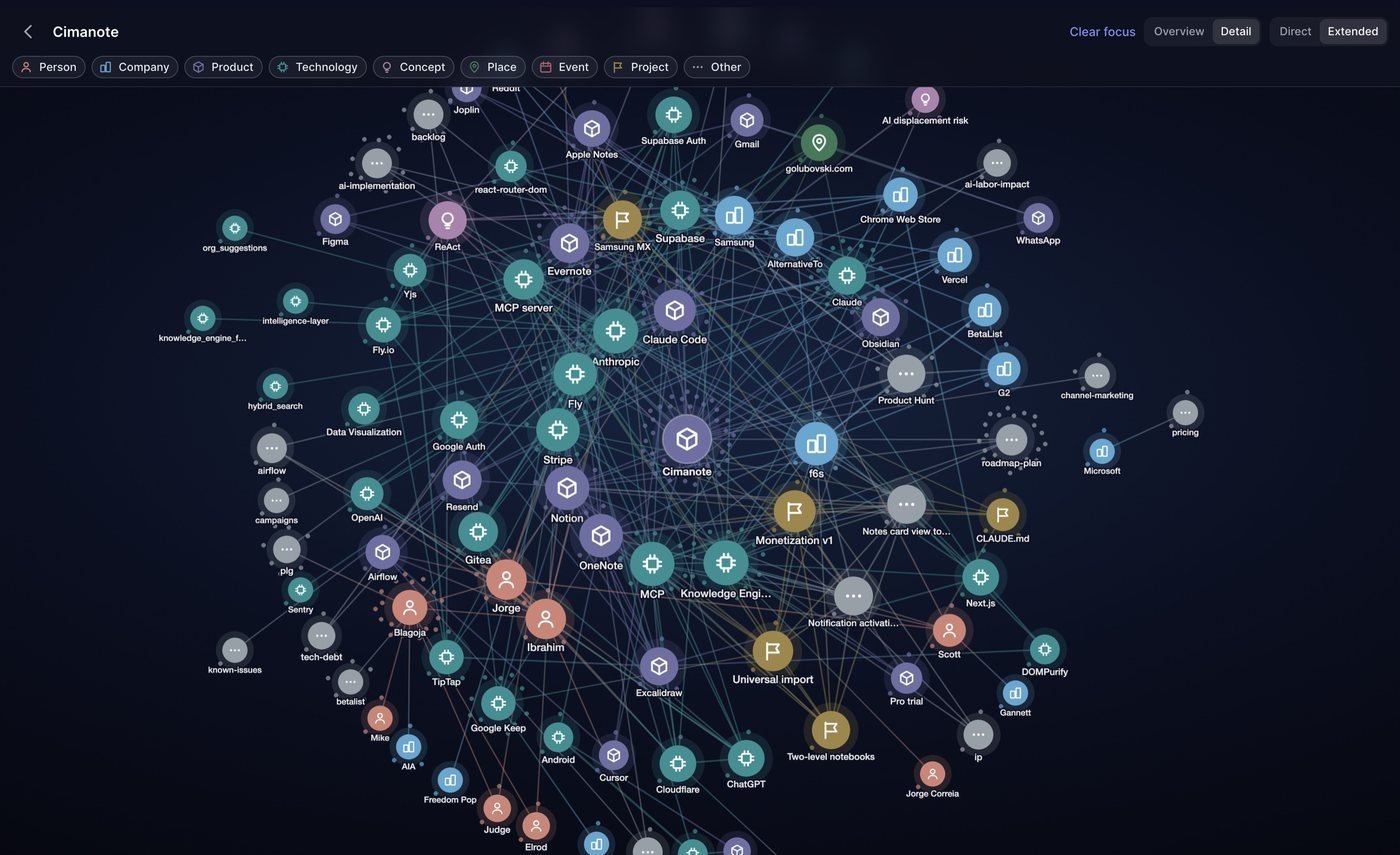
Startup.talk:What are some of the use cases for Cimanote that are not obvious and can add a lot of value to users? List as many as possible.
Golubovski:- Clip a dozen articles on a topic and get a page that connects them, with sources.
- Record a voice note after a meeting and find it later by what was said.
- Photograph receipts, whiteboards or book pages and search the text.
- Let the app keep a running page on each client, with every decision linked to the note where it happened.
- Catch contradictions, like two notes giving different dates for the same deadline.
- Ask Claude questions about your own notes through MCP, or have it write meeting summaries straight into Cimanote.
- Plan a family trip in a shared note, with everyone editing in real time.
- Prepare for a meeting by opening the person’s page and seeing every past interaction at once.
- Turn years of book highlights into pages organized by idea instead of by book.
Startup.talk:What is the one detail in Cimanote you are proudest of?
Golubovski:Every point on a knowledge page links back to the note it came from. AI can summarize anything, but you should always be able to check where an idea came from. That one link is the difference between a tool you use and a tool you trust.
“That one link is the difference between a tool you use and a tool you trust.”Blagoja Golubovski
Launch
Startup.talk:What did you learn from your public launch?
Golubovski:That people don’t fall in love with features; they fall in love with relief. The comments weren’t about the knowledge graph. They were about how it felt to open a note app that just opens. I also learned that the day after a launch matters more than launch day. That’s when you find out who actually stays.
Startup.talk:Which feedback from the launch surprised you?
Golubovski:How emotional people are about their notes. Someone wrote that they had been carrying fifteen years of Evernote “like a suitcase they couldn’t open.” Several people asked if they could pay for a lifetime plan before they’d even finished the trial. I didn’t expect a note app to make anyone feel anything.
The hard part
Startup.talk:How many people use Cimanote today?
Golubovski:Close to 1,800 people have signed up since we launched in March, and the community keeps growing. We’re focused on the people who stay and make Cimanote part of their day.
Startup.talk:What is a challenging time you had building Cimanote?
Golubovski:The moment I realized building wasn’t the hard part. With AI I could ship a feature in an afternoon. Then real people arrived, and the work became everything after the demo: sync conflicts, data safety, support, the bug that only happens at 2 AM in a timezone you’re not in. One night a sync issue duplicated notes for a handful of early users. I fixed it before breakfast and personally wrote to every one of them. Two of them became our most vocal fans. That’s when I learned that trust is built in the moments when something breaks.
Startup.talk:Who believed in you before there was anything to show? What did they say or do?
Golubovski:I have an amazing group of friends and colleagues who push me to keep moving forward and who inspire me every day. They tested the earliest versions, told me honestly what was broken, and kept asking when the next version was coming. And my family, who put up with a founder at the dinner table. I’m grateful for all of them.
Startup.talk:How do you win users in a category where people rarely switch apps?
Golubovski:You show up when they’ve already decided to leave. Nobody switches note apps on a whim. They switch after a price increase or an update that makes everything slower. Cimanote is there at that moment, with a free plan, so trying it costs nothing, and the knowledge graph shows its value in the first hour instead of the first month.
What it is all for
Startup.talk:What would make you say Cimanote has succeeded?
Golubovski:When people trust Cimanote with ten years of their thinking, the way they once trusted Evernote, and find it gives them back more than they put in.
Startup.talk:What will taking notes look like when AI remembers everything for us?
Golubovski:Remembering will be free. Understanding won’t be. When AI can record everything, the hard part becomes knowing what matters, what connects and what contradicts. Notes won’t be an archive anymore. They’ll be a map of how you think, and you’ll want that map to be yours, with every point traceable to where it came from.
“Remembering will be free. Understanding won’t be.”Blagoja Golubovski
The road ahead
Startup.talk:What are your milestones for the next 12 to 18 months?
Golubovski:We don’t publish revenue numbers. The goal for the next year is to become the obvious choice for people leaving Evernote, and to keep the app fast as it grows.
Startup.talk:Where do you want Cimanote to be in five years?
Golubovski:The default home for personal knowledge: the place people capture everything, and the layer that makes a lifetime of notes useful.
Startup.talk:What are your hopes and fears for a post AGI world?
Golubovski:My hope is that AI gives people more time to think. My fear is that people stop thinking for themselves. The tools we build should make your own thinking stronger, not replace it. That’s why every idea in Cimanote leads back to something you wrote.
This interview was conducted in writing and has been edited lightly for length and clarity.
About Cimanote
Cimanote is a fast, clean note app built by Blagoja Golubovski whose notes organize themselves, with a knowledge graph that builds living pages for the people, projects and ideas in your notes.
| Attribute | Verified Detail |
|---|---|
| Company | Cimanote |
| Founder(s) | Blagoja Golubovski |
| Country | Portugal |
| Grew up in | Strumica, North Macedonia |
| Studied | Electrical engineering; master’s in VLSI chip design, USC |
| Previously | VP Product, Usercentrics; 25+ years in product leadership |
| Based in | Lisbon, Portugal |
| Funding | Bootstrapped |
More Startups in Spotlight
For founders
Building something? Want to share your journey?
Tell us how it started, what nearly broke it and where it is headed. We will turn it into a story like this one.
Share your journeyFor readers
Want to read more human stories behind the startups?
New founder interviews and stories, as they are published.
Follow us on LinkedIn