
Erin McIntyre trained in theater in New York City, taught herself to build websites for actors when casting directors began expecting an online presence, and found she liked the technical side more than the audition room. Now an independent web developer in Montpelier, Vermont, she has shipped several small products, including CSV Cleaner, Unfollow Assistant and AI Recipe Writer.
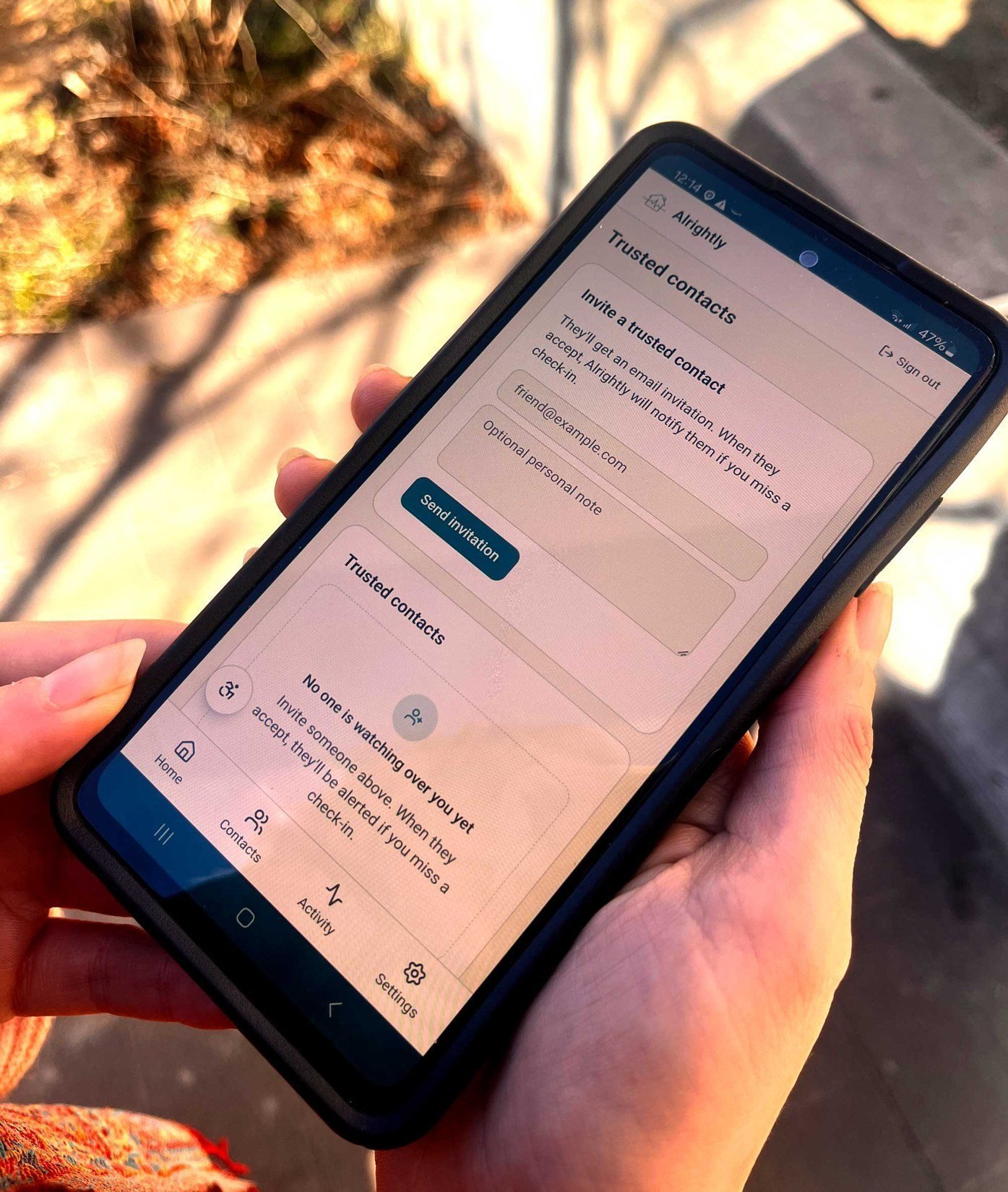
Alrightly came from a gap in her own safety net: she has lived alone for much of her adult life and wondered how long it would take anyone to notice if something went wrong. Users get a check-in by email, SMS or push at a time they choose, tap once to say they are okay, and if they miss it past a grace period, the trusted contacts they picked are alerted. There is no location tracking, and the company is self-funded.
Key takeaways
- McIntyre built Alrightly for people who live independently and want to keep doing so: one tap a day, with no GPS tracking and no continuous monitoring.
- Users set their own check-in time, grace period and trusted contacts, and any emergency information is optional and shared only while an alert is active.
- She names Snug Safety as the closest competitor and says the difference is that Alrightly collects no location data and works in a browser with nothing to download.
- Audiences turned up that she had not planned for, including a single father who signed up so someone would know to step in for his children, and a plan for senior centers and faith communities.
- As a solo founder who loves building more than marketing, her main goal for the next year is to reliably reach the people who would benefit.
Before any of this
Startup.talk:Where did you grow up, and what was childhood like?
McIntyre:I was born in Pittsburgh, Pennsylvania, but my family moved around quite a bit when I was growing up. We lived in southern Virginia when I was very young, then central Vermont, then Montreal for a year, and finally back to Vermont for high school. With the exception of that year in Montreal, my childhood was very rural. Lots of woods and fields, lots of playing outside, and plenty of room to explore!
Startup.talk:What first got you into building things?
McIntyre:I graduated from theater school in New York City right around the time casting directors were starting to expect actors and singers to have an online presence, in addition to the traditional headshot and resume they'd bring to auditions. I figured out how to build a website for myself, and then started building websites for a few actor friends. I discovered that I really enjoyed the technical side of things, and what started as a practical solution to a problem eventually turned into a whole new career direction.
Startup.talk:What was your first job, and what did it teach you?
McIntyre:My first job as a kid was delivering newspapers in the little Vermont town where I lived. My brother and I shared a paper route, and we hauled all the newspapers around in a little red wagon. What did it teach me? Mostly that if you're going to pull a wagon full of newspapers up and down the steep hills of a Vermont town, you'd better be really strong. We weren't!
The road to Alrightly
Startup.talk:What made you start Alrightly?
McIntyre:I've lived alone for much of my adult life, and I genuinely enjoy it. But there's always been one little concern in the back of my mind: if something happened to me at home and I couldn't reach out for help, how long would it take for someone to realize something was wrong?
As a web developer, my instinct when I encounter a problem is usually to see whether I can build something to solve it. So that's what I did! I figured that if this was something I'd been thinking about, there were probably plenty of other people who'd appreciate a solution, too. That's how Alrightly got started.
Startup.talk:You have said you lived alone for much of your life. What moment made you decide you needed a safety net of your own?
McIntyre:There wasn't one dramatic moment. It was more of a realization that developed over time. I started thinking about the difference between having people who care about you and having a system in place that makes sure they'll know when you need them. If I fell and injured myself, or had some kind of medical emergency and couldn't get to my phone, my friends would absolutely want to help. The problem is that they might not know anything was wrong.
“my friends would absolutely want to help. The problem is that they might not know anything was wrong”Erin McIntyre
Startup.talk:You have shipped several small products before, from CSV Cleaner to AI Recipe Writer. What did those launches teach you that shaped Alrightly?
McIntyre:I built AI Recipe Writer when AI was first becoming accessible to independent developers. It was really an experiment to see whether I could get AI to come up with reasonably good recipes using whatever ingredients I happened to have on hand. As it turned out, it did a pretty good job! I've since taken that app offline, since tools like ChatGPT, Claude, and Gemini can now do the same thing so easily.
CSV Cleaner was a more recent project, and it came out of a problem I was having with my own work. I needed to export large amounts of data from one application and import it into another, and CSV imports can be incredibly finicky if the data isn't formatted exactly the way the receiving application expects. I built a tool to make that process easier for myself, and then decided to put it online so other people could use it, too.
I think the biggest lesson I've taken from both projects is that if I'm running into a problem, chances are other people are dealing with it, too. If I can build something that solves that problem for me, it might be exactly what someone else needs. That's very much how Alrightly came about.
Startup.talk:What is it like to build Alrightly as a solo founder in Vermont?
McIntyre:Building Alrightly as a solo founder in Vermont has been particularly meaningful. Vermont is a beautiful, very rural state, and while that's part of what makes living here so wonderful, it can also mean that people are physically isolated from one another. You can have a terrific network of friends and family and still live quite a distance from the people who would be there for you if you needed help.
That's part of what makes Alrightly feel especially relevant here. It's a simple way to bridge that physical distance and make sure the people in your life can be there when you need them, even if they're not right next door.
The product
Startup.talk:Why the name Alrightly?
McIntyre:I just really liked the sound of it! It had a friendly, reassuring quality that felt right for what I was building. It brings to mind the idea of being "all right," which is really the heart of the whole concept. I wanted a name that felt warm and approachable, rather than clinical or overly serious, and Alrightly just seemed to fit.
Startup.talk:Why did you design Alrightly around one tap a day instead of continuous monitoring?
McIntyre:I wanted Alrightly to be something that fits easily into people's lives, rather than something that changes the way they live. I don't want to be monitored all day, and I figured there were probably plenty of other people who felt the same way!
There are some terrific safety services out there for people who need more active monitoring, fall detection, GPS tracking, or immediate access to emergency responders. Alrightly isn't designed to replace those services. It's for people who are active and independent, who don't need that level of monitoring but would still like a backup plan in place in case something unexpected happens.
The idea is that you shouldn't have to give up your privacy or independence just to have a safety net. You just need a simple way to say, "I'm okay," and a system that will let your trusted contacts know if you don't check in. One tap a day seemed like a really nice balance. It's simple enough to become part of your daily routine, but it provides that extra layer of reassurance without being intrusive.
“you shouldn't have to give up your privacy or independence just to have a safety net”Erin McIntyre
Startup.talk:How do you decide the right grace period before trusted contacts are alerted?
McIntyre:The nice thing is that I don't have to decide that for everyone! Alrightly lets users set their own grace period based on what works best for them. Some people might want their trusted contacts notified fairly quickly if they miss a check-in, while others might prefer a little more breathing room. Everyone has different routines, schedules, and comfort levels, so I didn't think it made sense to impose a one-size-fits-all rule.
Startup.talk:How do you protect people's emergency information while still making alerts useful?
McIntyre:Providing any emergency information at all is completely optional. Many users choose trusted contacts who already know how to, for example, access their home in an emergency and don't need to have that information provided to them by Alrightly. In a case where no emergency info has been provided, an alert would just let a user's trusted contacts know that the user missed a check-in and might need help. For many people, that's enough: a signal that something might not be okay.
Some users do choose to provide information that might be helpful in an emergency, like medical notes, building access instructions, or where to find a spare key. None of this information is available to contacts during normal daily check-ins. It becomes accessible to the contacts you've authorized only when you miss a check-in and an alert is triggered, and that access ends when the alert is resolved. We also have safeguards in place to restrict access on the administrative side, so routine customer support can't simply browse through users' sensitive emergency information.
Startup.talk:Who gets the most value from Alrightly: seniors, families, lone workers, travelers or college students?
McIntyre:I think the people who get the most value from Alrightly are those who are living independently and want to keep it that way! That could be a healthy, active senior who lives alone, a single person in their thirties or forties, someone who works remotely, or someone who lives in a rural area where neighbors aren't necessarily close by.
I'm also discovering that the need for a safety net isn't necessarily limited to people who live alone. Single parents, for example, may want to make sure someone will know if something happens to them so their children aren't left without help. There are quite a few situations where someone might benefit from having a simple check-in system in place.
I think what all these people have in common is that they recognize that unexpected things can happen to anyone. They don't necessarily need someone monitoring their every move, but they'd like to know that if something happened and they couldn't reach out for help, someone would be alerted. Ultimately, it's about making independence and connection work together.
Startup.talk:What do you deliberately leave out of Alrightly?
McIntyre:I've tried to be very intentional about keeping things simple. There are no social feeds, no unnecessary notifications, and no complicated routines to manage. I don't want people to feel like they're taking on another responsibility just by signing up for a safety service.
The biggest thing I left out is location tracking. There's no GPS tracking, continuous activity monitoring, or anything that requires people to give up their privacy. Those technologies can be incredibly valuable in the right circumstances, but they're not what Alrightly is designed to provide.
I want Alrightly to do one thing really well: make it easy for someone to check in each day, and make sure their trusted contacts are notified if they don't. Everything else should support that purpose, rather than distract from it.
Positioning
Startup.talk:Who is Alrightly for, and what job does it do for them? Describe the person who gets the most value.
McIntyre:I think of someone a lot like myself. They're independent, they enjoy their life, and they have friends and family who care about them. They might live alone in a city apartment or in a little house in rural Vermont. They're active, capable, and perfectly happy managing their own lives. They're also practical enough to recognize that unexpected things can happen to anyone. They don't need someone checking up on them constantly, and they don't want to change the way they live. They just want to know that if something happened and they couldn't reach out for help, someone would be notified.
Startup.talk:How do you view your positioning relative to Snug Safety, Life360, medical alert pendants and daily call services for people living alone? Is there another competitor you think of first?
McIntyre:I think there's room for a lot of different approaches to personal safety, because people have very different needs. Someone with a serious medical condition or a high risk of falling might really benefit from a medical alert device with automatic fall detection and access to emergency responders. Someone who wants their family to know where they are throughout the day might love Life360. Those are valuable services, but they're not what I was looking for when I started building Alrightly.
Snug Safety is probably our closest competitor, since it also offers daily check-ins and alerts when someone misses one. One important difference is that Snug collects location information, while Alrightly doesn't track your location at all. Snug also requires users to download an app, while Alrightly does not. Alrightly can be installed on a mobile device, but it can also work right in your web browser, with nothing to download.
I think what distinguishes Alrightly is the particular combination of simplicity, privacy, and user control. I wanted something for people who are active and independent, who don't need continuous monitoring or immediate emergency response, but who recognize that something unexpected could happen and would like to have a backup plan.
Ultimately, I don't think there's one right safety solution for everyone. I just wanted to create one that I would feel comfortable using myself, and that I thought other independent people might appreciate, too.
Startup.talk:What is your core moat in safety check-in services?
McIntyre:It may be a little early to claim that Alrightly has some enormous competitive moat! What I think gives Alrightly an advantage is that I'm building it from the perspective of someone who actually wants to use it. I understand the audience because I'm part of it. I know what it's like to enjoy living independently, to have a good network of people who care about you, and still recognize that there's a gap in your safety net.
That firsthand understanding influences the decisions I make about the product. I'm not trying to build the most feature-packed safety platform or compete on the sheer number of things Alrightly can do. I'm trying to build something that solves a very specific problem in a way that feels natural and comfortable for the people who experience it. Over time, I hope that my understanding of the people I'm building for, combined with a reputation for reliability and trustworthiness, will become Alrightly's real competitive advantage.
“I understand the audience because I'm part of it”Erin McIntyre
Startup.talk:What are some of the use cases for Alrightly that are not obvious and can add a lot of value to users? List as many as possible.
McIntyre:One of the things that's been really interesting since launching Alrightly is discovering how many different situations could benefit from a simple safety check-in. I originally built it with people who live alone in mind, but the underlying idea is useful in all sorts of circumstances.
Single parents are a great example. I recently had a single father sign up because he wanted to make sure that if something happened to him, someone would know and could step in to care for his children. That hadn't been an audience I'd specifically considered, but it makes so much sense. When you're the sole caregiver for someone else, having a safety net isn't just about your own well-being.
I can also see Alrightly being valuable for people who work alone, particularly those who work in isolated locations or don't have coworkers checking in on them. People who travel solo could use it as an extra layer of reassurance while they're away from home. It could be useful for college students living away from their families for the first time, or for people recovering at home after a medical procedure who want someone to know if they don't check in as expected. Of course, in situations where someone needs active medical monitoring or immediate emergency response, they'd need a more specialized service.
Another area I'm really excited about is Alrightly for Organizations. We've created a plan that allows organizations like senior centers, faith communities, and social service agencies to provide Alrightly memberships to the people they serve. The organization can act as a trusted contact, so if someone misses a check-in, designated staff members are notified and can follow up. I think there's tremendous potential for organizations that want to help people remain independent while making sure they have a connection to support when they need it.
Startup.talk:What is the one detail in Alrightly you are proudest of?
McIntyre:I think I'm proudest of how much control Alrightly gives people over their own safety arrangements. Users choose when they check in, how much of a grace period they want, who gets notified, and what information those people can access if an alert is triggered. They can even choose how they want to use Alrightly itself; either right in their web browser or by installing it on their mobile device. I didn't want to build something that dictated how people should manage their safety. I wanted to give them the tools to make those decisions for themselves. Everyone's circumstances are different, and I think the technology should respect that.
The hard part
Startup.talk:What is a challenging time you had building Alrightly?
McIntyre:I think one of my biggest challenges as a solo founder is that I love building things, but I really don't love marketing them! I can happily spend hours working on a new feature, solving a technical problem, or experimenting with an idea. When it comes time to actually promote what I've built, however, I'd much rather go back to writing code. I know that Alrightly isn't going to help anyone if nobody knows it exists, so I'm having to push myself to spend more time on the marketing part of the business.
Startup.talk:Who believed in you before there was anything to show? What did they say or do?
McIntyre:I have a couple of close friends who I talked to quite a bit about Alrightly when it was still just an idea. We're all single, and we share a similar philosophy about relationships and independence. None of us sees living alone as a problem that needs to be solved, and we certainly don't think being in a romantic relationship should be a prerequisite for feeling safe and secure.
Even so, we all recognized the same gap. We have people in our lives who care about us, but if something happened to one of us at home, how long would it take before anyone realized something was wrong? It's a concern we'd all thought about, even though we're perfectly happy with our living arrangements.
When I described my idea for Alrightly, their response was pretty immediate: "I'd use that!" That was incredibly encouraging, because it confirmed that I wasn't the only person who wanted something like this. A friend who happens to be particularly good at marketing also kept telling me that Vermont was exactly the right place to launch a service like this. She could see the potential for it in a state where so many people value their independence and live in relatively rural communities.
Startup.talk:How do you earn the trust of people who are wary of safety apps that track them?
McIntyre:I think the first thing is to recognize that their concerns are completely reasonable! I'm one of those people myself. I don't particularly want an app tracking my location or monitoring my activities, and I don't think I should have to give up that privacy just to have a little extra peace of mind. That's actually one of the reasons I built Alrightly the way I did. It doesn't track your location, monitor your movements, or collect information about what you're doing throughout the day. You simply check in at a time you've chosen, and if you miss that check-in, the people you've designated are notified.
Ultimately, I think trust comes from being transparent about what a product does and doesn't do, and then consistently respecting those boundaries. I want people to feel that Alrightly is something they're in control of, not something that's keeping an eye on them.
What it is all for
Startup.talk:What would make you say Alrightly has succeeded?
McIntyre:Of course, I'd love for Alrightly to grow into a successful, financially sustainable business. I'm an entrepreneur, after all! I'd like to reach a point where the business can support itself and I can continue improving the product and reaching more people.
I think one of the most meaningful moments, though, would be hearing that Alrightly worked exactly as intended when someone needed it. Maybe someone missed a check-in because something had happened, their trusted contacts were alerted, and someone was able to step in and help. Knowing that something I built made a real difference in that situation would be incredibly meaningful. If Alrightly helps people feel more comfortable and confident living independently, without feeling like they need to sacrifice their privacy or change the way they want to live, I'd consider that a success, too.
Startup.talk:What will living alone safely look like when AI assistants can notice that something is wrong?
McIntyre:I think there's enormous potential for AI to make independent living safer. I also think we're going to have some important decisions to make about privacy and autonomy. Just because technology can monitor every aspect of our lives doesn't necessarily mean we want it to. There's a difference between having an assistant that's there when you need it and feeling like you're being watched all the time.
My hope is that the future offers people a range of options, from sophisticated AI monitoring to something as simple as Alrightly's daily check-in. I don't think there's going to be one right solution for everyone. The important thing is that people have the freedom to choose the level of assistance they're comfortable with, and that the technology supports their independence rather than taking it away.
The road ahead
Startup.talk:What are your milestones for the next 12 months, in users and revenue?
McIntyre:My biggest goal for the next year is to figure out how to consistently reach the people who would benefit from Alrightly. I've already discovered that there are more potential audiences and use cases than I originally anticipated, so part of the challenge is figuring out where to focus my efforts and which marketing approaches actually work.
I'd also like to start building relationships with organizations that could offer Alrightly to the people they serve. We already have an organizational membership option, and I'm interested in exploring how that could help us reach people through existing community networks.
On the business side, I'd like to establish a solid foundation for growth, with an increasing number of active users and paying subscribers. My priority is to understand what attracts people to Alrightly, what makes them want to keep using it, and how to build on that over time.
Startup.talk:Where do you want Alrightly to be in five years?
McIntyre:In five years, I'd love for Alrightly to be a well-established, trusted service that people naturally think of when they're looking for a simple way to make sure someone will know if they need help. I'd like the idea of having a daily safety check-in to feel as normal and practical as having a smoke detector or keeping an emergency contact on your phone. It's just one of those sensible things you do to look after yourself.
I'd also love to see Alrightly become a widely available resource through organizations that support independent living. I can imagine senior centers, community groups, faith-based organizations, and other nonprofits offering Alrightly memberships as part of the services they provide. That could be a wonderful way to make this kind of safety net accessible to people who might not otherwise seek it out.
Startup.talk:What are your hopes and fears for a post AGI world?
McIntyre:I find the possibilities of AI genuinely exciting. I've always loved technology because of what it allows people to create, and I think we're only beginning to imagine what's going to be possible.
My biggest hope is that we'll be able to integrate AI into our work and our everyday lives thoughtfully and responsibly, in ways that genuinely improve the human experience. I think there's enormous potential for AI to make our lives easier, expand what's possible, and free us up to spend more time on the things that really matter. I don't think progress should be measured simply by how much more productive or efficient we become, though. I hope we'll be thoughtful about what we choose to automate, what we want to preserve, and how we make sure these advances actually contribute to happier, healthier, more fulfilling lives.
My biggest concern is whether the benefits will actually be shared. If AI creates tremendous wealth and productivity, but most of that ends up concentrated in the hands of a relatively small number of people or companies, we could end up with a world that's technologically astonishing but not necessarily better for most of humanity. I also worry about how we preserve individual freedom and autonomy as these systems become more powerful and more deeply integrated into our lives.
This interview was conducted in writing and has been edited lightly for length and clarity.
About Alrightly
Alrightly is a privacy-first daily safety check-in service built by Erin McIntyre in Vermont, USA: users tap once a day to say they are okay, and trusted contacts are alerted if a check-in is missed, with no location tracking.
| Attribute | Verified Detail |
|---|---|
| Company | Alrightly |
| Founder(s) | Erin McIntyre |
| Country | USA |
| Based in | Montpelier, Vermont |
| Education | The American Musical and Dramatic Academy (New York, NY) The New School University; BFA, Musical Theater Performance (New York, NY) Fort Hays State University; MPS, Web Development (Hays, KS) |
| Background | Independent web developer |
| Also built | CSV Cleaner, Unfollow Assistant |
| Funding | Self-funded |
More Startups in Spotlight
For founders
Building something? Want to share your journey?
Tell us how it started, what nearly broke it and where it is headed. We will turn it into a story like this one.
Share your journeyFor readers
Want to read more human stories behind the startups?
New founder interviews and stories, as they are published.
Follow us on LinkedIn