
Ján Turský is the middle of three brothers in a family that works in IT. He fell for Android development because he could see what he had programmed working almost at once. He studied at Matej Bel University in Banská Bystrica, started out as an Android developer at a small company in the same city, and has spent more than 14 years building mobile and web apps. Today he runs Apptiary, his own studio in Bratislava, Slovakia.
LoupeKit grew out of his search for tools to improve his own websites. It is a browser extension for Chrome, Edge and Firefox that names a page’s tech stack with evidence, pulls its palette, fonts and assets, exports design tokens, and gives a 0 to 100 Vibe audit score for how much of a page reads as raw AI output. It has more than 200 users and has reached version 1.0.0. We spoke about scoring something as subjective as an AI-made page, why the extension asks for no website permissions, and the last 10 percent of a release.
Key takeaways
- The Vibe audit scores a page from 0 to 100 across six weighted categories using 100 heuristics. Each finding states the measurement behind it and offers a fix, and hand-written pages are calibrated to score low.
- Every stack detection shows its evidence: a DOM marker, an asset URL, a header, a page global or a cookie name.
- LoupeKit asks for no permission on any specific website. Its code runs only in the tab you click, only when you ask.
- Every tool is free for 24 hours with no account. Pro is €6.99 a month or €49.99 for life.
Before any of this
Startup.talk:Where did you grow up, and what was childhood like?
Turský:I was the middle child, with one older brother and one younger. The whole family works in IT.
Startup.talk:What first got you into building things?
Turský:Android. I liked development itself, and I liked how quickly you could see something new you had programmed actually working. I enjoyed it a lot and I still do.
Startup.talk:What was your first job, and what did it teach you?
Turský:I was an Android developer at a small company in Banská Bystrica, Slovakia.
The road to LoupeKit
Startup.talk:How did you come to build LoupeKit?
Turský:I like the idea of bringing a large number of tools together in one place instead of having them scattered across many apps.
Startup.talk:What was the moment you wanted to read any page the way you would read your own?
Turský:I was looking for good tools to help me improve my own websites. Either I could not find the functionality, it was paid, or the content did not suit me.
Startup.talk:What were the first pages you ran a Vibe audit on?
Turský:My own websites, jantursky.com and apptiary.com.
Startup.talk:What does building under Apptiary mean for how you pick projects?
Turský:I wanted to start a business, and this was the option that appealed to me most.
Startup.talk:What is it like to build browser extensions for three browsers?
Turský:Chrome, Edge and Firefox all ship as real MV3 builds, not a Chrome extension with a Firefox promise. The engines disagree on permissions in small ways. Firefox's screenshot call, for example, accepts a different grant than Chrome's, so each build gets checked on its own.
The product
Startup.talk:Why the name LoupeKit?
Turský:A loupe is the small magnifier you hold up to look closely at one thing. LoupeKit is the set of tools for doing that to a web page.
Startup.talk:Why a Vibe audit for how much of a page is raw AI output?
Turský:A stack detector tells you what a page is. I wanted a tool that also says how it was made. The audit scores a page from 0 to 100 across six weighted categories: HTML artifacts, CSS and utility-class verbosity, JavaScript runtime artifacts, copy patterns, accessibility and page weight. It is the one result people want to screenshot and compare.
Startup.talk:Why name the tech stack with evidence?
Turský:A bare label is easy to doubt. Every detection shows how it matched: a DOM marker, an asset URL, a header, a page global or a cookie name. You can check the claim yourself instead of trusting the tool.
“You can check the claim yourself instead of trusting the tool.”Ján Turský
Startup.talk:Why export design tokens as a Tailwind theme?
Turský:A palette you cannot paste into a project is only half useful. LoupeKit exports the colours to a tailwind.config.js or to CSS variables, and it can also check a page's colours and fonts against a Tailwind 4 @theme block you paste in.
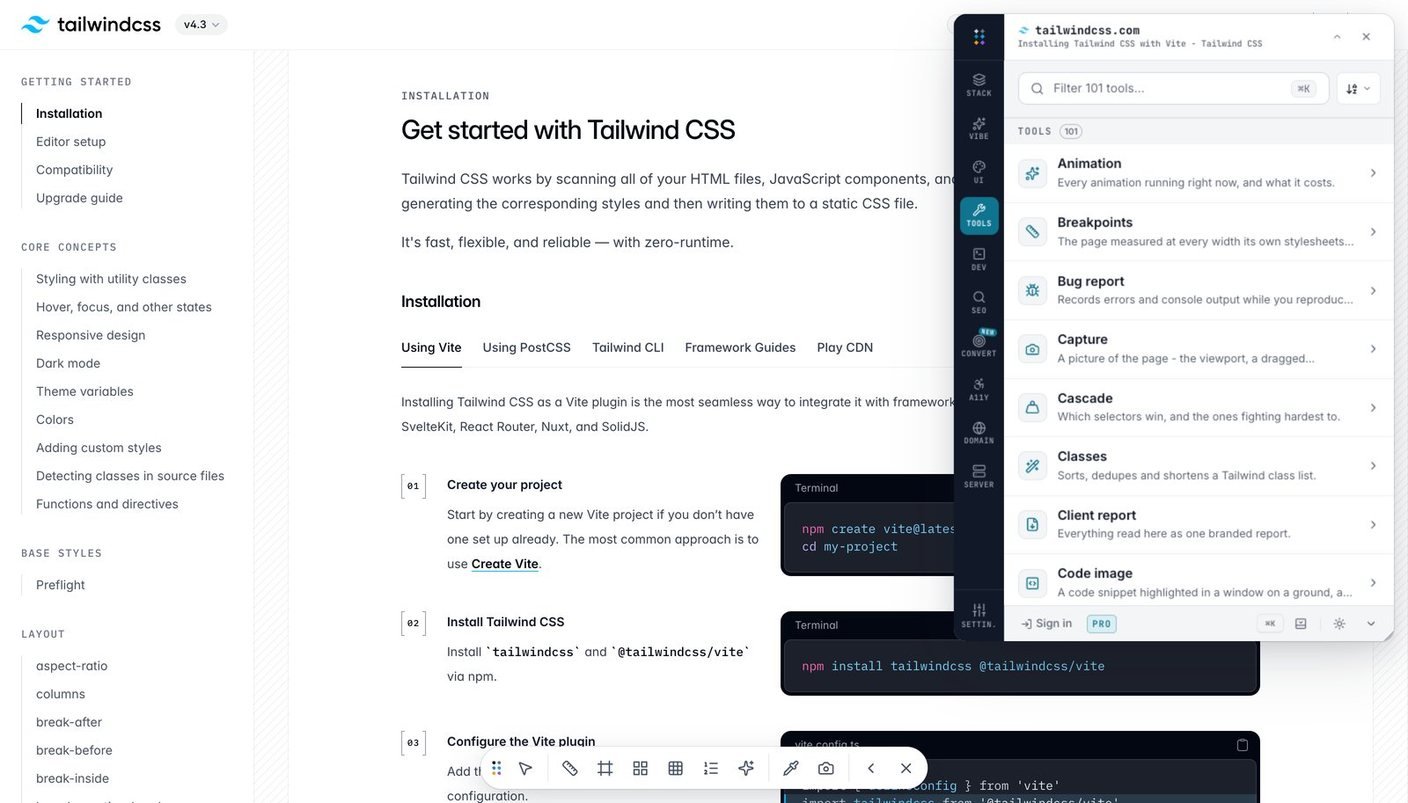
Startup.talk:Why read only the tab you click?
Turský:Because the extension asks for no permission on any specific website. The inspection code goes into the tab you are on, at the moment you ask, through activeTab. Nothing runs in the background and nothing is collected across tabs. Audits run only when you press the button.
“Nothing runs in the background and nothing is collected across tabs.”Ján Turský
Startup.talk:Why a 24 hour trial with all tools?
Turský:Every tool is unlocked for the first 24 hours, with no account. You judge it on your own pages, and when the trial ends the panel locks until you buy Pro or enter a licence key.
Startup.talk:Why build tools like a cookie editor with so few permissions?
Turský:Security comes first, and so does asking for as few invasive permissions as possible.
Startup.talk:What do you deliberately leave out of LoupeKit?
Turský:Background collection across tabs, permissions for specific websites, and accounts for the trial. Live edits to a page stay in the page, can be undone, and are never saved or uploaded. AI provider keys stay in your browser and never reach my server.
Positioning
Startup.talk:Who is LoupeKit for, and what job does it do for them? Describe the person who gets the most value.
Turský:Developers and designers who need to know what a page in front of them is made of. Typical jobs: naming the stack behind a site, pulling its palette, fonts and SVGs, checking contrast, and finding out whether a page, their own included, reads as raw AI output. The most value goes to people who do this several times a week.
Startup.talk:How do you view your positioning relative to Wappalyzer, WhatRuns and Hoverify? Is there another competitor you think of first?
Turský:Stack detectors tell you what a page runs on. LoupeKit also scores how it was made, shows the evidence for each match and asks for no website permission at install. I think of it as an inspector that sits next to a detector rather than replacing one.
Startup.talk:What is your core moat when stack detectors are everywhere?
Turský:Three things together. The Vibe audit, a score that no stack detector produces. Empty host permissions in both built manifests, which anyone can verify in the manifest instead of taking a bullet point on faith. And evidence for every detection.
Startup.talk:What are some of the use cases for LoupeKit that are not obvious and can add a lot of value to users? List as many as possible.
Turský:Checking a client's or a competitor's site before a pitch. Auditing your own AI-built site before launch. Pulling a full palette, the font matrix and every SVG from a page you admire. Checking colours and fonts against your design tokens. Contrast checks measured against the real background behind the text. Previewing a page at other screen sizes. It is also a very good tool for checking accessibility and search engine optimization, and it has many other tools that can be really helpful.
Startup.talk:What is the one detail in LoupeKit you are proudest of?
Turský:LoupeKit is not only a separate extension. It also has shortcuts and a bar at the bottom of the page for quick, dynamic use, and the app scales well as it grows.
Launch
Startup.talk:What did you learn from the launch?
Turský:That you have to prepare for the release: good graphics, good copy, and promotion across several channels. I am still learning the last part.
Startup.talk:Which feedback from the launch surprised you?
Turský:Most of the feedback came privately by email, from several people. They were good ideas, and I worked some of them in and adapted my work to them.
The hard part
Startup.talk:How many people use LoupeKit today?
Turský:Over 200 users at the moment.
Startup.talk:What is a challenging time you had building LoupeKit?
Turský:A stretch where I was not sure the app would get a good response or appeal to users. I still think it is a useful app that can help people and make their work easier.
Startup.talk:Who believed in you before there was anything to show? What did they say or do?
Turský:My wife believed in me, and she still does.
“My wife believed in me, and she still does.”Ján Turský
Startup.talk:How do you score something as subjective as how AI made a page looks?
Turský:I do not pretend it is objective. The audit runs 100 heuristics, and each finding states the measurement that triggered it and offers a concrete refactor. The weights differ by category, and the whole thing is calibrated so that hand-written pages score low. A tool that flags careful work is worse than no tool.
What it is all for
Startup.talk:What would make you say LoupeKit has succeeded?
Turský:Getting the release done. The last 10 percent always takes the longest, so I am glad to have reached version 1.0.0, the official production release. I also learned a lot along the way about programming, languages and technologies across several areas.
“The last 10 percent always takes the longest”Ján Turský
Startup.talk:What does it feel like to see other people use LoupeKit?
Turský:I like the idea of my software being used by someone else for a good purpose, and of that person enjoying using it.
The road ahead
Startup.talk:What are your milestones for the next 12 months, in users and revenue?
Turský:Keep adding features and services to the product, listen to the community and support it, and build the requests that are reasonable.
Startup.talk:And for the next 24 months?
Turský:I am already working on my next product, podcasttotranscript.com.
Startup.talk:Where do you want LoupeKit to be in five years?
Turský:Five years is far off, but I would like to stay in the startup space and keep working on my own projects. LLMs and AI are popular right now, so why not learn more in that area and push further.
Startup.talk:What are your hopes and fears for a post AGI world?
Turský:I worry that the demand growing right now, along with all the low-quality content that drains the world's resources, will hit a point where the bubble bursts. I am also sad about all the pointless content being created, in images, videos and so on, that adds no value.
This interview was conducted in writing and has been edited lightly for length and clarity.
About LoupeKit
LoupeKit is a browser extension for Chrome, Edge and Firefox that inspects any web page: it names the tech stack with evidence, extracts the palette, fonts and assets, exports design tokens to Tailwind or CSS variables, checks contrast and accessibility, and gives a 0 to 100 Vibe audit score for how much of a page reads as raw AI output. Every tool is free for 24 hours; Pro is €6.99 a month or €49.99 lifetime. LoupeKit is made by Apptiary in Bratislava, Slovakia. loupekit.com
| Attribute | Verified Detail |
|---|---|
| Company | LoupeKit |
| Founder(s) | Ján Turský |
| Country | Slovakia |
| Based | Bratislava, Slovakia |
| Studied | Matej Bel University, Banská Bystrica |
| Before | Android developer; 14+ years in mobile and web apps |
| Also makes | Podcast To Transcript, TextArray, AddonHive, Engraving Studio |
| Studio | Apptiary s.r.o. |
More founder interviews
 Dailies.games
 VoCalm
 Skillbox
 OkTreat
For founders
Building something? Want to share your journey?
Tell us how it started, what nearly broke it and where it is headed. We will turn it into a story like this one.
Share your journeyFor readers
Want to read more human stories behind the startups?
New founder interviews and stories, as they are published.
Follow us on LinkedIn