
Pierre Kasparian grew up in a suburb near Paris and started coding at 13. Kasparian built Podcastify as an auditory learner studying computer science engineering at UTT, to listen to dense papers and course notes on a commute instead of reading them, and works on it from France alongside the degree and freelance work as an AI and data engineer, after an AI software internship at Pretto.
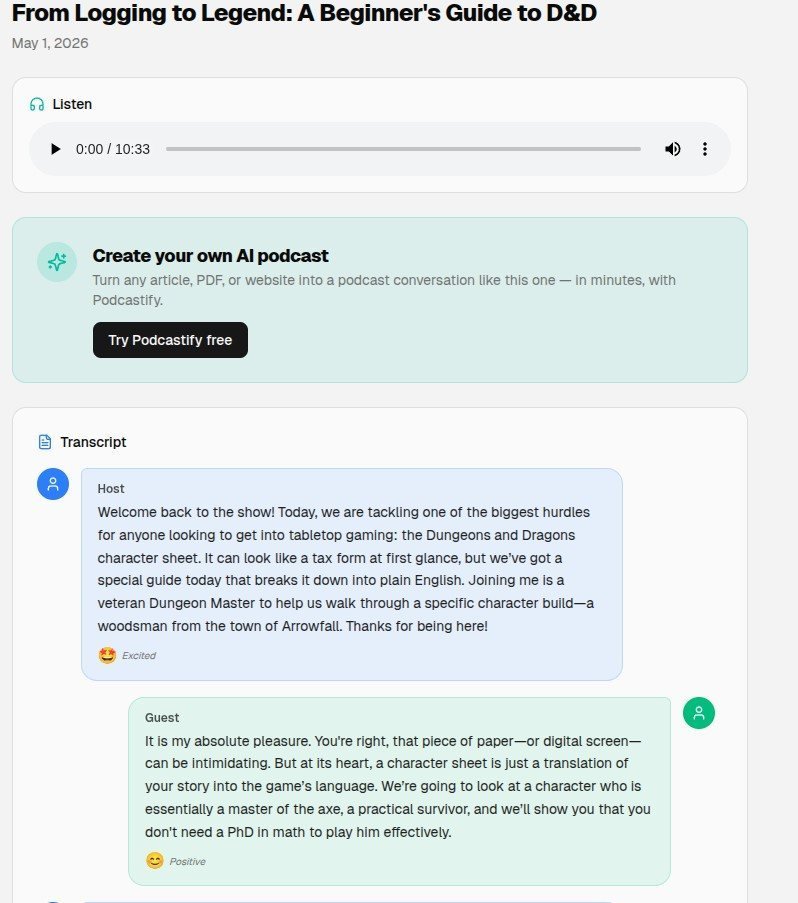
Podcastify turns text, PDFs, webpages, images and YouTube videos into two-host podcast episodes, with an editable transcript, a downloadable MP3, 20+ premium voices, voice cloning and 15 languages. It has been live since 2025, is bootstrapped with no outside funding, and has about 100 regular users, according to Kasparian.
Key takeaways
- The transcript appears before the audio, so a user can fix a weak opening, cut a repeated point or change the tone before spending a single audio character, which Kasparian calls the main product decision.
- Kasparian built Podcastify as an auditory learner who retains more by hearing than by reading, and other people began asking to use it.
- Kasparian says no model wrapper is a moat: the defensible part is the workflow around it, from mixed inputs and a transcript-first editor to voice cloning from a short sample and 15 languages.
- Marketing was the underestimated part: Podcastify has relied almost entirely on SEO, and Kasparian is now learning paid ads, with rough first campaigns.
- The targets are 1,500 euros or more in monthly recurring revenue within 12 months and monthly churn below 10% at 18 months, and in five years Kasparian would like to sell Podcastify and start another product.
Before any of this
Startup.talk:Where did you grow up, and what was childhood like?
Kasparian:I grew up in a peaceful suburb near Paris, where I developed an early passion for technology and computer science. I started coding at the age of 13, and since then, I've been fascinated by the idea of building things from scratch. I've always dreamed of creating an online business, turning ideas into successful startups, and, most importantly, using technology to solve real problems and make people's lives easier.
Startup.talk:What first got you into building technology?
Kasparian:I am finishing a computer science engineering degree at UTT. The part I kept coming back to is shipping: writing code, putting it in front of users, and fixing what breaks in production. That loop is still what I spend most of my time on.
Startup.talk:What was your first job, and what did it teach you?
Kasparian:My first industry work was an AI software internship at Pretto. I also built a RAG-powered chatbot for Live Session on a freelance mission. The useful lesson was that the model is a small part of the job. Retrieval, evaluation, latency, and error handling decide whether a feature survives contact with real users.
The road to Podcastify
Startup.talk:What made you start Podcastify?
Kasparian:I am an auditory learner. I retain much more when I hear something than when I read it, and I was studying computer science engineering at UTT at the time. Most of what I had to get through was dense text: papers, course notes, long articles. I built a tool that turned that material into a conversation between two hosts so I could listen on a commute. Then other people asked to use it.
Startup.talk:What problem were you seeing that convinced you to build Podcastify?
Kasparian:The problem was not a lack of text to speech. A single voice reading a document aloud is still a document, and it is hard to follow for twenty minutes. I wanted the structure a real podcast gives you. One host introduces the idea, the other asks the question you are probably thinking about, and the argument unfolds in order. That makes long material easier to finish and easier to remember.
Startup.talk:What is it like to build Podcastify from where you are?
Kasparian:I build it from France while finishing my computer science engineering degree at UTT and working as a freelance AI and data engineer. That means the product has to be boring to operate. Next.js on the front end, FastAPI with Celery and Redis on the back end, Google Gemini for the script, several TTS providers for voices, all in one docker-compose stack. I ship small changes, watch what breaks, and fix it.
Startup.talk:How has Podcastify grown so far?
Kasparian:Podcastify has been operational since 2025 and is independent, with no outside funding. The product grew from text and URLs to PDFs, images, and YouTube videos. It now offers 20+ premium voices, voice cloning from a 10 to 90 second sample, and 15 languages for the interface and the audio. It has grown to 100 users now, which I am really proud of, but I am still looking forward to making this number bigger.
The product
Startup.talk:Why the name Podcastify?
Kasparian:Podcastify is podcast plus -ify: take something and make it listenable as a podcast. It is quite a simple name, with a decent number of searches per month even before I launched it. So I decided to take this name, for SEO reasons and because of its clarity.
Startup.talk:What do you deliberately leave out of Podcastify?
Kasparian:What we leave out is distribution on platforms such as Spotify and Apple Music. We produce the MP3, the transcript, a share link, and an embed code, and the user decides where it is published. That keeps the product focused on turning a source into a finished episode instead of becoming a hosting platform or a DAW. Maybe I could create a connection between Podcastify and Spotify, for example, so that users can publish directly from the app. But it is not a priority at the moment.
Startup.talk:What is the one detail in Podcastify you are proudest of?
Kasparian:The transcript appears before the audio. A user can read the dialogue, fix a weak opening, remove a repeated point, or change the tone before spending a single audio character. That ordering is the main product decision, and it is the difference between a generator you can direct and a button that reads a document aloud.
“That ordering is the main product decision”Pierre Kasparian
Positioning
Startup.talk:Who is Podcastify for, and what job does it do for them? Describe the person who gets the most value.
Kasparian:The person who gets the most value already has something worth reading and an audience that would rather listen. That is a marketer repurposing blog posts, a teacher turning notes into lessons, a newsletter writer offering an audio edition, or a team summarizing reports. It also fits anyone who learns better by listening, which is where the product started.
Startup.talk:How do you view your positioning relative to the other companies in your space? Which competitor do you think of first?
Kasparian:NotebookLM is the first comparison because it is free and good at audio overviews of documents. It also gives you two fixed hosts, little control over the transcript, and commercial rights that are not stated clearly, which is the gap we are aiming at. Wondercraft is an all-in-one production suite. ElevenLabs is a voice and TTS company. Podcastle is built around recording and editing a human-hosted show. Podcastify is narrower: mixed inputs in, an editable two-host episode out, with voice cloning and commercial use.
Startup.talk:What is your core moat that prevents competitors from replicating what you offer?
Kasparian:No model wrapper is a moat. The defensible part is the workflow around it: the transcript-first editor, a pipeline that accepts text, PDFs, URLs, images, and YouTube links, voice cloning with a short sample, 15 output languages, and two years of small product decisions that are annoying to reproduce together. A competitor can copy the feature list. Copying the behavior users expect at each step takes longer.
“No model wrapper is a moat.”Pierre Kasparian
Startup.talk:What are some of the use cases for Podcastify that are not obvious and can add a lot of value to users? List as many as possible.
Kasparian:Beyond blog posts and course notes: employee training and internal communications, annual reports and whitepapers, case studies and customer testimonials, meeting notes, recorded webinars, press releases, book chapters and memoirs, online course modules, language practice, and revision material for nursing or STEM students. The pattern is the same each time. A long document that a specific audience will not read becomes a conversation they can finish on a walk.
The hard part
Startup.talk:How many people or companies use Podcastify today?
Kasparian:About 100 people are using Podcastify.io regularly.
Startup.talk:What is a challenging time you had building Podcastify?
Kasparian:Marketing. The product side comes naturally to me: I can sit down, build the feature, and ship it. Getting people to find it is the part I underestimated. I have relied almost entirely on SEO because it is measurable and I can do it myself, but it is slow, and it is not where I am comfortable. I am learning paid ads now, and the first campaigns have been rough. Targeting, creative, and budgets are a different skill from shipping code.
Startup.talk:Who believed in you before there was anything to show? What did they say or do?
Kasparian:Honestly, almost no one knew. I did not announce what I was building, and I had shipped side projects before that got zero users. Anyone who had watched me do that would have been right to say, "OK, another project." So the early belief was mostly mine. I kept using the product for my own studying, which was proof it solved a real problem for at least one person. The first signal from outside came when people started asking to use it.
“So the early belief was mostly mine.”Pierre Kasparian
What it is all for
Startup.talk:What would make you say Podcastify has succeeded?
Kasparian:Success looks like the original problem disappearing for more people. They finish the report, the chapter, or the newsletter because it reached them as a conversation instead of a wall of text. Commercially, that means the product is durable enough to keep improving without outside funding. I would rather be the tool people return to every week than the one with the biggest launch.
The road ahead
Startup.talk:What are your milestones for the next 12 to 18 months, in users and revenue?
Kasparian:At 12 months, I want to reach €1,500+ in MRR, with the work focused on acquisition through SEO and paid ads. At 18 months, I want monthly churn below 10%. I am not setting a user target I cannot control. At that stage, revenue and churn tell me whether the product keeps the people it attracts.
Startup.talk:Where do you want Podcastify to be in five years?
Kasparian:In five years I would like to have sold Podcastify and started another product. I like building more than I like running the same product forever, and a sale would be the cleanest proof that the company is worth something on its own. I want to leave it in a state where it keeps running without me, then start the next thing.
Startup.talk:What are your hopes and fears for a post AGI world?
Kasparian:My hope is that AGI gives indie hackers the leverage of a small team. One person can build and operate products that used to need engineers, designers, and support staff. That creates new problems to solve, and I would like to work on some of them, such as an AI CTO that keeps a codebase and its infrastructure coherent, or memory systems that make agents useful across months instead of one session. My fear is the same leverage turned against SaaS. If anyone can replicate a website and its features in an afternoon, distribution and trust become the only defensible parts, and many small products lose their reason to exist.
This interview was conducted in writing and has been edited lightly for length and clarity.
About Podcastify
Podcastify is an AI podcast generator built by Pierre Kasparian in France that turns text, PDFs, webpages, images and YouTube videos into editable two-host podcast episodes.
| Attribute | Verified Detail |
|---|---|
| Company | Podcastify |
| Founder(s) | Pierre Kasparian |
| Country | France |
| From | A suburb near Paris, France |
| Studies | Computer science engineering, UTT |
| First job | AI software internship, Pretto |
| Also works as | Freelance AI and data engineer |
| Funding | Bootstrapped, no outside funding |
More Startups in Spotlight
For founders
Building something? Want to share your journey?
Tell us how it started, what nearly broke it and where it is headed. We will turn it into a story like this one.
Share your journeyFor readers
Want to read more human stories behind the startups?
New founder interviews and stories, as they are published.
Follow us on LinkedIn