
Luka Cvrk grew up in Zagreb in the age of the Commodore 64, the Atari and the first 286 PCs, and first learned to program in Commodore BASIC. While still at a graphic design high school, Luka was already producing printed work for real clients, and went on to run Vizua, a web development company.
SectionsGrid grew out of that agency work: a library of hand-written, lightweight HTML and CSS sections, from headers and pricing tables to testimonials and footers, that combine into full templates with no frameworks and no build step. Almost everything is free with no registration. The project is bootstrapped and gets around 2,000 visits a month.
Key takeaways
- SectionsGrid started because the section libraries Luka found depended on heavy frameworks and did not work on their own.
- Every section is self-contained, with its own CSS naming convention so it never clashes with another section or an existing project.
- Most alternatives are built to cover 100% of situations when a project needs about 5%; the rest, in Luka’s words, is pure bloat.
- The launch feedback that the sections are too simple is, for Luka, the point: no heavy animations that break basic accessibility.
- Luka is realistic that hand-written code will matter less as AI writes more of the web, and wants SectionsGrid to adapt to that world.
Before any of this
Startup.talk:Where did you grow up, and what was childhood like?
Luka:I grew up in Zagreb, the younger of two brothers. My childhood was full of the nostalgic, beautiful things of the 80s and 90s: the Commodore 64, the Atari, the first 286 PCs, all that jazz. Those machines were where my curiosity about computers began.
Startup.talk:What first got you into building things?
Luka:My first contact with programming was on the Commodore 64. As a kid, I found it immensely fun that you could build something entirely on your own. Commodore BASIC had some really annoying design flaws that belong in a museum now, but the feeling of making something from nothing stuck with me.
“the feeling of making something from nothing stuck with me.”Luka Cvrk
Startup.talk:What was your first job, and what did it teach you?
Luka:While I was still at a graphic design high school, I was already designing and producing printed graphic work for real clients. That's where I got my first real experience with design. It taught me that design is about solving problems as much as making things look good, and that print is unforgiving: once it's printed, a mistake can't be fixed the way it can on a screen.
The road to SectionsGrid
Startup.talk:What made you start SectionsGrid?
Luka:In my work I kept needing a library of ready-made HTML sections that I could stack one on top of another to get the starting structure of a website very quickly. The libraries I found usually depended on heavy frameworks and didn't work on their own. With SectionsGrid I tried to solve that problem: every section is self-contained and uses a fraction of the code that other libraries need.
Startup.talk:Why did you choose plain hand-written HTML and CSS when so much of the web runs on frameworks?
Luka:It gives you completely clean, minimal, native code that doesn't require knowing any framework. Just as important, you can copy a section and paste it into a new project or into any existing one. Pages load fast, you stay in full control, and plain HTML and CSS will still be easy to read ten years from now.
Startup.talk:How did SectionsGrid grow from your own components into a library for others?
Luka:I figured that if a system like this was useful to me, it had to be useful to others too. Many web developers will pick the framework of their choice, but a good number of them simply want minimal code. There's also a learning element: SectionsGrid sections make it easy to see why an element is positioned the way it is in CSS. To keep every section fully independent, the CSS classes follow their own naming convention, so they never clash with each other or with an existing project. The website also has documentation to make the sections easier to use.
Startup.talk:What has it been like to build SectionsGrid so far?
Luka:It's been demanding but fun. SectionsGrid is a project that needs a constant stream of new sections, in the direction users expect. Once the foundations were in place (the naming convention, the CSS structure, the global styles and the handling of default font sizes), working on new sections became a lot more fun.
The product
Startup.talk:Why the name SectionsGrid?
Luka:The name is a direct description of the project: sections arranged in a grid. I really liked it, and I was lucky the domain was still free in a sea of new startup projects.
Startup.talk:How do you design sections so they combine cleanly into one consistent template?
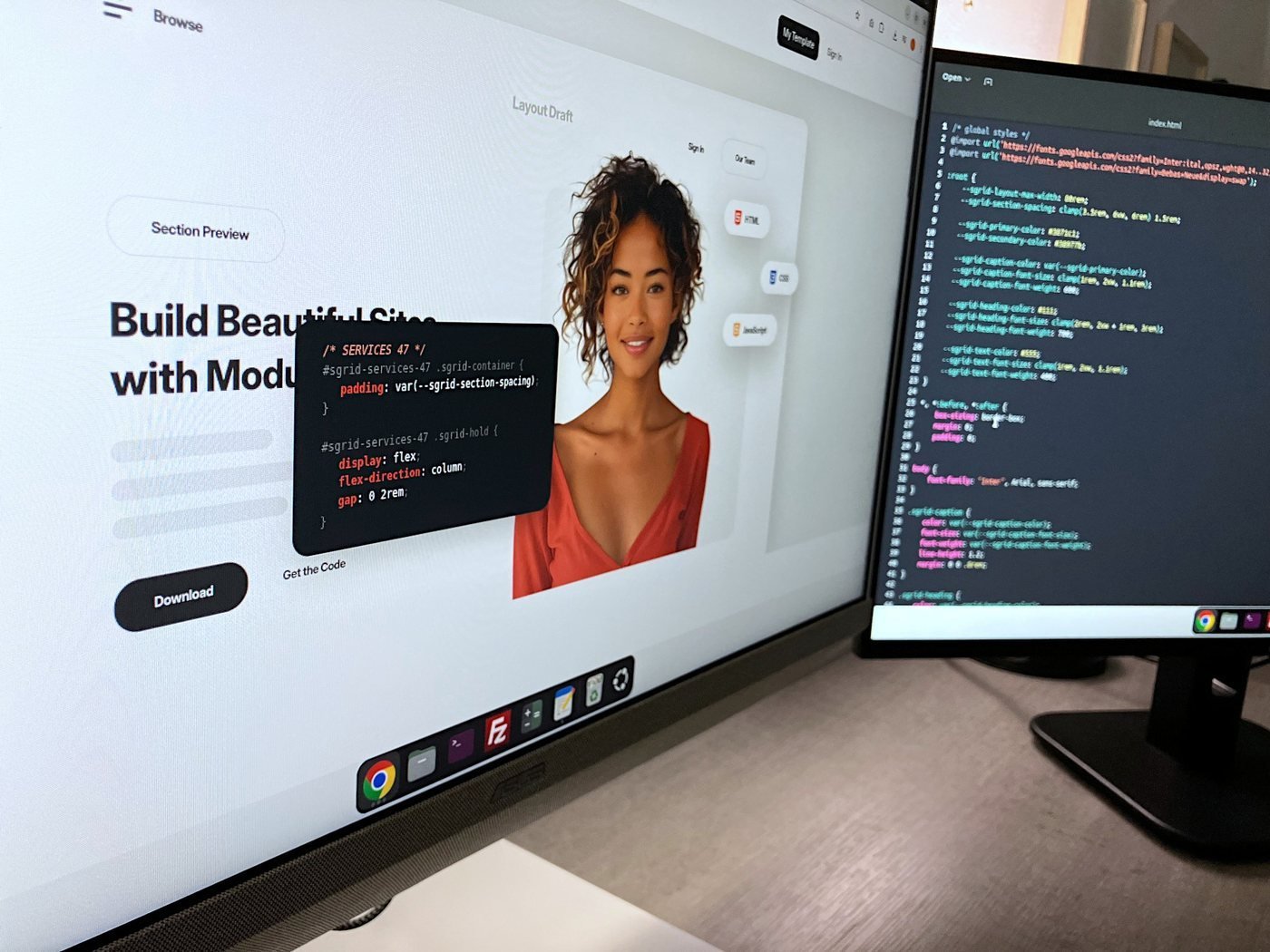
Luka:I design several sections at a time inside one template, so they come out as part of the same visual set. Sections from different sets can also be combined, because they all share the same spacing and padding, the same container width, the same type scale, a color palette defined in CSS variables in the global styles, the same mobile breakpoints, and dark and light themes that can be mixed on one page.
Startup.talk:Who uses SectionsGrid most: developers, designers, agencies or startups?
Luka:All of them: developers, designers, agencies and startups. Quite a few beginners use it too.
Startup.talk:How do people use the sections inside a CMS or internal dashboards?
Luka:On SectionsGrid, people pick all the sections they need and export a ready-made HTML template, which they then use to build an internal CMS, a dashboard or anything else. Later, if they need to add just one specific section, they find it on SectionsGrid and copy and paste it in.
Startup.talk:How do you decide which section to design next?
Luka:It makes sense to fill the gaps in the library and design sections in popular styles. I also keep a close eye on web design trends and on the download statistics for each section.
Startup.talk:What do you deliberately leave out of SectionsGrid?
Luka:No frameworks and no build step. No bloated JavaScript libraries, no external dependencies apart from Google Fonts, and no heavy animations. No hundred variations of the same section, and no page builder or drag-and-drop. Leaving all of that out is what keeps the code light, fast and easy to read.
Positioning
Startup.talk:Who is SectionsGrid for, and what job does it do for them? Describe the person who gets the most value.
Luka:It's for web developers who want a custom front end in a few clicks, one they can easily adapt and maintain later. They can use the code in the CMS of their choice or simply run it as a static site. Agencies use SectionsGrid the same way, to get the starting structure of a client's landing page in a few clicks.
Startup.talk:How do you view your positioning relative to Tailwind UI, Bootstrap themes, Webflow templates, ThemeForest and AI website builders? Is there another competitor you think of first?
Luka:SectionsGrid is fundamentally different because there's no learning curve. Pick a few sections and you can download a ready-to-use HTML/CSS template that reads as if a web developer had written it by hand. The alternatives you mention are designed to cover 100% of situations, but in reality you only need about 5%. The rest of the code is pure bloat.
“The alternatives you mention are designed to cover 100% of situations, but in reality you only need about 5%.”Luka Cvrk
Startup.talk:What is your core moat in website section libraries?
Luka:Honestly, it isn't especially hard to copy. The moat is the human touch: minimal code, written for exactly what's needed and nothing more.
“The moat is the human touch: minimal code, written for exactly what's needed and nothing more.”Luka Cvrk
Startup.talk:What are some of the use cases for SectionsGrid that are not obvious and can add a lot of value to users? List as many as possible.
Luka:Learning CSS layout from real, readable examples
Quick prototypes and mockups to show clients
Landing pages for campaigns, events and product launches
A starting point for HTML email and newsletter templates
Internal tools and admin panels
Documentation and pages for open-source projects
Refreshing old websites without rewriting the backend
Teaching web design and development in classes and workshops
A starting point for your own design system
Portfolio and CV websites
Hackathons and MVPs, where time matters most
A clean base for AI-generated content
Startup.talk:What is the one detail in SectionsGrid you are proudest of?
Luka:How simple it is to export a whole template, how well the sections work together, and how clean and small the code is in kilobytes. And that almost everything is free, with no registration.
Launch
Startup.talk:What did you learn from the public launch of SectionsGrid?
Luka:That there's huge competition in every category, but that users still recognize projects that bring real value. And that visuals are one of the most important parts of presenting a project on Product Hunt.
Startup.talk:Which feedback from the launch surprised you?
Luka:One piece of feedback was that the sections are too simple. In a sea of cluttered designs overloaded with animations, which often take away the browser's basic accessibility features, I can see why it might look that way.
The hard part
Startup.talk:How many people use SectionsGrid today?
Luka:SectionsGrid gets around 2,000 visits a month, and a share of those visitors regularly download sections and templates.
Startup.talk:What is a challenging time you had building SectionsGrid?
Luka:It was challenging to watch AI tools improve and gradually replace hand-written code, and to keep going and finish the project in spite of that.
Startup.talk:How do you keep the code lightweight and accessible as the library grows?
Luka:I keep the HTML minimal and reuse the global styles instead of repeating CSS in every section. I also test sections with Lighthouse, PageSpeed Insights and similar tools, which check performance and accessibility.
What it is all for
Startup.talk:What would make you say SectionsGrid has succeeded?
Luka:More interest from users over the next six months, and feedback from developers, especially beginners telling me they're learning from the sections.
Startup.talk:Will hand-written code still matter when AI can generate whole websites?
Luka:AI learns from good human-written code, and clean code is a better base for AI tools too. But we have to be realistic: in the future, hand-written code won't matter much, and it won't even be common. And we don't have to wait for the future, because it's happening right now.
“AI learns from good human-written code, and clean code is a better base for AI tools too.”Luka Cvrk
The road ahead
Startup.talk:What are your milestones for the next 12 to 24 months?
Luka:Keep adding new sections step by step, and at the end of every quarter look back and weigh the time I've put in against user feedback. Visitor numbers have to keep growing if I want the project to become profitable and start generating revenue.
I have a list of planned features that I'll build depending on user feedback. I also want to develop more benefits for subscribers on the Pro plan, so they can build projects for their clients even faster.
Startup.talk:Where do you want SectionsGrid to be in five years?
Luka:I'd love to see SectionsGrid become a collaborative, multi-author platform with a huge collection of templates, and a project that has successfully adapted to a world where AI writes most of the code.
Startup.talk:What are your hopes and fears for a post AGI world?
Luka:I'm optimistic and excited about the progress in medicine and science, and about how easily anyone can now bring their own (recycled?) ideas to life. At the same time, I'm very worried about losing the creative human touch in almost everything, about the internet becoming centralized, a place dominated by just a few big names, and finally, about many jobs disappearing. I'll make sure to revisit this interview every so often to see whether I read the way the world was changing correctly, or whether I was completely wrong.
This interview was conducted in writing and has been edited lightly for length and clarity.
About SectionsGrid
SectionsGrid, founded by Luka Cvrk in Zagreb, Croatia, is a library of hand-written, lightweight HTML and CSS website sections that combine into full templates and work as static HTML, inside a CMS or in internal tools, with no frameworks.
| Attribute | Verified Detail |
|---|---|
| Company | SectionsGrid |
| Founder(s) | Luka Cvrk |
| Country | Croatia |
| Based in | Zagreb, Croatia |
| Studied | Zagreb University of Applied Sciences |
| Also runs | Vizua (web development) and Kumi, a website builder for Croatia |
| Funding | Bootstrapped |
| Official Website | sectionsgrid.com |
More Startups in Spotlight
For founders
Building something? Want to share your journey?
Tell us how it started, what nearly broke it and where it is headed. We will turn it into a story like this one.
Share your journeyFor readers
Want to read more human stories behind the startups?
New founder interviews and stories, as they are published.
Follow us on LinkedIn