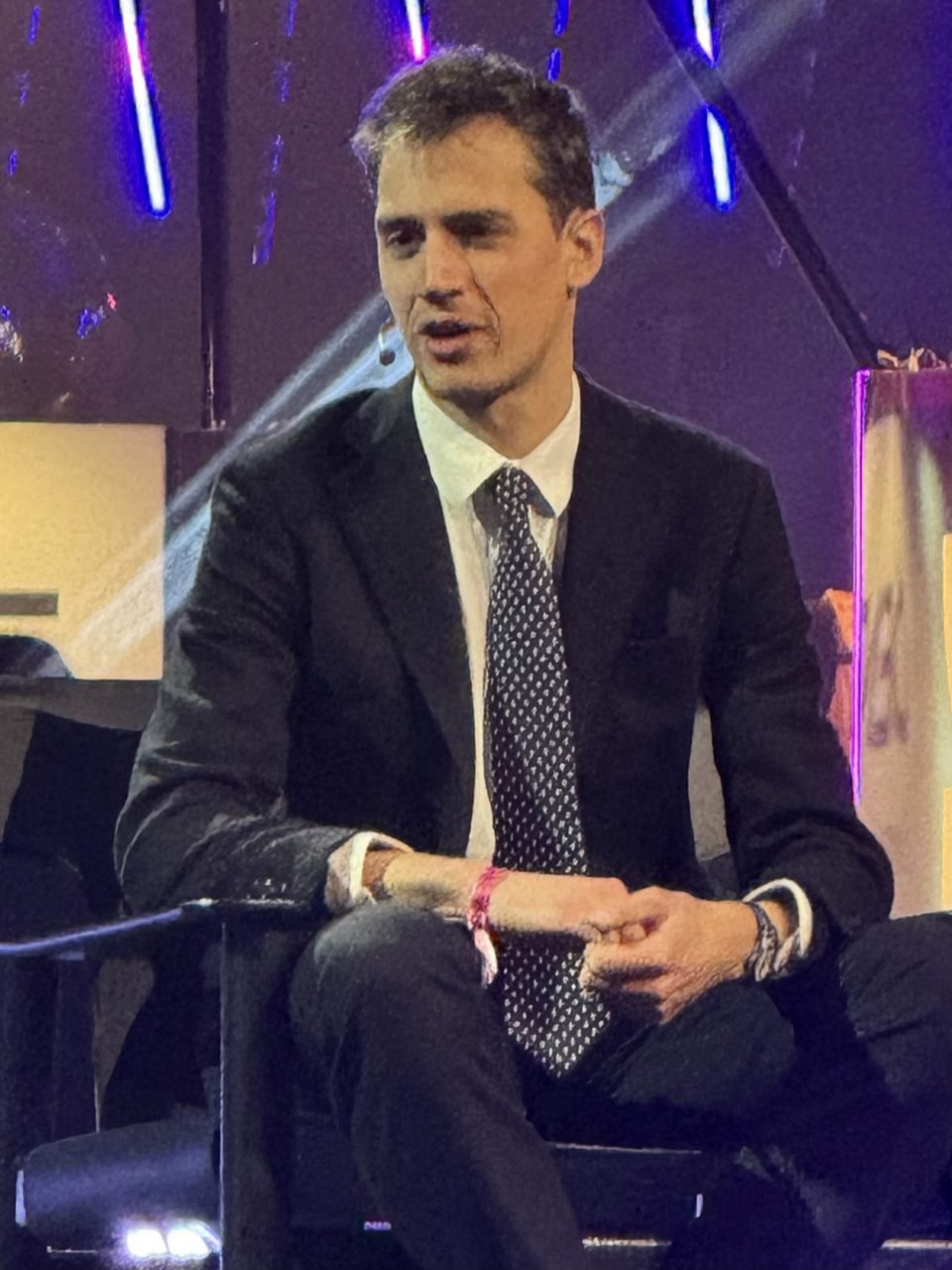
Before Arthur Mensch ever trained a language model, he spent three years staring at pictures of the human brain.
Between 2015 and 2018 he was a doctoral student at Inria and NeuroSpin, the neuroimaging centre at CEA Saclay, working on optimisation methods to read patterns in fMRI scans. It was a long way from chatbots. He had come to it by the most French of routes: raised in Ville-d'Avray on the western edge of Paris, a businessman's son whose mother taught physics, then the preparatory class at lycée Hoche and a place at École polytechnique.
What nobody outside that circle knew was how crowded his own head had become with a single question.
The brain work was only the first of many detours. A postdoc at ENS Paris on optimal transport. A stretch at New York University's Courant Institute with Joan Bruna. Then, in 2020, a job at Google DeepMind's small Paris office, where he stayed about three years and worked on large language models. By any measure he had arrived: a safe, well-paid seat at the one of the best labs on earth.
What nobody outside that circle knew was how crowded his own head had become with a single question. If the best language models were being built behind closed doors in California, who in Europe would ever be allowed to look inside one?
He left DeepMind in May 2023. With him were two old classmates from École polytechnique, Guillaume Lample and Timothée Lacroix, both of whom had been building large models at Meta. They incorporated Mistral AI on 28 April 2023, before Mensch had even resigned. In June they raised 105 million euros, an astonishing seed for a company with no product, from backers including Lightspeed, Xavier Niel and former Google chief Eric Schmidt.
Then they shipped. In September 2023 came Mistral 7B, released openly, which the company said beat Llama 2 13B on every benchmark it tested. Three months later a mixture-of-experts model, Mixtral 8x7B, was claimed to beat GPT-3.5 on most tests. In December 2023 the company was valued at over two billion euros. By June 2024 it was 5.8 billion.
The price of that speed is capital. Training frontier models eats money at a pace that no European startup had ever faced, and in March 2026 Mistral borrowed 830 million dollars to build datacenters near Paris and in Sweden. A reported stake from Samsung in September 2026 put its valuation at around 21 billion euros. Critics, meanwhile, pointed to a 2024 study showing its models could reproduce copyrighted text, a reminder that moving fast leaves marks.
Mensch has become the public face of European digital sovereignty, once arguing that France should not become a US 'vassal state' in AI. It is a long way from the quiet scan rooms at Saclay.
The lesson for a young founder is hiding in that detour. Nothing Mensch studied was wasted: the maths, the brain, the big-lab years all turned out to be the same education. Wander if you must, but wander toward the hard problem.