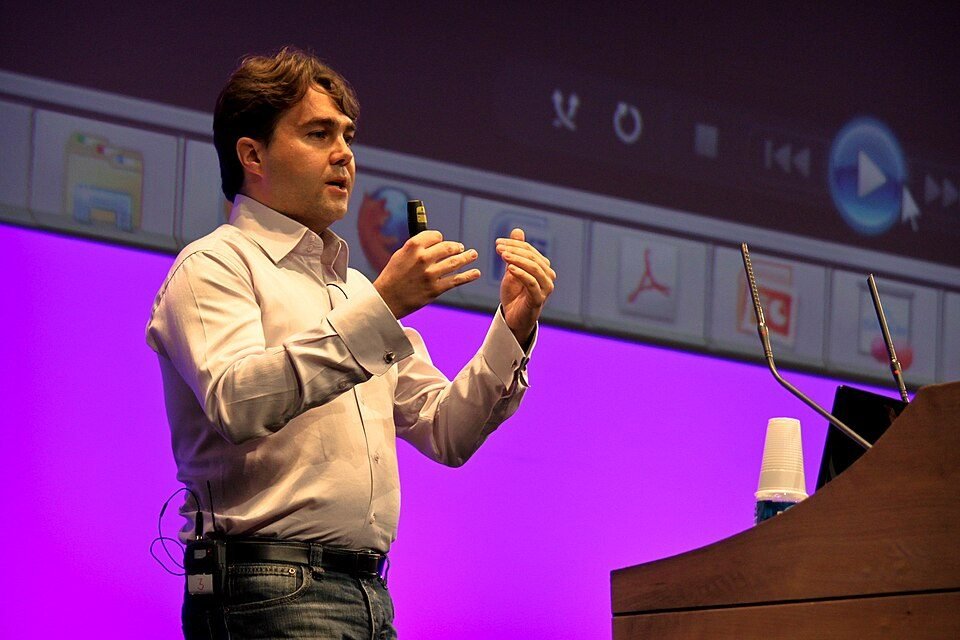
In 2013, the year his company got a name the whole of Europe would learn, Frédéric Mazzella finished paying off a loan. It was 70,000 euros, borrowed to put himself through INSEAD.
That detail says more about him than any valuation. Mazzella was born in Nantes in 1976 and grew up in Sérigné, in the Vendée, where his father taught mathematics and his mother French. A scholarship took him to the lycée Henri-IV in Paris, then to the École normale supérieure to study physics, then to Stanford from 1999 to 2002. He also studied music at the Conservatoire and plays four instruments. On paper, a safe academic career lay ahead.
The itch came in 2003. Returning home from Paris for a holiday trip, he noticed that nearly every car heading his way carried an empty seat. The idea stuck with him. In 2006 he bought a small site called Covoiturage.fr and, with Nicolas Brusson and Francis Nappez, began to turn it into something bigger.
What almost nobody saw was how long it paid nothing. Mazzella did not take a salary until 2009. The business had been funded first by 600,000 euros from founders, friends and family. Then came a million-euro-scale cheque from ISAI in 2010 and 7.5 million from Accel and others in 2012. Meanwhile the INSEAD debt hung in the background.
The turn was a hard commercial choice. Carpooling had been free. In 2011 and 2012 the team introduced online booking, which let them charge a fee, and the platform began to work as a business. In 2013 the site was renamed BlaBlaCar. Investors followed: 100 million dollars from Index Ventures in 2014, and in 2015 200 million more at a 1.6 billion dollar valuation.
Growth came at a price. By 2017 the company had opened offices in India, Turkey and Mexico and then closed them, admitting it had overspent and over-hired. In 2018 it bought Ouibus from SNCF and turned it into BlaBlaBus. In 2022 it suspended investment in its Russian subsidiary. Revenue reached about 250 million euros in 2023.
Mazzella handed day-to-day management to Brusson in 2016, staying as chairman. Xavier Niel once called him the biggest star of the French internet, a title that sits oddly with a man who waited three years for his first pay cheque.
The lesson is in the order of events. He borrowed against himself for an education, then worked for years unpaid on an idea nobody thought would scale. The debt and the empty seats were the same thing: a bet that something owned by one person could be shared.