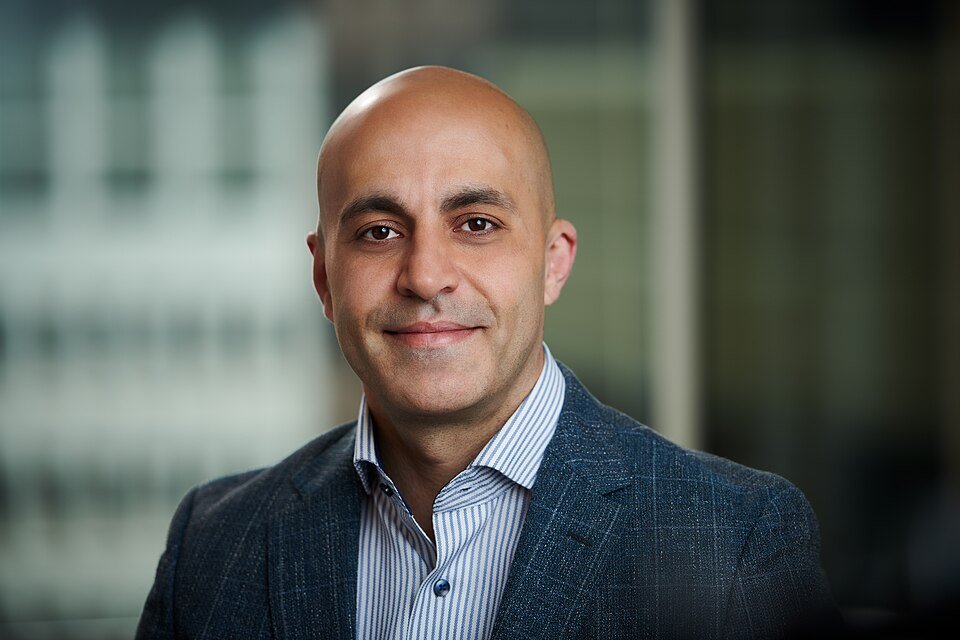
Ali Ghodsi was born in Tehran in December 1978, and by the time he was a small boy his family was leaving. It was 1983, the Iran-Iraq war was escalating, and they settled in Stockholm. His parents were physicians. In Sweden their qualifications did not simply carry over; they had to go through recertification and rebuild their careers. Ghodsi grew up feeling like an outsider.
That is the detail that rarely appears in the Databricks story. The company is usually told as a tale of seven academics and a free piece of software. Before any of that, one of them had watched his parents start over.
He took his master's and an MBA at Mid-Sweden University in 2002 and a PhD at KTH in Stockholm in 2006. A paper from his thesis, Dominant Resource Fairness, became foundational for Apache Mesos. He co-founded a peer-to-peer company, Peerialism, in Stockholm and worked as an assistant professor at KTH. He later found Swedish academia slow and the atmosphere suffocating.
In 2009 he took a visiting scholar post at UC Berkeley's AMPLab. There he met Matei Zaharia, a Romanian-Canadian student who had built Apache Spark that year as a faster alternative to MapReduce, and worked alongside professors Ion Stoica and Scott Shenker.
Spark spread because it was free. Free software does not pay salaries, so in 2013 seven people from the project, Ghodsi, Zaharia, Stoica, Andy Konwinski, Arsalan Tavakoli-Shiraji, Patrick Wendell and Reynold Xin, started Databricks. Andreessen Horowitz led a $13.9 million Series A. Stoica, who had arrived in the US from Romania in 1994, was the first CEO. Ghodsi, then running engineering and product, took over in January 2016.
The public record on those early years is thin on struggle. What it shows is the order of moves: be available on every large cloud, including Azure from 2017; keep formats open; then build the lakehouse. The money grew to match, with a $62 billion valuation in December 2024.
In February 2026 the company reported a $5.4 billion revenue run rate, and by August 2026 about $7 billion, with a Coatue-led round at $190 billion. It is still private.
A founder who has been the outsider already knows how little a credential guarantees. Ghodsi's parents had degrees and had to prove themselves again. He built a company on technology the whole field could use for free, and trusted that being useful to everyone would come back to him.